A review of the pharmacological evidence for five traditional herbal bioactives used in avian enteric health management
By Dr Manish Mukherjee
Abstract
Gastrointestinal disturbances remain among the costliest challenges in commercial poultry production, contributing to wet litter, pasty vent, impaired nutrient absorption and depressed flock performance. With regulatory and consumer pressure limiting antibiotic growth promoters, phytogenic feed additives derived from traditionally used medicinal plants have drawn renewed scientific interest as adjuncts for managing enteric complications. This review synthesises the published pharmacological evidence for five botanicals long used in South Asian ethnoveterinary and Ayurvedic practice — Aegle marmelos (bael), Helicteresisora (Indian screw tree), Holarrhenaantidysenterica (kurchi), Zingiber officinale (ginger) and Myristica fragrans (nutmeg) — and outlines a unifying mechanistic framework for their gut-protective actions in poultry.
1. Introduction
Enteric health disorders in broilers, layers and breeders arise from a convergence of infectious, nutritional and environmental stressors. Pathogenic bacteria such as Escherichia coli, Salmonella spp. and Clostridium perfringens, together with protozoal challenges from Eimeria species, disrupt the intestinal epithelium and its resident microbiota. These insults are compounded by abrupt feed or water changes, mycotoxin contamination, heat and transport stress, high stocking densities, and the progressive withdrawal of antibiotic growth promoters from commercial diets. The clinical consequence is a familiar cluster of signs to poultry veterinarians: loose or watery droppings, pasty vent, damp and ammoniacal litter, increased fly pressure, soiled eggs and reduced feed conversion efficiency.
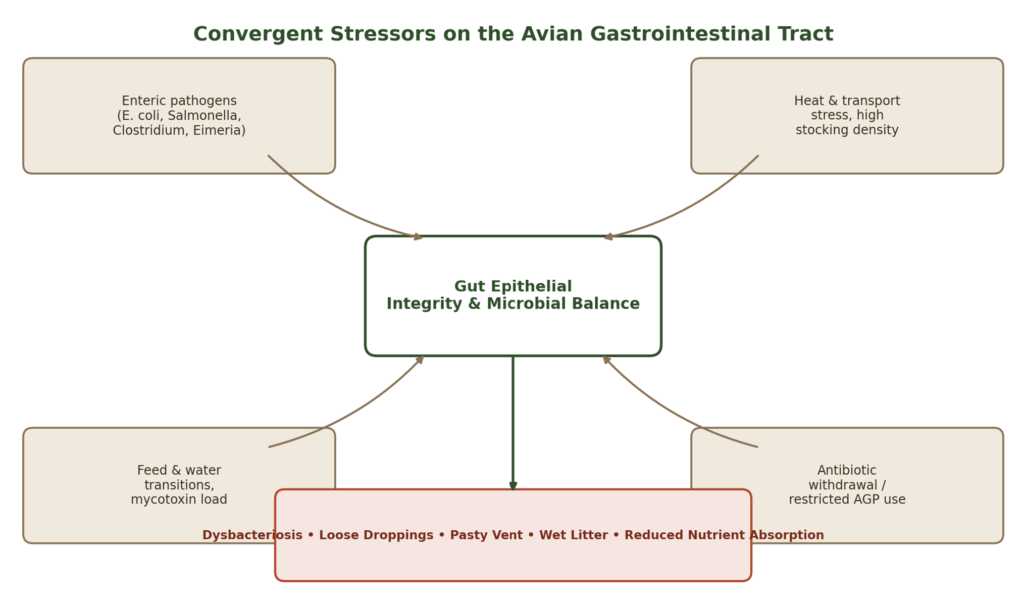
Figure 1. Multiple, often simultaneous, stressors converge on gut epithelial integrity and microbial balance, producing a common syndrome of enteric signs in commercial flocks.
Because these presentations frequently have mixed, non-specific aetiology, management strategies increasingly favour multi-target interventions rather than single-pathogen therapeutics. This has directed scientific attention toward standardised phytogenic blends — combinations of plant-derived bioactives selected for complementary pharmacological actions on gut motility, the mucosal barrier, and the resident microbial population.
2. The Phytogenic Rationale
Unlike single-target antimicrobials, whole-plant extracts and their standardised fractions typically contain dozens of interacting secondary metabolites — alkaloids, flavonoids, tannins, terpenoids and essential-oil constituents — that act through multiple, complementary mechanisms simultaneously. This polypharmacological profile is consistent with the historical use of several of these botanicals in classical Ayurvedic anti-dysenteric formulations (e.g., Kutajarishta, Kutajghan Vati), where combinations rather than single herbs were the norm. Contemporary pharmacological studies have begun to validate the traditional rationale for several of these plants specifically in the context of gastrointestinal disorders.
3. Botanical Constituents and Documented Actions
Table 1 summarises the principal phytoconstituents and the pharmacological actions reported for each of the five botanicals reviewed here, drawn from published pharmacognostic and pharmacological literature.
| Common Name | Botanical Name | Key Phytoconstituents | Documented Pharmacological Actions |
| Bael | Aegle marmelos | Alkaloids, flavonoids, tannins, coumarins (marmelosin), terpenoids | Dose-dependent reduction of castor-oil-induced diarrhoea; inhibitory activity against E. coli, Vibrio cholerae and Shigella flexneri; anti-inflammatory and gastroprotective effects |
| Indian Screw Tree | Helicteresisora | Polyphenols, tannins, alkaloids, neolignans (helicterins) | Traditionally used for diarrhoea and dysentery; extracts show measurable antibacterial inhibition zones and antioxidant (free-radical scavenging) activity |
| Kurchi | Holarrhenaantidysenterica | Steroidal alkaloids (conessine and related bases) | Gut motility studies show a dual stimulant/relaxant action mediated via histamine-receptor activation and calcium-channel blockade, supporting historical use for dysentery and colic |
| Ginger | Zingiber officinale | Gingerols, shogaols, zingibain (proteolytic enzyme) | Broiler trials link dietary inclusion to lower caecal microbial loads and improved feed conversion; zingibain supplementation improves nutrient digestibility and gut histomorphology |
| Nutmeg | Myristica fragrans | Myristicin, sabinene, terpineol, lignans | Essential-oil fractions show measurable antibacterial zones against E. coli and S. aureus and strong DPPH free-radical scavenging (antioxidant) capacity |
Table 1. Summary of key phytoconstituents and documented pharmacological actions of five botanicals traditionally used for gastrointestinal support.
3.1 Aegle marmelos (Bael)
The unripe fruit of A. marmelos has long featured in Ayurvedic management of diarrhoea and dysentery. Ethanolic extracts have demonstrated a dose-dependent reduction in castor-oil-induced diarrhoea in experimental models, and aqueous fruit-pulp extracts have shown activity against E. coli, Vibrio cholerae and Shigella flexneri. Feeding trials in CARIBRO-Vishal broilers have also evaluated bael leaf powder without adverse effects on growth performance, alongside favourable shifts in immune and biochemical parameters.
3.2 Helicteresisora (Indian Screw Tree)
Traditionally used in the Indian System of Medicine for diarrhoea, dysentery and abdominal pain, H. isora fruit and bark extracts are rich in polyphenols, tannins and alkaloids. In-vitro studies report measurable inhibition zones against Staphylococcus aureus using ethanolic extracts, alongside demonstrable free-radical scavenging activity, supporting its traditional classification as an anti-dysenteric and antidiarrhoeal agent.
3.3 Holarrhenaantidysenterica (Kurchi)
Pharmacological work on hydro-ethanolic extracts of H. antidysenterica in isolated gut-tissue preparations indicates a dual action on intestinal smooth muscle — a histamine-receptor-mediated stimulant effect at lower concentrations and a calcium-channel-blockade-mediated relaxant effect at higher concentrations. This dual motility action provides a plausible mechanistic basis for its long-standing ethnobotanical use in both colic and diarrhoeal presentations.
3.4 Zingiber officinale (Ginger)
Ginger rhizome contains gingerols, shogaols and the proteolytic enzyme zingibain. Broiler studies have associated dietary ginger inclusion with reduced caecal microbial loads and improved feed conversion, while zingibain-specific supplementation trials report improvements in nutrient digestibility, immune parameters and gut histomorphology. Ginger’s broader pharmacological literature consistently reports anti-inflammatory activity via suppression of pro-inflammatory cytokines, alongside carminative and antiemetic properties recognised across multiple traditional medicine systems.
3.5 Myristica fragrans (Nutmeg)
Nutmeg seed and its essential-oil fraction, rich in myristicin and terpenoids, show consistent in-vitro antibacterial activity against both Gram-positive organisms (Staphylococcus aureus) and Gram-negative organisms (Escherichia coli), together with strong DPPH free-radical scavenging capacity. These antioxidant and antimicrobial properties are reported to extend to poultry-relevant applications, including preservation studies on poultry meat itself.
4. Mechanistic Synthesis
Considered together, the pharmacological literature on these five botanicals points to four broadly complementary mechanisms operating on the poultry gut: direct antimicrobial and antidysenteric activity against enteric pathogens; modulation of gut smooth-muscle motility via calcium-channel and histaminergic pathways; suppression of inflammatory mediators coupled with antioxidant free-radical scavenging; and tannin-mediated astringent protection of damaged mucosal surfaces. Figure 2 illustrates how these mechanisms are proposed to converge on the clinical endpoints most relevant to flock management.
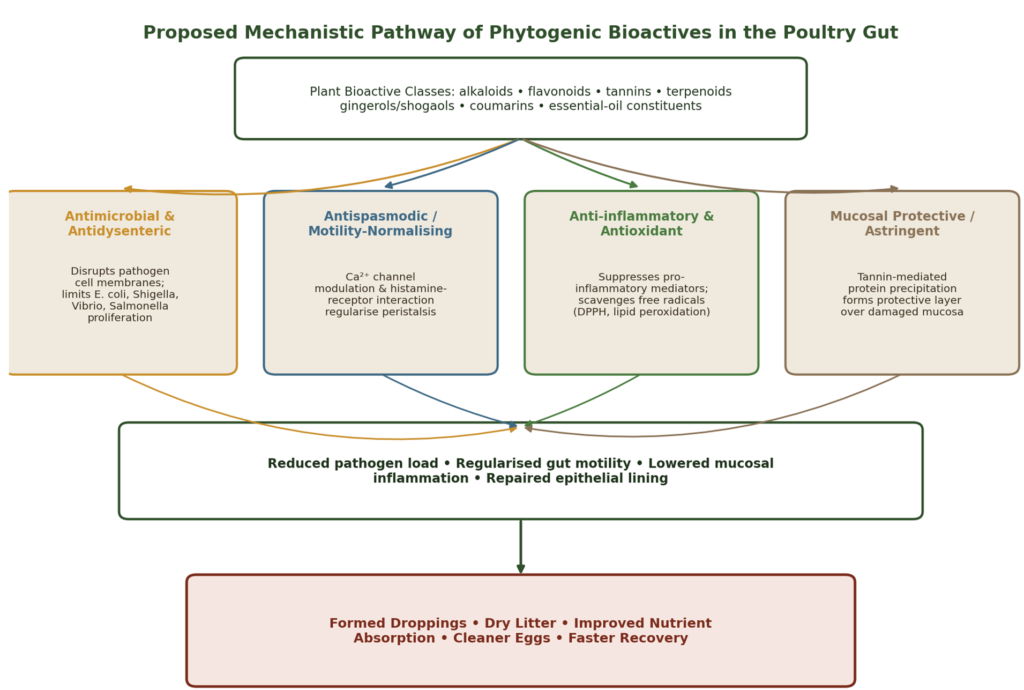
Figure 2. Proposed convergence of four complementary phytogenic mechanisms on the physiological outcomes most relevant to commercial flock management.
5. Practical Implications for Flock Management
From a herd-health perspective, phytogenic blends built on this class of botanicals( Like Vamdia Clearshot) are positioned as adjunctive support during periods of gut-health challenge rather than as replacements for specific antimicrobial or anticoccidial therapy where indicated. Reported field-level benefits associated with this category of additive(Vamdia Clearshot) include improved litter quality and reduced fly pressure, lower incidence of pasty vent, cleaner egg surfaces in layer and breeder operations, and — when used alongside targeted veterinary treatment — a faster clinical recovery from enteric upset. Water-soluble formats are typically favoured for rapid, flock-wide delivery, with inclusion rates commonly scaled to bird age and physiological stage, as illustrated in Table 2.
| Rearing Phase | Typical Water-Soluble Inclusion* | Primary Objective | Duration |
| Starter | Low inclusion, e.g. 40–50 mL per 1000 birds/day | Gut priming and early microbial balance | 5–7 days or as advised |
| Grower | Moderate inclusion, e.g. 150–200 mL per 1000 birds/day | Managing loose droppings during rapid growth | 5–7 days or as advised |
| Finisher / Layer | Higher inclusion, e.g. 250–350 mL per 1000 birds/day | Supporting recovery and clean egg production | 5–7 days or as advised by the attending veterinarian |
Table 2. Representative inclusion pattern for water-soluble phytogenic gut-support formulations(VamdiaClearshot) across production phases (illustrative; label directions and veterinary guidance should govern actual use).
6. Conclusion
The five botanicals reviewed here — bael, Indian screw tree, kurchi, ginger and nutmeg — each carry a substantial ethnomedicinal history in the management of diarrhoeal and dysenteric conditions, and a growing, if still uneven, body of in-vitro, in-vivo and poultry-specific pharmacological evidence lends mechanistic plausibility to this traditional use. Their complementary actions on pathogen load, gut motility, inflammation and mucosal integrity offer a rational, multi-target basis for phytogenic gut-health support in commercial poultry, particularly as an adjunct within reduced-antibiotic production systems. Controlled, peer-reviewed field trials in commercial flock settings remain the priority for further validating efficacy, optimal inclusion rates and consistency of standardised extract combinations.
For more Information feel free to write to us at manish.mukherjee@vamsobiotec.com.