


Introduction:
Mycotoxins are fungal secondary metabolites primarily from the genera Aspergillus, Fusarium, Penicillium, Alternaria, and Claviceps. Of over 400 mycotoxins, aflatoxins (AF), fumonisins (FUM), deoxynivalenol (DON), zearalenone (ZEA), ochratoxin A (OTA), and T-2 toxin are the main threats to feed due to toxicity and prevalence. Co-contamination is widespread, with over 88% of global feed samples in 2019 containing multiple toxins. Control methods are categorized by mechanism:
- Adsorbing Agents (Mycotoxin Binders)
- Biotransforming Agents (Mycotoxin Modifiers)
Adsorbing Agents (Binders):
These agents limit mycotoxin bioavailability, reducing uptake and systemic distribution.
A. Inorganic Adsorbents – Stable and highly adsorptive, they include phyllosilicates (bentonite, montmorillonite, smectite, HSCAS, kaolinite, hectorite, sepiolite, palygorskite) and tectosilicates (zeolites like clinoptilolite, mordenite, heulandite), as well as high-surface-area activated carbon.
B. Organic Adsorbents – Of biological origin, these include yeast cell wall (YWCCW) components (β-glucans, mannan oligosaccharides, glucomannans), plant-derived and agricultural fibre-based adsorbents, and humic substances.
Why a Single Binder Cannot Solve Every Mycotoxin Challenge?
The universal mycotoxin binder concept was abandoned because adsorption requires specific interactions between the physicochemical properties of both the adsorbent and the mycotoxin. Each toxin acts differently in the gastrointestinal tract, and adsorbents have unique structural and chemical traits.
Multiple factors prevent a single product from being universally effective.
a. Diversity of Mycotoxin Chemistry
Adsorption efficacy depends on mycotoxin physicochemical properties (Galvano et al., 1997). Highly polar, small molecules like aflatoxins bind easily. Fumonisins and OTA/T-2 (intermediate to high polarity) exhibit moderate binding, while DON and ZEA (low polarity, steroid-like) are difficult to bind. This variability explains why binders effective against aflatoxins often fail against Fusarium toxins.
b. Adsorbent Characteristics Determine Performance
Mineral binder efficacy depends on four core properties: Cation Exchange Capacity (CEC) defines site availability; Na-montmorillonite (80–130 meq/100g) outperforms Ca-montmorillonite (40–70 meq/100g). Surface Area determines binding potential, ranging from bentonite (150–200 m²/g) to activated carbon (500–3000 m²/g). Interlayer Spacing regulates penetration; bentonite’s 15–20 Å layers fit AF B₁ (10–12 Å) better than zeolite’s narrow pores (3–8 Å). Finally, Surface Charge varies with GI pH; binders must remain stable despite gastric protonation to maintain effective cation exchange.
Comparison of Adsorbents and Mycotoxin Preferences:
| Adsorbent | Mechanisms / Components | Advantages & Targets | Limitations |
| Bentonite & Montmorillonite | Cation exchange, H-bonding, Van der Waals forces | High adsorption/CEC, expandable layers. Best for aflatoxins, some fumonisins | Limited efficacy against DON, ZEA |
| HSCAS | Electron donor-acceptor interactions (aflatoxin carbonyls-clay cations) | Gold standard for aflatoxins; stable during digestion | Less effective against Fusarium toxins |
| Zeolites | Molecular sieving, ion exchange | High thermal stability; adsorbs aflatoxins, some fumonisins | Lower affinity for non-polar toxins (hydrophilic) |
| Activated Carbon | Hydrophobic interactions, π-π- bonding, pore-filling | Broad spectrum, very high surface area | Low specificity; non-selectively adsorbs nutrients, medications |
| Yeast Cell Wall | β-glucans, mannans, glucomannans; H-bonding, Van der Waals, 3D recognition | Biological origin; better activity against certain Fusarium toxins | Lower aflatoxin adsorption than clay minerals |
C. Modified Adsorbents
Natural hydrophilic clays show limited efficacy against lipophilic mycotoxins, including zearalenone, ochratoxin A, and T-2 toxin. Surface modification using organic cations like choline, carnitine, or quaternary ammonium compounds increases hydrophobicity and broadens their adsorption spectrum. For example, organically modified zeolites can increase ZEA adsorption from ~5% to >90%, though high inclusion rates may reduce aflatoxin-binding efficiency or interfere with fat digestion. Additional polymer applications include Cholestyramine, an insoluble quaternary ammonium anion exchange resin with a robust binding capacity for anionic compounds, and Polyvinylpyrrolidone, a highly polar amphoteric polymer.
Evaluation of Mycotoxin Binder Efficacy:
a. Techniques for Quantifying Mycotoxin Binder Adsorption Capacity:
To evaluate the sequestration performance of mycotoxin binders (MTB), in vitro testing is routinely implemented as an initial screening protocol (Gallo et al., 2010). These methodologies comprise: Individual in vitro assays , Adsorption isotherm profiling and Dynamic gastrointestinal simulation models
b. Characteristics of an Effective Mycotoxin Adsorbent:
The efficacy of a mycotoxin adsorbent cannot be evaluated solely by its adsorption capacity under laboratory conditions. An effective product must maintain stable toxin binding throughout the dynamic environment of the gastrointestinal tract while minimising interactions with essential nutrients.
According to guidelines established by the EFSA (European Food Safety Authority), a top-performing adsorbent should demonstrate the following criteria:
● Documented effectiveness within a standardised in vitro trial.
● Validation through a minimum of two separate in vivo studies.
● Consistent adsorption stability across the entire gastrointestinal pH range.
● Strong adsorption affinity at an inclusion level of 1–2 kg/tonne.
● Swift binding action before intestinal absorption can occur.
● Negligible interaction with nutrients (amino acids, vitamins, minerals) and veterinary drugs.
● Guaranteed safety for both the animals and final consumers.
The adsorption efficiency of an adsorbent is influenced by both the physicochemical characteristics of the adsorbent and the molecular properties of the mycotoxin, including polarity, molecular size, charge distribution, pore dimensions, and environmental pH.
Key attributes of an ideal adsorbent:
● High affinity and selectivity for target mycotoxins
● Broad adsorption spectrum where appropriate
● Stability over the physiological gastrointestinal pH range
● Strong retention of the toxin-adsorbent complex during digestion
● High cation exchange capacity and suitable surface chemistry
● Compatibility with different feed matrices
● Minimal adsorption of vitamins, minerals, amino acids, and veterinary drugs
● Proven efficacy through standardised in vitro and in vivo evaluations
For these reasons, modern commercial mycotoxin-detoxification products increasingly combine multiple mineral adsorbents with organic adsorbents, biotransformation technologies, and supportive functional additives to achieve broader-spectrum efficacy and improved performance under commercial production conditions.
C. Interaction of Mycotoxin Binders with Nutrients
Evaluating nutrient adsorption by mycotoxin binders is critical. Although most in vivo studies show negligible nutrient reductions at recommended inclusion levels, selecting highly selective binders with minimal nutrient adsorption remains crucial (Kihal et al., 2022).
Biotransforming Agents:
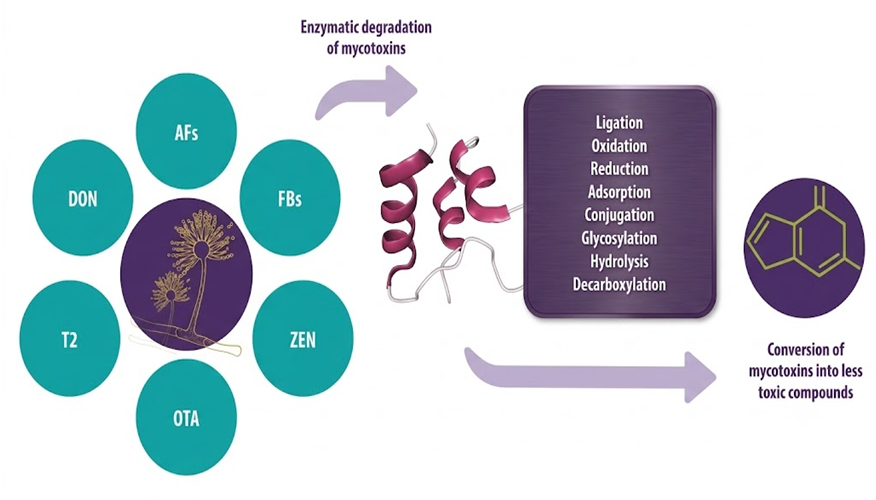
Biotransformation uses biological entities like bacteria, fungi, or enzymes to neutralise mycotoxins by breaking them down into non-toxic metabolites through irreversible chemical reactions, without altering feed nutritional value. Differentiated by their high specificity and efficiency, enzymes are the most promising detoxification technology. Key options include epoxidases for trichothecenes (DON), lactonohydrolases for zearalenone (ZEA), and fumonisin esterases for fumonisins, alongside protease A, pancreatin, and carboxypeptidase A (Boudergue et al., 2009). Because this enzymatic process is highly specific and irreversible, it critically complements binders within modern, multi-target mycotoxin mitigation strategies.
Conclusion:
Due to the complex co-occurrence of structurally diverse mycotoxins that prevents a single tool from providing complete protection, management has shifted from a solitary binder to a multifaceted strategy combining adsorbing agents, biotransforming enzymes, and supportive feed additives. Consequently, selecting a detoxifying agent must rely on empirical data, specific in vitro profiles, and field validation rather than the assumption of universal efficacy.
Reference will be available on request.