Gourab Basak1, Tilak Chandan S2, Partha Baishnab3, Chinmay Patil3, Abhilash D. Jadhao4 and Sumeet Singh5
1Assistant Professor, Department of Veterinary Public Health and Epidemiology, Siksha ‘O’ Anusandhan (Deemed to be University), Bhubaneswar, Odisha
2Ph.D Scholar, ICAR-Indian Institute of Veterinary Research, Hebbal, Bengaluru, Karnataka
3M.V.Sc. Scholar, ICAR-Indian Institute of Veterinary Research, Hebbal, Bengaluru, Karnataka
4Lead Pathologist, Small Animal Hospital TATA, Mumbai, Maharashtra
5Veterinary Officer, Government of Punjab, Kapurthala, Punjab
Milk is considered as a complete food because of the presence of essential nutrients important for sustaining of life. As per definition, ‘milk is the wholesome, fresh, clear lacteal secretion obtained by complete milking of one or more apparently healthy udders excluding that obtained within 15 days before and 5 days after calving or such period as may be necessary to render the milk colostrum free and containing the minimum prescribed percentage of milk fat and milk solids-not-fat’. According to solution-mixture, milk is an emulsion of fat in water. Accordingly, milk is also a colloidal suspension of proteins in which compounds like lactose and minerals are finely dissolved in the solution. The white-liquid consists of 87.5% of water, 3.9% of fat and 3.4% of proteins with 5.2% of lactose and minerals content.
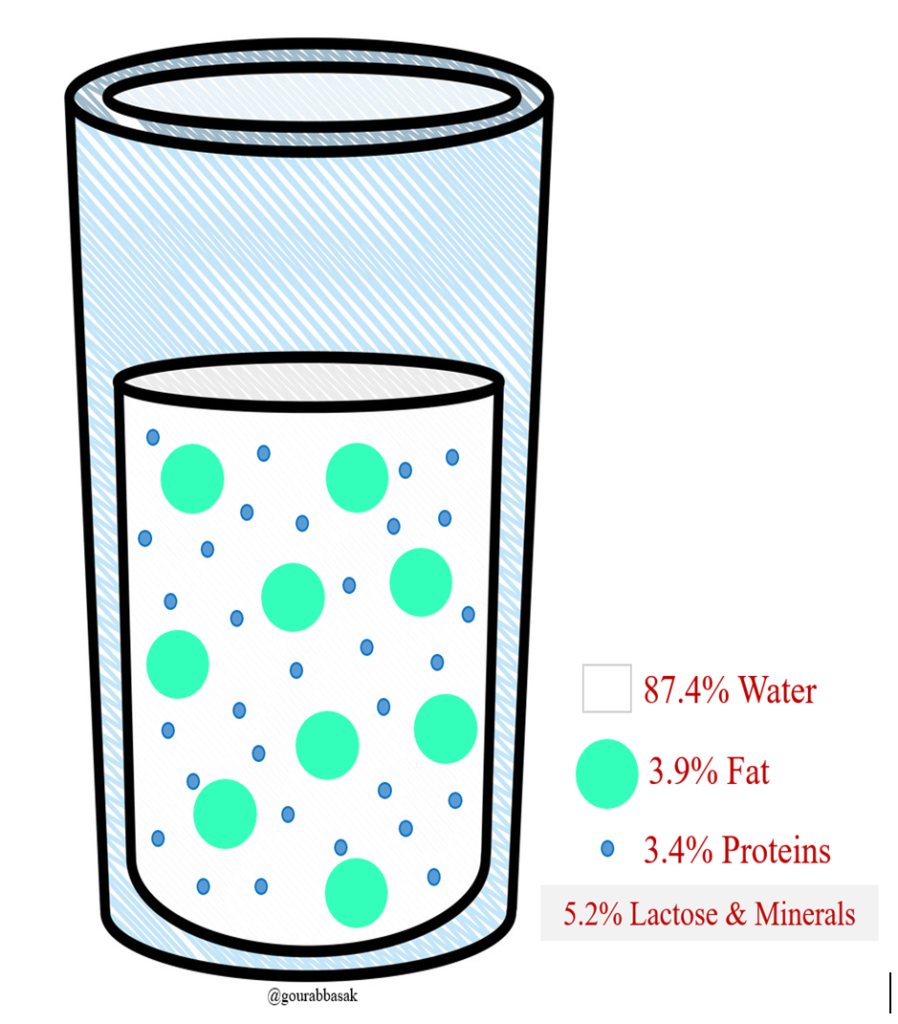
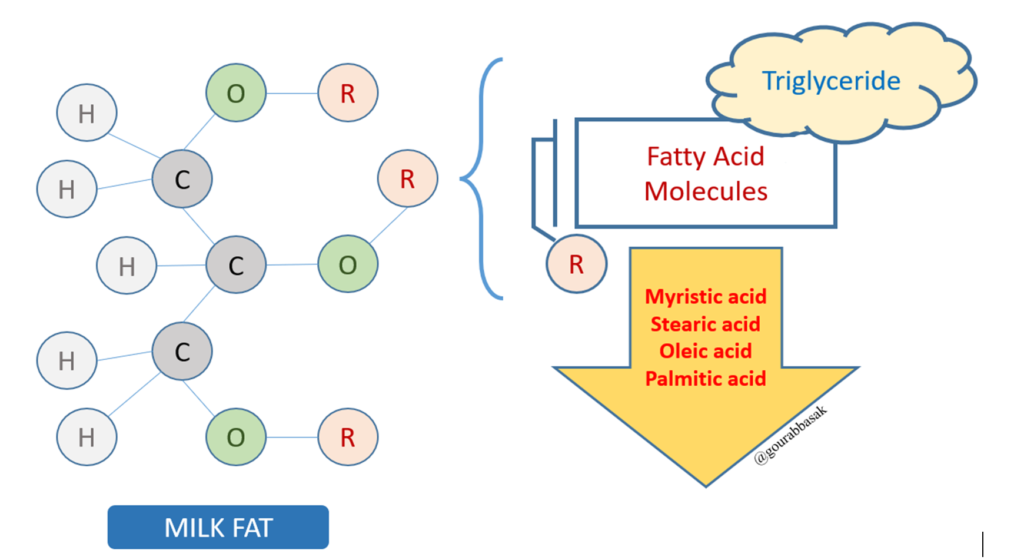
The droplets of fat in milk possess an average size of 3–4 µm consisting mainly of triglycerides along with fat-soluble vitamins. Generally, triglycerides are fatty acid molecules, comprising of 23.6% – 31.4% palmitic acid, 14.9% – 22.0% oleic acid, 10.4% – 14.6% stearic acid and 9.1% – 11.9% myristic acid.
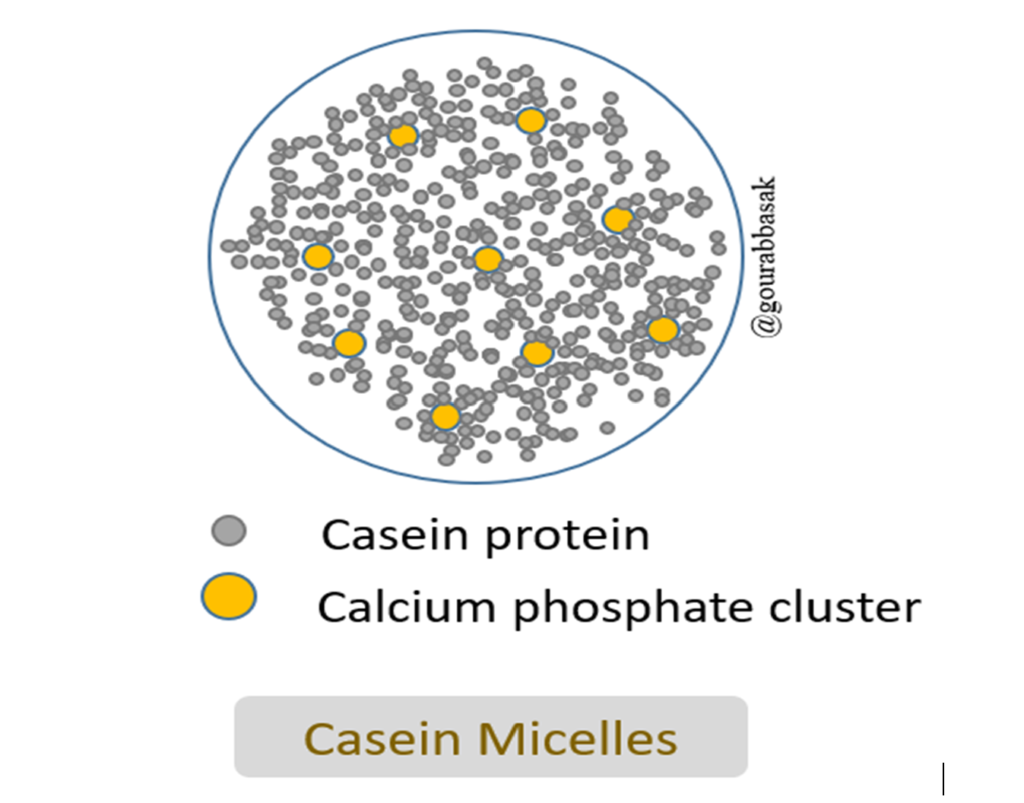
Now a question arises here that why milk is a white-liquid? This is because milk possesses several different types of proteins among which casein occupies the major part, establishing itself as the main ingredient. These proteins hence form micelles which scatter light that ultimately causes the white coloration of milk. Casein micelles are basically supramolecule of colloidal size modelled as lattice structure. The structure forms when casein-calcium phosphate aggregates and subsequently casein-polymer chains maintain the supramolecular integrity.
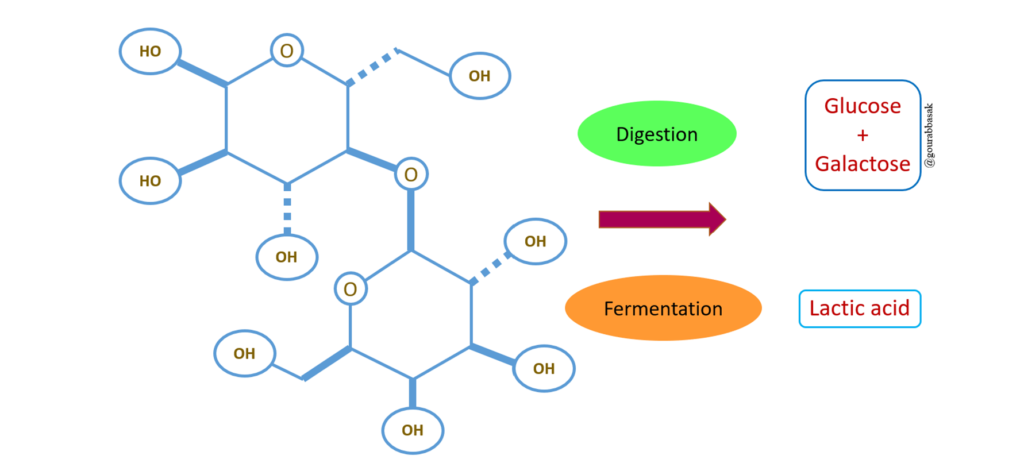
Another major component of milk is the lactose. It is a sugar to which microorganisms on fermentation forms lactic acid which causes souring of milk. Generally, lactose on digestion breaks down into glucose and galactose.
Though the composition of milk’s constituents varies from species to species, even from breed to breed of same species, viz., approximate milk fat percentage of Jersey, Zebu, Holstein-Friesian and Brown Swiss cows count as 5.2, 4.7, 3.6 and 4.0 respectively, the nutritional value of milk is much rich including various vitamins and minerals which are mandatory for our health.