A mechanistic review of herbal and microbial actives supporting intestinal integrity, digestion and disease resistance in broilers, layers and breeders
1. Introduction
Gut health drives nearly every production outcome in poultry farming. The intestinal epithelium absorbs nutrients, holds back a dense microbial population, and hosts much of the bird’s immune tissue. When this balance is disturbed — by pathogens such as E. coli, Salmonella, Clostridium perfringens or Eimeria, by mycotoxins, or by high-density rearing stress — the result is villus blunting, protein leakage, poor absorption, wet litter and depressed growth.
A growing body of pharmacological research shows that specific medicinal plants and yeast-derived compounds counter this cascade through several complementary mechanisms at once: repairing the epithelial barrier, excluding or neutralising pathogens and toxins, calming excess motility, and tuning mucosal immunity. Rather than acting on a single target the way a conventional antimicrobial might, these actives tend to work in combination, which is part of why they are so often formulated together rather than used singly. This article reviews the evidence behind eight such actives — seven Ayurvedic gut-modulatory herbs and brewer’s yeast — commonly combined in intestinal-support feed formulations for broilers, layers and breeders.
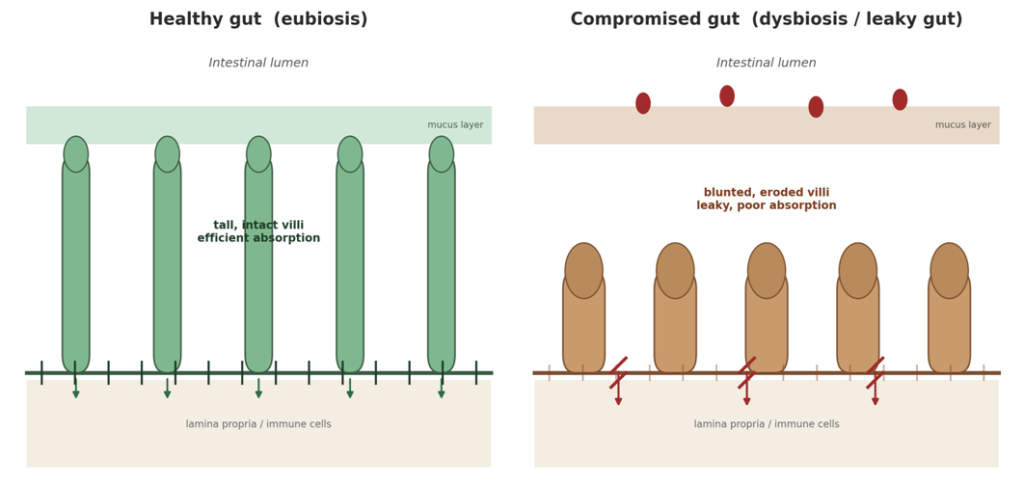
Figure 1. A healthy gut has tall, intact villi and a closed barrier (left); challenge and dysbiosis blunt villi and open gaps that let pathogens and toxins cross into tissue (right).
2. Indicators of poor gut health
- Disturbed gut integrity — protein leakage and reduced absorption as tight junctions and villus architecture deteriorate.
- Enteric challenge — colonisation by E. coli, Salmonella, Clostridia (necrotic enteritis) and coccidia.
- Compromised immunity — reduced mucosal cytokines and immunoglobulins (IgA, IgM, IgG).
- Poor performance — lower digestibility, slower growth and worse feed conversion.
Because these problems reinforce one another, an effective strategy must act on more than one at once — the pattern seen in combinations of gut-modulatory herbs and yeast cell-wall components.
3. The actives and their mechanisms
Each herb has a distinct phytochemical fingerprint, but recurring compound classes — alkaloids, tannins, flavonoids and volatile oils — carry documented antimicrobial, antispasmodic, anti-inflammatory or antioxidant activity. Brewer’s yeast contributes a different, structural mode of action: its cell wall β-glucans and mannan-oligosaccharides (MOS) preserve villus height, act as decoy binding sites for pathogen lectins, adsorb mycotoxins, and stimulate innate and humoral immunity.
| Active | Key constituents | Principal mechanism |
| Bael (Aegle marmelos) | Coumarins, alkaloids, tannins, flavonoids | Reduces E. coli adherence and toxin action; antidiarrhoeal, spasmolytic |
| Kutaja (Holarrhenaantidysenterica) | Conessine, holarrhenine, tannins | Antimicrobial, inhibits efflux pumps; normalises gut motility |
| Marorphali (Helicteresisora) | Tannins, triterpenoids, flavonoids | Astringent, reduces fluid loss; antioxidant |
| Daru Haldi (Berberis aristata) | Berberine, berbamine | Antispasmodic, anti-inflammatory, shapes gut flora |
| Dhaiphool (Woodfordiafruticosa) | Hydrolysable tannins, flavonoids | Astringent protein precipitation; gastroprotective |
| Kattha (Acacia catechu) | Catechins, flavan-3-ols | Antimicrobial and strongly antioxidant |
| Ginger (Zingiber officinale) | Gingerols, shogaols, volatile oils | Carminative, normalises peristalsis; anti-inflammatory |
| Brewer’s yeast (S. cerevisiae) | β-glucans, mannan-oligosaccharides | Binds toxins/pathogens (decoy lectins), stimulates immunity |
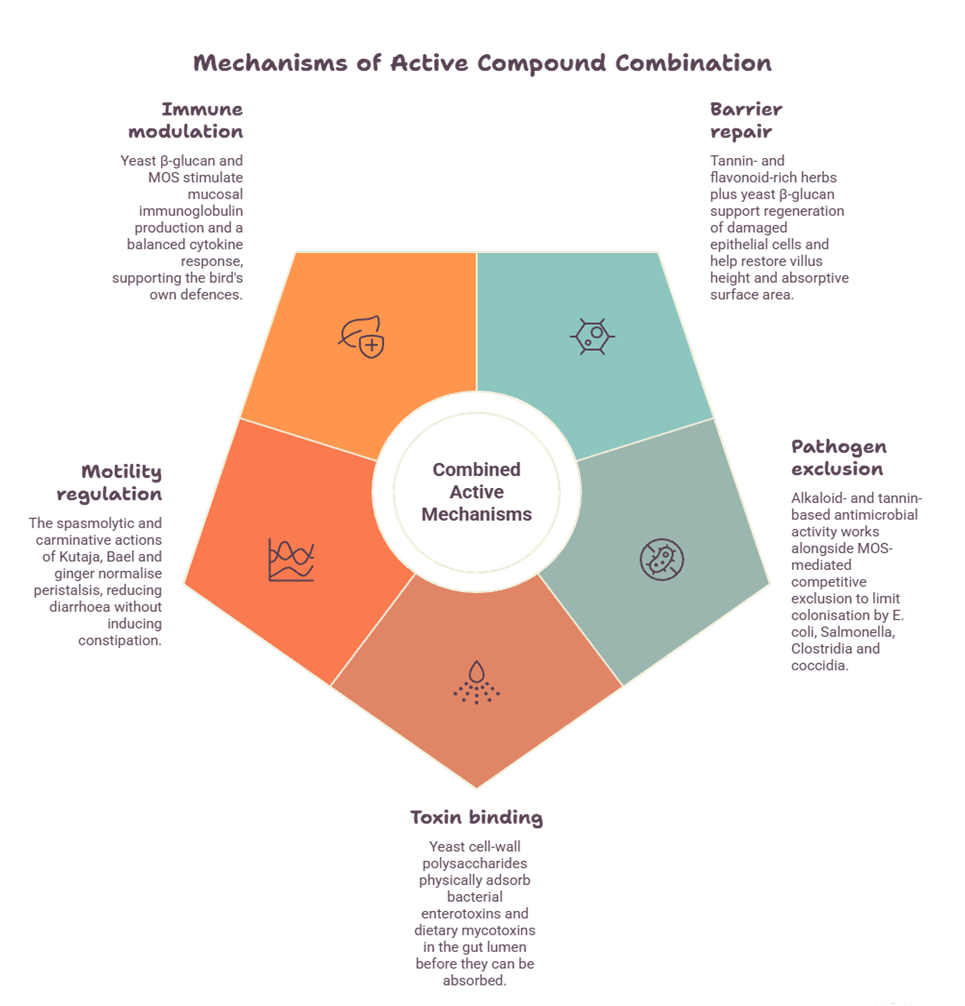
Figure 2. The herbal actives and brewer’s yeast converge on five complementary mechanisms rather than a single mode of action.
4. How the mechanisms converge
- Barrier repair — tannin/flavonoid-rich herbs plus yeast β-glucan support villus and epithelial regeneration.
- Pathogen exclusion — antimicrobial herbs work alongside MOS-mediated competitive exclusion against E. coli, Salmonella, Clostridia and coccidia.
- Toxin binding — yeast cell-wall polysaccharides adsorb enterotoxins and mycotoxins before absorption.
- Motility regulation — Kutaja, Bael and ginger normalise peristalsis without inducing constipation.
- Immune modulation — yeast β-glucan and MOS support mucosal immunoglobulin and cytokine responses.
Because enteric disease, dysbiosis, barrier damage and immune suppression are interdependent, addressing all five mechanisms together — rather than any one alone — is what lets this class of formulation support digestibility, growth, feed conversion and litter quality under routine and challenge conditions.
5. Conclusion
The literature on Aegle marmelos, Holarrhenaantidysenterica, Helicteresisora, Berberis aristata, Woodfordiafruticosa, Acacia catechu, Zingiber officinale and Saccharomyces cerevisiae cell-wall components independently supports each as a gut-protective agent. Their pharmacology is complementary: alkaloids and tannins give direct antimicrobial and astringent action, flavonoids and volatile oils give anti-inflammatory and motility-normalising effects, and yeast β-glucans/MOS give toxin binding, pathogen exclusion and immune stimulation — together offering a multi-target approach to intestinal integrity, nutrient utilisation and flock performance under both routine and challenge conditions in broilers, layers and breeders.
For more details write to us : manish.mukherjee@vamsobiotec.com