An Integrated Strategy for Salmonella Control in Poultry

Chief Operating Officer
Stallen South Asia Pvt. Ltd.

Assistant Technical Manager
Stallen South Asia Pvt. Ltd.
INTRODUCTION
Salmonella remains a major bacterial and food-safety challenge for poultry production. The genus includes host-adapted serovars such as S. Gallinarum and S. Pullorum as well as non-typhoidal serovars such as S. Enteritidis and S. Typhimurium. Depending on the serovar, age and immune status of the bird, infection may range from silent intestinal carriage to enteritis, septicaemia, reproductive-tract colonisation and mortality. The importance of Salmonella extends beyond flock health because contaminated poultry meat and eggs can act as vehicles for human infection (Shaji et al., 2023; WOAH, 2024).
Why it matters in modern poultry production
• Subclinical intestinal carriage can occur without obvious clinical disease while birds continue to shed the organism.
• Vertical transmission can introduce Salmonella through breeder flocks, hatcheries and hatching eggs, while horizontal transmission amplifies contamination within houses.
• Feed, litter, faeces, water, hatchery environments, rodents, insects and contaminated equipment can form interconnected sources of exposure (Wang et al., 2023).
• S. Enteritidis is particularly important in layers because reproductive-tract colonisation can result in contamination of egg contents even when hens show few or no clinical signs.
• Successful control requires a layered programme combining source control, biosecurity, surveillance, vaccination where appropriate and management of the intestinal environment.
ETIOLOGY
Salmonella belongs to the family Enterobacteriaceae and comprises numerous serovars within Salmonella enterica. Poultry-associated infections are commonly discussed as either host-adapted Salmonella—especially S. Gallinarum biovars Gallinarum and Pullorum—or non-typhoidal Salmonella (NTS), including S. Enteritidis and S. Typhimurium. The biological behaviour of a flock depends strongly on the serovar, dose, age, route of exposure and host factors (Shaji et al., 2023; Shah et al., 2017).
TRANSMISSION
The principal route of flock-to-flock amplification is faecal–oral transmission. Birds may ingest Salmonella from contaminated litter, dust, feed, water, equipment, footwear or the surrounding environment. Vertical transmission is particularly important in breeding populations because infected hens can introduce Salmonella into eggs and thereby into hatchery populations. A systematic review of pre-harvest poultry production identified hatchery, litter, faeces, the house environment, feed and water among important sources associated with Salmonella positivity (Wang et al., 2023).
INFECTION CYCLE OF SALMONELLA
Unlike Eimeria, Salmonella does not have a developmental life cycle with distinct sexual and asexual stages. Its poultry infection cycle is better described as a sequence of exposure, intestinal colonisation, invasion, persistence or systemic dissemination, shedding and re-exposure. After ingestion, organisms encounter the crop and gastrointestinal tract, then preferentially colonise intestinal sites including the caeca. In susceptible birds, invasion and survival within host cells can facilitate spread to organs such as the liver and spleen. In laying hens, reproductive-tract colonisation is epidemiologically important because it can precede contamination of forming eggs (Shah et al., 2017).
CLINICAL SIGNS
Clinical presentation varies substantially with serovar and bird age. Non-typhoidal Salmonella infections may be subclinical, whereas S. Gallinarum and S. Pullorum are capable of producing systemic disease. In young chicks, Pullorum disease may present with weakness, anorexia, diarrhoea, dehydration and mortality. Fowl typhoid can produce acute septicaemia with rapid spread and high mortality, particularly in susceptible growing or adult birds (WOAH, 2024).
- Reduced feed and water intake, depression and poor growth.
- Diarrhoea or pasting of the vent, particularly in young chicks.
- Dehydration, weakness, huddling and uneven flock appearance.
- In severe systemic disease: increased mortality, septicaemic signs and marked depression.
- In breeder/layer flocks: reduced production or hatchability may occur with host-adapted Salmonella, while S. Enteritidis infection can remain clinically inapparent.
SEROVAR-SPECIFIC BEHAVIOUR
| Serovar / biovar | Important poultry behaviour | Typical field relevance |
| S. Enteritidis | Intestinal carriage with potential systemic and reproductive-tract colonisation | Egg contamination; often limited clinical signs in adult layers |
| S. Typhimurium | Broad host range; intestinal colonisation and possible systemic spread | Food-safety concern; flock shedding and environmental persistence |
| S. Gallinarum biovar Gallinarum | Host-adapted systemic infection | Fowl typhoid; septicaemia and mortality |
| S. Gallinarum biovar Pullorum | Host-adapted infection, especially severe in young chicks | Pullorum disease; vertical transmission and carrier state |
PATHOGENESIS: FROM GUT TO SYSTEMIC INFECTION
Following ingestion, Salmonella must survive the gastrointestinal environment and compete with resident microbiota. Colonisation is influenced by the integrity of the intestinal barrier, gut microbiota, age and immune status. Virulence-associated systems, including type III secretion systems encoded by Salmonella pathogenicity islands, contribute to interactions with intestinal and host cells. In S. Enteritidis, intestinal colonisation may be followed by invasion and dissemination to the liver and spleen; in laying hens, reproductive-tract colonisation can lead to internal egg contamination (Shah et al., 2017; Shaji et al., 2023).
DIAGNOSIS AND SURVEILLANCE
Clinical signs and gross lesions are suggestive but not sufficient to identify Salmonella serovar reliably. Confirmation should rely on appropriate laboratory testing, typically involving culture and identification, with molecular or serological methods used according to the surveillance objective. WOAH notes that serology can support flock-level surveillance but should be interpreted in relation to vaccination status and the serovars targeted by the assay (WOAH, 2022). Sampling plans should be designed around the production stage and objective—for example, breeder monitoring, hatchery surveillance, environmental monitoring or investigation of clinical disease.
POST-MORTEM LESIONS
Salmonella lesions are variable and should be interpreted together with age, history, clinical presentation and laboratory confirmation. In systemic infections, the liver and spleen are commonly affected. Fowl typhoid may produce an enlarged, friable, dark or bronze-coloured liver with necrotic foci, while splenic congestion or enlargement may occur. Pullorum disease in chicks can be associated with unabsorbed yolk sacs, necrotic foci in viscera and firm caecal cores. In non-typhoidal salmonellosis, lesions may include enteritis, congestion and multifocal hepatic or splenic lesions (WOAH, 2018; Damor et al., 2024).
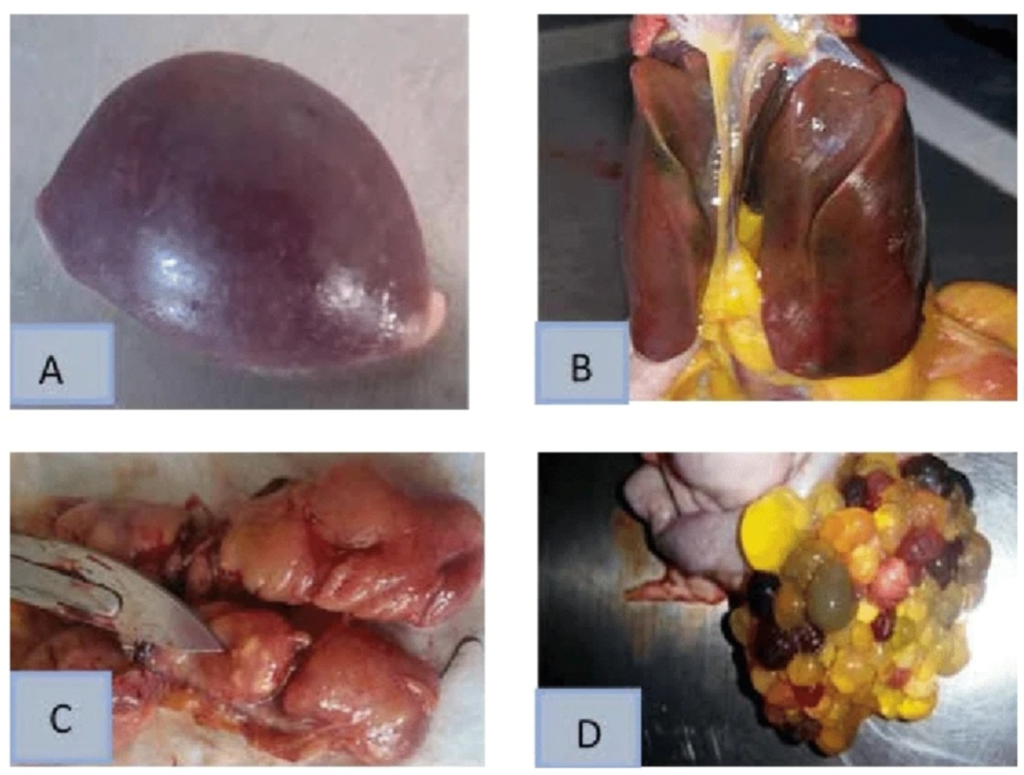
| Gross lesions reported in Salmonella-positive organs: enlarged and mottled spleen (A), discoloration and enlargement of the liver (B), enlargement and white-spot appearance of the kidney (C), and discoloration and misshaping of ovarian follicles (D). |
PREVENTION AND CONTROL
Effective Salmonella control is a multi-layered process. WOAH emphasises that no single intervention is sufficient by itself; control programmes should combine good agricultural practices, biosecurity and targeted measures such as vaccination, competitive exclusion or organic-acid interventions when appropriate. Control should be built around the epidemiology of the serovars present in the region and production system (WOAH, 2024).
1. Biosecurity and farm hygiene
- Use clean entry procedures, dedicated footwear/clothing, hand hygiene and effective disinfection between flocks.
- Control rodents, wild birds, flies, beetles and other vectors that can move contaminated material between houses.
- Maintain clean, dry litter and prevent faecal contamination of feed and water lines.
- Clean and disinfect equipment, crates, egg-handling areas and high-traffic surfaces.
- Manage flock flow and personnel movement so that contamination is not carried from older or positive houses to younger flocks.
2. Feed, water and hatchery control
Feed is a recognised potential source of Salmonella introduction. Feed mills should use validated hygiene and pathogen-control procedures, and farms should protect stored feed from rodents, wild birds and moisture. Drinking-water systems require routine cleaning and monitoring because biofilm and organic contamination can support bacterial persistence. Hatchery hygiene is particularly important because contamination at this stage can seed many chicks and subsequently amplify within broiler or layer houses (Wang et al., 2023; WOAH, 2024).
3. Vaccination
Vaccination can be incorporated into control programmes for relevant Salmonella serovars, particularly where regional epidemiology and production objectives justify its use. Vaccines are not a substitute for biosecurity, sanitation or surveillance. Live and inactivated approaches differ in their immunological characteristics, and vaccination can also influence interpretation of some serological tests; therefore programmes should follow the product label and veterinary guidance (WOAH, 2024).
4. GUT HEALTH AND COMPETITIVE EXCLUSION
The intestinal microbiota is an important barrier against Salmonella colonisation. Competitive-exclusion cultures, probiotics, prebiotics, synbiotics and other microbiome-directed approaches have been investigated to reduce intestinal carriage. Proposed mechanisms include competition for attachment sites and nutrients, production of inhibitory metabolites, improvement of epithelial barrier function and modulation of host immunity. Evidence is heterogeneous, so the expected response should be evaluated under the actual farm conditions rather than assuming that one product or one organism will work uniformly in every flock (Shaji et al., 2023; Bakin et al., 2025).
5. ORGANIC ACIDS AND FEED/WATER INTERVENTIONS
Organic acids and other feed or water interventions are used in some Salmonella-control programmes to influence bacterial survival and the gastrointestinal environment. Their performance depends on acid type, concentration, buffering capacity of the feed or water, delivery route and farm hygiene. A recent systematic review found feed/water additives to be the most frequently evaluated category of pre-harvest Salmonella interventions, although effectiveness varied among studies (Bakin et al., 2025).
6. ANTIMICROBIAL STEWARDSHIP
Routine antimicrobial treatment should not be considered the primary method for controlling Salmonella at flock level. WOAH notes that antimicrobial treatment has limited effectiveness for control, can interfere with detection, may select for antimicrobial resistance and can disrupt normal gut flora. Use of antimicrobials, when justified for individual clinical circumstances, should therefore be based on veterinary assessment, diagnostic information, local regulations and responsible-use principles (WOAH, 2024).
BREAKING THE CYCLE: A PRACTICAL FARM FRAMEWORK
| Control point | What to check | Practical objective |
| Before placement | Breeder status, chick source, hatchery hygiene | Start with low-risk chicks and clean facilities |
| Feed & water | Feed hygiene, storage, water sanitation, biofilm | Prevent continuous re-introduction |
| House environment | Litter, dust, beetles, rodents, flies, wild birds | Reduce environmental amplification |
| Flock monitoring | Environmental/cloacal sampling, mortality, production data | Detect contamination early |
| Immunity | Vaccination status and programme timing | Support protection against relevant serovars |
| After depopulation | Cleaning, disinfection, downtime and verification | Break carry-over between cycles |
KEY FIELD MESSAGES
- A Salmonella-positive result should trigger an investigation of the source and transmission pathway, not just a treatment response.
- Different serovars behave differently; the control programme should be based on the Salmonella identified or suspected in the production system.
- Breeder and hatchery control has a major downstream effect because vertical introduction can seed large numbers of chicks.
- Rodent, insect, litter, feed and water management are interconnected parts of the same epidemiological chain.
- No single feed additive, acidifier, probiotic or vaccine should be expected to replace biosecurity and surveillance.
STALLEN SOUTH ASIA PVT. LTD. — SALMONELLA VACCINATION APPROACH
Stallen South Asia Pvt. Ltd. offers BIO-VAC SGP 695, a live attenuated vaccine for oral suspension against fowl typhoid and Salmonella Enteritidis infection.
BIO-VAC SGP 695
Efficient, safe and cost-effective vaccination approach for Salmonella control.
Composition: BIO-VAC SGP 695 contains the attenuated SGP 695 AV strain of Salmonella Gallinarum/Pullorum. The supplied product information describes the vaccine as inducing active immunity against fowl typhoid and Salmonella Enteritidis infection.
Indication: Immunization of poultry against fowl typhoid and Salmonella Enteritidis infection. The supplied product information describes protection against clinical effects and a reduction in Salmonella colonisation of visceral organs in vaccinated birds.
Administration: The supplied product information recommends administration through drinking water. After dissolution in water, the vaccine should be used within 3 hours.
Recommended age: BIO-VAC SGP 695 is indicated for vaccination of pullets at 6–8 weeks of age, followed by a second vaccination at 16–18 weeks of age.
Dosage: Use 1 dose per bird according to the approved product label. The supplied leaflet specifies a pack size of 1000 doses.
Storage: Store the freeze-dried vaccine at +2°C to +8°C. Do not freeze.
Field approach: BIO-VAC SGP 695 should be used as part of an integrated Salmonella-control programme together with biosecurity, hatchery hygiene, feed and water management, vector control and surveillance.
The product-specific information above is based on the Stallen BIO-VAC SGP 695 material supplied for this article. The current approved product label and local regulatory instructions should be followed.
CONCLUSION
Salmonella control in poultry is best understood as a cycle that links introduction, intestinal colonisation, environmental amplification, shedding and re-exposure. In layers and breeders, reproductive-tract colonisation adds an additional route through which infection can reach eggs and progeny. The most durable strategy is therefore an integrated programme combining monitored sources of birds, hatchery hygiene, feed and water protection, vector control, litter management, surveillance, vaccination where appropriate and responsible use of gut-health interventions. The objective is not simply to suppress clinical disease, but to reduce colonisation, shedding and the probability that Salmonella moves from one flock or production stage to the next (WOAH, 2024; Wang et al., 2023).