By Sopaphan Pruekvimolphan, Technical Manager, Orffa (Thailand) Ltd., Dr. Tushar Kulkarni
Ph.D., Global Solution Manager – Mineral Nutrition, Orffa Additives B.V., The Netherlands.
As poultry production moves away from routine antibiotic growth promoters, copper (Cu) can provide both nutritional and gut-health benefits. Broilers require about 8 mg Cu/kg diet (NRC, 1994), while 100–250 mg/kg has been studied for antimicrobial and growth-promoting effects (Nguyen et al., 2020). By disrupting bacterial membranes and metabolism, inducing oxidative damage, and supporting antioxidant defenses and intestinal integrity, Cu may reduce Enterobacteriaceae pressure and improve feed efficiency. Effective programs must optimize Cu source, dose, and timing while limiting mineral interactions, residues, health risks, and environmental impact.
Evidence in broiler studies
Arias and Koutsos (2006) tested broilers on recycled or fresh litter using four diets: negative control (NC), 188 mg Cu/kg from CuSO4 or copper hydroxychloride (CH), and a positive control (PC) with 0.055 g bacitracin/kg. Under used litter, both Cu sources increased day-45 carcass weight versus NC (P < 0.05) and reduced intestinal lamina propria lymphocytes (LPL) and/or intraepithelial lymphocytes (IEL), indicating lower immune stimulation (Figure 1). Under fresh litter, CH increased day-47 carcass weight versus PC (2.16 vs. 1.93 kg/bird; P < 0.05), whereas CuSO4 had no significant effect. Overall, CH provided more consistent intestinal and growth benefits than CuSO4 across litter conditions.
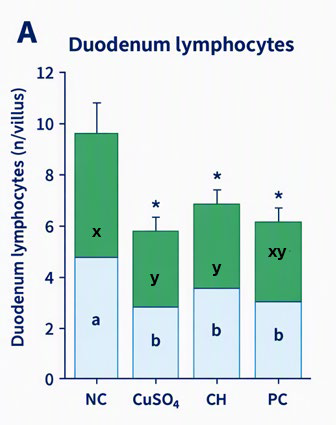
number of lymphocytes. When superscripts are different within a tissue, means are significantly different (P < 0.05).
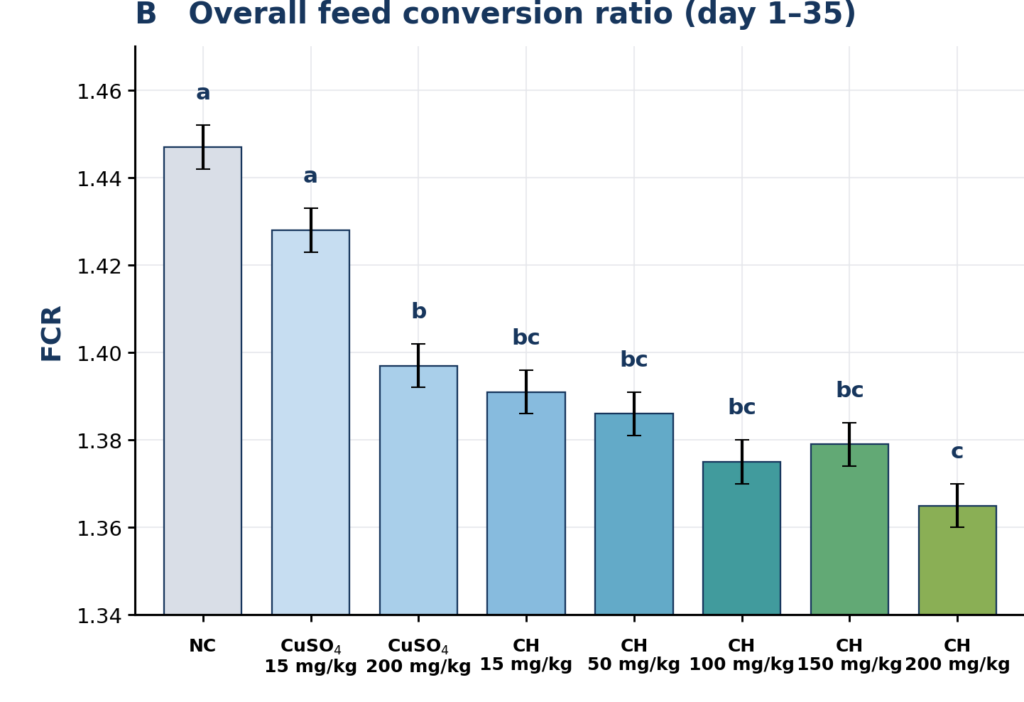
Nguyen et al. (2020, 2022) analyzed the same 35-day trial in 864 Ross 308 broilers fed basal diets supplemented with 15–200 mg Cu/kg from CuSO₄ or CH. At 200 mg/kg, CH increased body weight gain by 77 g/bird and improved FCR by 3.2 points versus CuSO₄ (P < 0.01; Figure 2). High Cu also improved cecal bacteria and intestinal morphology, with CH outperforming CuSO₄ at equal inclusion.
Evidence in layer study
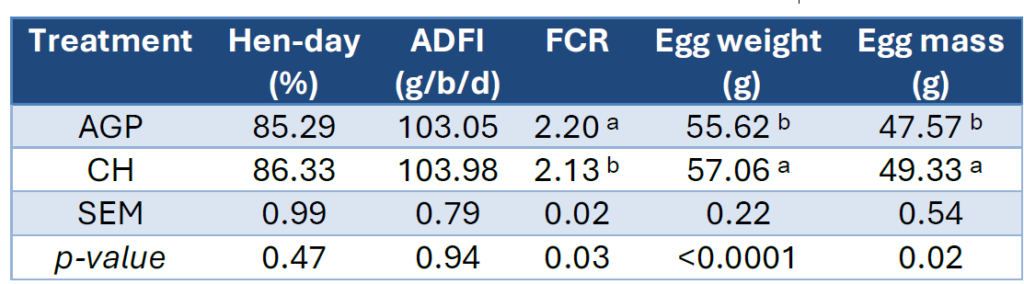
Layer evidence is limited, and long production cycles raise concerns about Cu accumulation and manure loading. Villanueva et al. (2025) fed 400 Hy-Line hens from 16 weeks of age either 180 mg/kg virginiamycin or 216 mg/kg CH for 24 weeks. CH maintained egg production, shell quality, and albumen height, while improving FCR, egg weight, egg mass (Table 2). Thus, high-dose CH may replace AGP while maintaining performance and improving feed efficiency and selected egg traits.
Table 2. Performance of laying hens fed diets containing AGP and CH. Means with different superscripts are significantly different (P < 0.05).
How much copper is “high copper” and why Cu source matters?
About 8–15 mg Cu/kg complete feed meets nutritional needs but does not provide antimicrobial effects; gut-health programs typically use 100–150 mg supplemental Cu/kg, while higher dose requires careful control of mineral antagonism and Cu excretion. In this context, CH offers a smarter, more efficient Cu source than conventional CuSO4: its low feed reactivity limits nutrient interactions and oxidation, while pH-dependent release keeps it stable in feed and delivers Cu in the acidic gut, supporting Cu availability, feed stability, and safety. These advantages can enable effective performance at lower doses, reducing Cu excretion and soil accumulation.
Conclusion: from HIGH copper to SMART copper
Copper Hydroxychloride provides more consistent performance than CuSO₄ through lower feed reactivity and controlled gastrointestinal release, enabling smarter Cu use with fewer mineral interactions and lower environmental excretion.
References available upon request