


Introduction:
Global research and practical experience indicate that respiratory diseases constitute approximately 30–50% of all poultry diseases. Common respiratory diseases include Newcastle disease (Bakar et al., 2025), avian influenza (Blagodatski et al., 2021), infectious bronchitis, chronic respiratory disease and fowl cholera (Zhou et al., 2025). Respiratory diseases have become a major concern because of their high incidence, strong infectiousness and significant impact on production efficiency.
These diseases can reduce growth rates and increase mortality, resulting in substantial economic losses and negatively affecting poultry health and welfare. Their occurrence is influenced by several factors, including viral diversity, seasonal changes, environmental conditions, stocking density and the complex avian respiratory system. Although improving ventilation and adjusting stocking density can help reduce disease pressure, these measures alone provide only limited mitigation (Zhou et al., 2025). Therefore, continuous monitoring of poultry health status and timely intervention are becoming increasingly important for reducing disease impact and maintaining production efficiency.
Respiratory syndrome: a complex disease rather than a single infection:
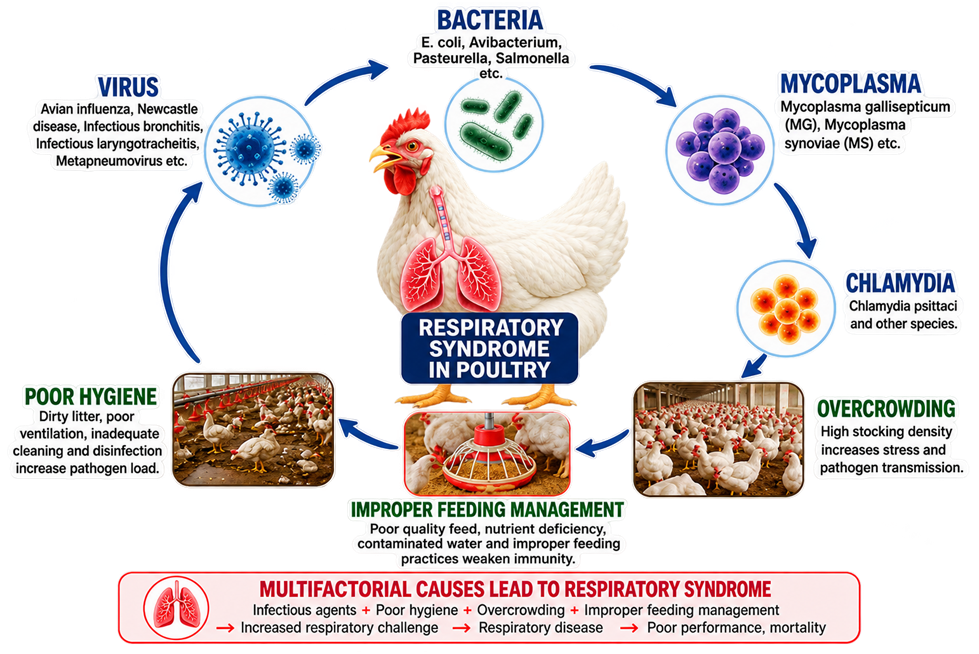
In poultry production, Respiratory Syndrome (RS) stems from both infectious agents and non-infectious conditions. Respiratory infections can be caused by a virus, bacteria, parasites or fungus and can affect the upper or lower respiratory tracts. Infectious aetiologies comprise viral, bacterial, Mycoplasma, and Chlamydia pathogens, whereas non-infectious causes frequently originate from substandard hygiene and suboptimal feed management.
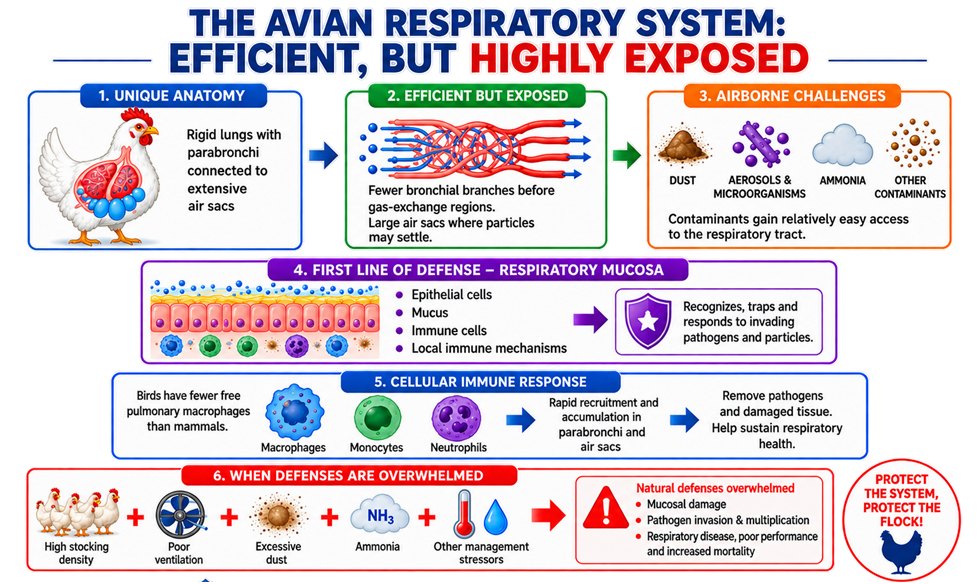
Viruses, bacteria, and mycoplasmas represent the primary drivers of avian respiratory distress. Prominent viral pathogens include infectious bronchitis virus (IBV), avian influenza virus (AIV), Newcastle disease virus (NDV), and infectious laryngotracheitis virus (ILTV) (Liu et al., 2025)
Avian respiratory syndrome spreads rapidly and exhibits high morbidity. In chicks, typical clinical signs comprise coughing, sneezing, dyspnea, tracheal rales, nasal discharge, periorbital edema, and lacrimation (Saif et al.,2008). In mature hens, infection frequently results in decreased egg production and compromised shell quality (Yehia et al., 2023).Post-mortem anatomical evaluations often demonstrate pathological lesions, including laryngeal and tracheal hemorrhages, excessive respiratory mucus accumulation, breast exudates, clouding of the air sac membranes, and pulmonary necrosis (Fletcher et al., 2010 and Hefez H.M 2011)
Symptoms of Upper Respiratory Tract Infections:
- Sneezing
- Facial swelling
- Discharge and/or blockage of nares
- Yawning
- Open-mouth breathing
- Fatigue
- Head-shaking
- Eye discharge or watery eyes
- Stretching neck outward
- Change in voice
Symptoms of Lower Respiratory Tract Infections:
- Decreased activity
- Abnormal respiratory sounds such as crackling, honking or rales
- Change or loss of voice
- Coughing, sneezing
- Labored respiration, open mouthed breathing
- Tail-bobbing (rhythmic jerking of the tail)
- Head-shaking
- Facial swelling
- Stretching neck
- Plugged nares or discharge
- Tearing or discharge from eyes
- Yawning
Nowadays, respiratory infections in poultry are rarely caused by a single pathogen. Instead, mixed or co-infections involving Mycoplasma, viruses and bacteria are increasingly recognized in field cases.
A study by P. Yadav et al. (2022) investigated 146 poultry flocks suspected of chronic respiratory disease (CRD) in Haryana and Rajasthan, India. Overall, 49.31% (72/146) of the flocks were positive for Mycoplasma. Among the 58 flocks carrying pathogenic Mycoplasma species (M. gallisepticum and/or M. synoviae), only 17.24% were single infections.
The majority had concurrent infections:
- 17.24% → Mycoplasma + APEC
- 43.10% → Mycoplasma + IBV
- 22.41% → Mycoplasma + APEC + IBV
- Only 17.24% → Mycoplasma alone
Prevention and Control of Respiratory Syndrome:
Effective management of respiratory syndrome requires an integrated, multifactorial strategy combining robust biosecurity, vaccination, optimized ventilation and environmental control, sound farm management, and early diagnosis. Diagnostic tools such as culture, serology, PCR and RT-PCR are essential for identifying respiratory pathogens and recognizing complex or mixed infections. Where antimicrobial treatment is indicated, pathogen identification and antimicrobial-sensitivity testing can support targeted therapy and help minimize unnecessary antibiotic use, thereby contributing to antimicrobial-resistance stewardship. Alongside these core interventions, strengthening immune resilience through essential nutrients such as vitamins A, C, D and E, selenium and β-glucans, together with phytogenics, immunomodulators and probiotics, can support respiratory health and flock resilience.
🌿 Essential Oils: Multifunctional Phytogenic Bioactives
Essential oils (EOs) are volatile plant extracts obtained from parts such as flowers, seeds, leaves, bark, herbs, fruits, wood and roots, commonly through steam distillation. They contain complex mixtures of bioactive compounds, including terpenoids, phenols and aromatic aldehydes.
Key components include:
- Terpenoids: linalool, geraniol, borneol, menthol and α-terpineol
- Phenols: thymol, carvacrol, eugenol and guaiacol
- Aromatic aldehydes: cinnamaldehyde, cuminaldehyde and phellandral
The multi-component nature of essential oils allows different phytochemicals to exert complementary biological activities, potentially supporting antimicrobial, anti-inflammatory, respiratory and immune functions (Brenes et al., 2010). Within this integrated respiratory-health strategy, Bentoli’s RespiraX™ is formulated to provide six-way respiratory support: Antimicrobial • Anti-inflammatory • Bronchodilator • Decongestant • Expectorant • Immunomodulator
Conclusion: Why a Six-Way Approach?
Respiratory syndrome is multifactorial, with infection, inflammation, mucus accumulation, airway constriction, congestion and compromised host defence often occurring together. Therefore, a single mode of action may not adequately address the different components of respiratory challenge.
A six-way approach provides complementary support across multiple aspects of respiratory health:
- Antimicrobial → supports control of microbial challenges
- Anti-inflammatory → helps manage excessive inflammatory responses
- Bronchodilator → supports airway opening and airflow
- Decongestant → helps relieve respiratory congestion
- Expectorant → supports mucus clearance
- Immunomodulatory → supports the host’s natural immune response
Together, these complementary activities aim to support airway function, mucus clearance, inflammatory balance and immune resilience, particularly during periods of respiratory challenge.
References:
- Bakar, M. A. A., et al. (2025). A hybrid chromaticity-morphological machine learning model to overcome the limit of detecting Newcastle disease in experimentally infected chicken within 36 h. Computers and Electronics in Agriculture.
- Blagodatski, A., et al. (2021). Avian influenza in wild birds and poultry: Dissemination pathways, monitoring methods, and virus ecology. Pathogens.
- Zhou, H., Zhu, Q., & Norton, T. (2025). Cough sound recognition in poultry using portable microphones for precision medication guidance. Computers and Electronics in Agriculture, 237, 110541.
- Fletcher, O. J., & Barnes, H. J. (2010). Avian respiratory system anatomy and diseases. In Y. M. Saif (Ed.), Diseases of Poultry (13th ed., pp. 181–240). Wiley-Blackwell.
- Hafez, H. M. (2011). Respiratory diseases in poultry. Poultry Science, 90(5), 1101–1108.
- Glisson, J. R. (2003). Mycoplasma gallisepticum infection. In Y. M. Saif (Ed.), Diseases of Poultry. Iowa State Press.
- Saif, Y. M., & Fadly, A. M. (2008). Poultry diseases and management of respiratory health. Avian Pathology, 37(6), 445–460.
- Liu, H., Pan, S., Wang, C., Yang, W., Wei, X., He, Y., Xu, T., Shi, K., & Si, H. (2025). Review of respiratory syndromes in poultry: Pathogens, prevention, and control measures. Veterinary Research, 56(1), 101. https://doi.org/10.1186/s13567-025-01506-y
- Yehia, N., Salem, H. M., Mahmmod, Y., Said, D., Samir, M., Abdel Mawgod, S., Sorour, H. K., et al. (2023). Common viral and bacterial avian respiratory infections: An updated review. Poultry Science, 102(5), 102553.
- Yadav, J. P., Singh, Y., Batra, K., Khurana, S. K., Mahajan, N. K., & Jindal, N. (2022). Molecular detection of respiratory avian mycoplasmosis-associated bacterial and viral concurrent infections in poultry flocks. Animal Biotechnology.
- Brenes, A., & Roura, E. (2010). Essential oils in poultry nutrition: Main effects and modes of action. Animal Feed Science and Technology, 158(1–2), 1–14.