Dr. Vishal and Dr. Manjeet Singh
ZIVOTA Private Limited, Panchkula
Livestock are inseparable from India’s prosperity and rural development, holding deep economic, social and cultural significance. Through milk, meat, wool, dung and other products, animals have long served as an important source of food security and livelihood for farmers and villagers and remain a cornerstone of India’s agricultural system.The scale itself is enormous. India produced 247.87 million tonnes of milk during 2024–25, making it the world’s largest milk producer. Today, however, reproduction-related problems have become one of the biggest obstacles to the sector’s growth, causing productivity losses across the dairy industry. When an animal fails to conceive on time, the consequences travel through the entire dairy operation:
Infertility → delayed conception → longer calving interval → fewer productive cycles → lower lifetime productivity → economic loss
The economic impact can be substantial. A study of dairy animals in Punjab estimated the average annual economic loss associated with anestrus at ₹24,362 per affected animal. The estimated loss was ₹27,511 for crossbred cattle, ₹27,039 for buffaloes and ₹18,297 for indigenous cattle. The study projected the total loss attributable to anestrus in Punjab at approximately ₹2,136 crore.
Infertility and its Causes
Infertility is reduced or complete failure of reproductive performance in cattle, failing to conceive, maintain pregnancy, or produce a calf.Infertility in animals can stem from several causes, the significant being malnutrition, poor animal management, infectious disease, hormonal imbalance, delayed puberty, irregular heat cycles, and reproductive tract abnormalities following difficult calving.
1. Malnutrition and Animal Feed
Malnutrition is a major reason cows and buffaloes struggle to conceive. A balanced diet maintains an animal’s general as well as reproductive health; without adequate protein, mineral salts and vitamins, the reproductive system fails to function properly, directly affecting the animal’s ability to conceive.Malnourished animals may fail to come into heat, abort, or not return to heat after calving and any one of these outcomes can become a crisis for a dairy operation. Deficiencies of calcium, phosphorus, iodine and zinc impair development of ovaries and ova. A simple safeguard is to include a good-quality mineral mixture like following NDDB’s feeding recommendations like feeding calves around 20–25 g/day, heifers & dry animals about 50 g/day and milking animals: 100–200 g/day depending on milk production and mineral supply from the rest of the ration.
2. Irregular Animal Management
Lapses in management,like poor monitoring during heat or inadequate rest after calving, can also cause infertility. Cows need about 45–60 days of sexual rest after a normal calving, and buffaloes around 90 days. Watch animals closely in the morning and evening to catch heat on time and follow the AM-PM rule: breed indigenous cows and buffaloes roughly 12 hours after the onset of heat.
3. Infectious Diseases
Bacterial and viral infections that affect the reproductive organs can hinder conception and sometimes cause abortion. An infected animal should be isolated and treated by a veterinarian promptly. Precautions to protect animals from these diseases include:
- Use appropriate artificial insemination practices.
- Examine male animals periodically and isolate any that are found infected.
- Keep infected and healthy female animals separated.
- In the event of an abortion, bury the placenta in the ground.
- Bury animals that have died from infection, rather than disposing of them in the open.
4. Hormonal Imbalance
Reproduction is controlled by a coordinated hormonal system.Disturbances involving reproductive hormones can interfere with ovarian activity, expression of heat, ovulation and maintenance of pregnancy.
5. Delayed Onset of Heat
Heifers of indigenous cow and buffalo breeds should come into heat at roughly two-and-a-half to three years of age, while heifers of crossbred cows should do so at around 15–18 months. But age alone should not determine when a heifer is ready for breeding.Body weight is also an important factor. Heifers should be bred only once they reach 55- 60% of their adult body weight for their breed.
6. Irregular and Silent Heat
Cows and buffaloes typically come into heat (oestrus) every 21 days, lasting about a day. If heat is markedly shorter or longer than this, the chances of conception fall considerably, and such animals should be examined by an experienced veterinarian.
Silent heat is a condition in which a female animal shows little or no visible signs of estrus, even though ovulation may be occurring. This makes heat detection difficult and often leads to missed breeding opportunities and delayed conception.
7. Reproductive Tract Abnormalities
These usually follow difficult calving or retained placenta and often show up as repeat-breeding problems affecting the ovaries, oviducts, uterus or vagina, occasionally with blood-tinged discharge. Such animals need sexual rest and treatment from a qualified veterinarian.Occasionally, heifers are born with hereditary defects in their reproductive organs that lead to infertility.
Diagnosis of Infertility
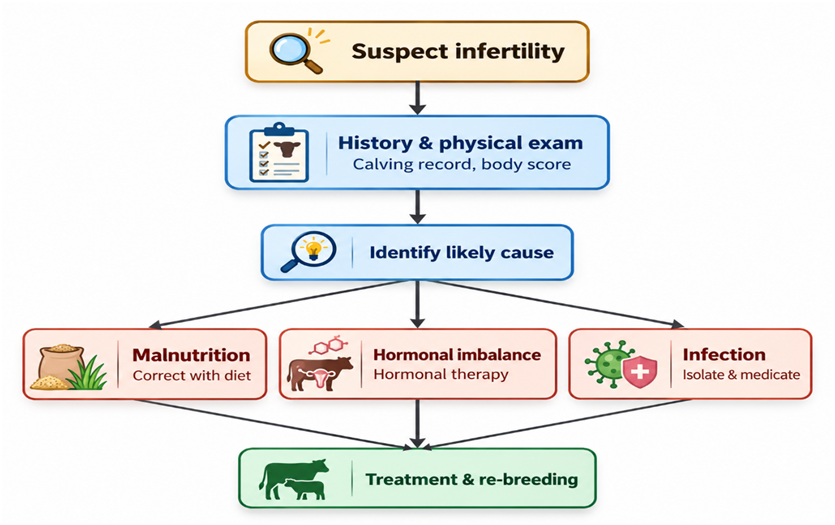
Infertility is a symptom or outcome. Diagnosis should search for its cause. It begins with a complete health history, including previous pregnancies, calving record, and other health issues, and is then followed by a physical examination that includes the reproductive organs. Ultrasonography (USG) and other modern diagnostic tools can help detect ovarian activity, uterine abnormalities, and pregnancy status even in animals showing silent heat. This should cover the animal’s body condition, weight and diet alongside the reproductive organs, so that any abnormality found can be treated promptly.
Treatment Measures and Reproduction Management
There is therefore no single treatment for infertility.For nutritional problems, the ration needs correction while for reproductive infection, appropriate veterinary treatment and disease-control measures are required.Where a genuine hormonal or ovulatory disorder has been diagnosed, appropriate reproductive therapy may be used under veterinary supervision like GPG protocol.Where the animal is cycling normally but heat is being missed, better heat detection and correct timing of artificial insemination may solve the problem.Artificial insemination with suitable semen at the correct time can improve the probability of successful conception, but repeated insemination without identifying an underlying problem is unlikely to correct infertility caused by disease, nutritional deficiency or reproductive abnormalities.Periodic reproductive examination can therefore help detect problems before they become prolonged repeat-breeding cases.
Conclusion
Infertility is a complex problem, principally driven by malnutrition, infectious disease, hormonal imbalance, and lapses in animal management. A balanced diet, sound management, and timely medical treatment address these drivers and improve reproductive efficiency.
Sound livestock management can strengthen the country’s dairy industry and rural economy, while also contributing to the nation’s overall prosperity and well-being.