Komal Mishra, Simmi Tomar,Buddhe LokeshShrikisan, Shubham Dabi
ICAR-Central Avian Research Institute
Introduction
Meeting global nutritional demandsrequires a significant increase in animal protein production, with poultry meat and eggs serving as the main drivers to bridge this food security gap. Official Animal Husbandry Statistics highlight this remarkable expansion, ranking India second globally in egg production with an annual output reaching 149.11 billion eggs, where commercial farms contribute over 84% of the total output. Similarly, national meat production has risen to 10.50 million tonnes, with poultry contributing nearly half of that total (5.18 million tonnes).
The growth of poultry production has also increased the importance of maintaining flock health. Birds kept in intensive production systems live in close contact with one another, which can favour the spread of bacterial, viral and fungal infections. Antimicrobials have been widely used to treat and prevent bacterial diseases in poultry, and their use as growth promoters has also been reported in some production systems. Excessive and inappropriate use of these drugs has contributed to antimicrobial resistance (AMR) and has raised concerns about antimicrobial residues in meat and eggs.
Faced with stricter government bans on routine antibiotics and growing consumer demand for drug-free food, producers urgently need modern solutions. This is where nanotechnology steps in. By engineering materials at the nanoscalebetween 1 and 100 nanometerswe alter their fundamental physical and biological behaviour. Their small size gives them a large surface area, which can increase their interaction with microbial cells and influence their antimicrobial activity. At this scale, particles do not rely on fragile chemical pathways; instead, they destroy pathogens through direct physical mechanisms that prevent bacteria from developing resistance, all while delivering essential minerals straight to host tissues with far higher efficiency.
Nanoparticles and its production
Nanoparticle synthesis follows two primary pathways: top-down physical breakdown and bottom-up chemical assembly. Top-down methods break bulk solids into nanoscale fragments using mechanical shear or thermal energy. Bottom-up approaches cluster individual atoms or molecules into structured nanoparticles.
| Approach | How it works | Typical processes |
| Top-down | Bulk materials are broken down into nanosized particles | Milling, grinding (physical processes) |
| Bottom-up | Nanoparticles form by assembling atoms or molecules | Chemical or biological reactions(Green Synthesis) |
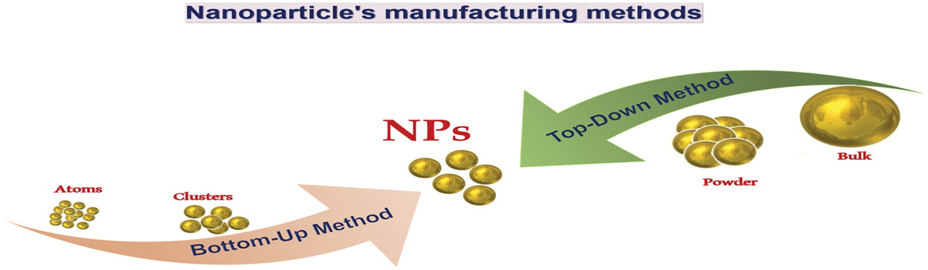
(source-Shaalan et al. 2016)
While physical top-down methods require high energy and yield non-uniform particles, standard bottom-up chemical reduction uses harsh solvents that leave toxic surface residues. To solve this, green synthesis replaces synthetic chemicals with natural plant extracts (e.g., neem, green tea) or microbial enzymes. Phytochemicals like flavonoids and polyphenols act as natural reducing and capping agents, producing biocompatible, eco-friendly nanoparticles safe for livestock and poultry consumption.
Types of nanoparticles and how they work
Once nanoparticles are synthesised, whether by milling, chemical assembly, or greensynthesis, the next question is which type to deploy.Several types of nanoparticles are being investigated for poultry health and production.Their properties vary according to their composition, size and surface characteristics, which also influence their biological effects.
| Type | Examples | Primary role |
| Metallic and its oxide | Silver, copper, gold,Zinc oxide, titanium dioxide, copper oxide | Strong, broad-spectrum antimicrobial effects |
| Polymeric | Chitosan-based (carrier) | Drug delivery and controlled release of antimicrobial compounds |
| Lipid-based | Liposomes, solid lipid nanoparticles | Improved stability, absorption, and targeted delivery of bioactive agents |
| Nanoemulsions | Fine dispersions | Efficient delivery of essential oils and natural antimicrobials |
Among these, metallic nanoparticlesespecially silver and zinc oxideare frequently reported for broad-spectrum antimicrobial activity against important poultry pathogens.
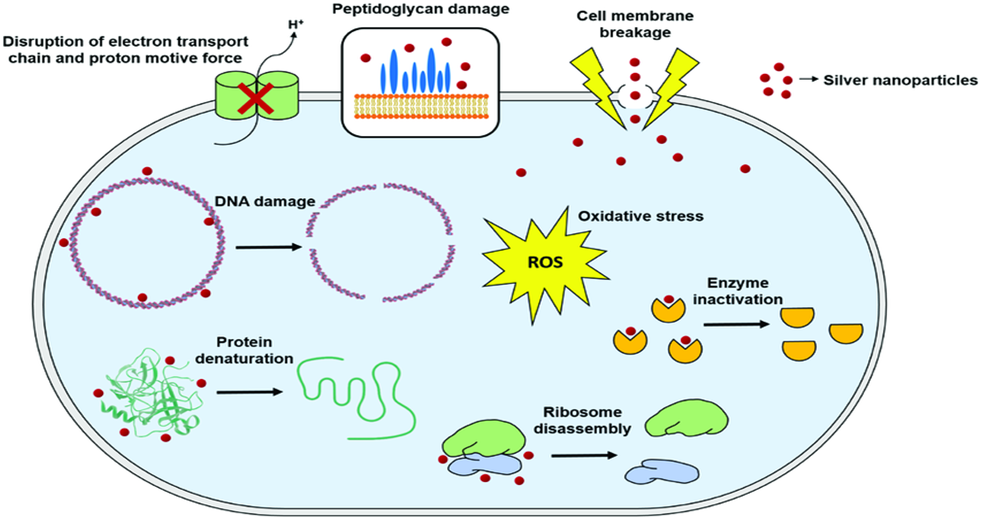
(source -Iracheet al., 2011)
Nanoparticles can affect microorganisms through several mechanisms at the same time which will reduce the chances of developing resistance. Silver nanoparticles, for example, can interact with the bacterial cell membrane, disturb membrane integrity and interfere with electron transport. They may also generate reactive oxygen species (ROS), damage proteins and DNA, inhibit enzymes and interfere with ribosomal function. The combined effects can ultimately impair essential cellular processes and lead to bacterial death.
Practical applications in Poultry Production
Nanoparticles is finding possible uses at different stages of poultry production. These include nutrition and gut health, disease control, farm hygiene and protection of poultry products after processing.
Internal Protection: Feed, Gut Health and Nanobiotics
- Nutritional additives and gut health: Nano-sized minerals such as zinc, selenium and copper are being studied for their role in improving nutrient utilisation and maintaining gut health. Recent studies in broilers have reported encouraging results with nano-selenium and zinc nanoparticles. Chitosan nanoparticles are also being investigated because of their antimicrobial properties and possible benefits for intestinal health.
- Nanobiotics and nutrient delivery: Silver, zinc oxide and other nanoparticles have shown activity against poultry pathogens such as Salmonella, E. coli and Clostridium perfringens. Their ability to interact with microbial cells has led to interest in their use as an additional tool for disease control. Some nano-mineral products are already available commercially. NanoSel, a nano-selenium supplement, and TocoSel-N, which combines nano-selenium with vitamin E, are marketed for poultry nutrition.
External Protection: Farm Hygiene and Food Safety
- Farm hygiene: Nanoparticles are also being explored for use in surface coatings, disinfectants and poultry-house equipment. Their antimicrobial properties could help reduce microbial contamination on surfaces and equipment that are frequently exposed to pathogens.
- Active packaging:Antimicrobial packaging films embedded with silver or titanium dioxide nanoparticles actively protect fresh meat and eggs. These functional coatings inhibit post-harvest spoilage microbes and foodborne pathogens, extending retail shelf life while preventing lipid oxidation during refrigeration.
Safety concerns and responsible use
Nanoparticles may offer several benefits in poultry production, but their safety needs careful attention. Their effects can vary with factors such as particle size, dose, surface properties, solubility and duration of exposure. Before their wider use, it is important to establish suitable doses, check for possible residues in meat and eggs, and maintain consistent quality during production. Clear guidelines are also needed for their use in poultry farming.
Green-synthesised nanoparticles and biodegradable delivery systems may offer safer options for some applications. However, more studies under practical farm conditions are needed to understand their long-term effects and to determine how safely they can be used on a larger scale.
Conclusions
Nanotechnology is opening new possibilities for poultry production, particularly in nutrition, gut health, disease management and food safety. Nanoparticles have shown promising results in laboratory studies and animal trials, while some nano-based nutritional preparations are already available commercially. Their ability to improve nutrient delivery and interact with microorganisms makes them an interesting addition to the search for alternatives to routine antimicrobial use.
At the same time, nanoparticles are not a replacement for good poultry management. Their wider use will depend on careful evaluation of dose, toxicity, residues, environmental effects, cost and regulatory requirements. Used alongside vaccination, probiotics, balanced nutrition and good biosecurity, nanotechnology could become one useful component of an integrated approach to poultry health. The future of poultry production will not depend on a single technology. It will depend on finding practical ways to maintain bird health while using medicines and other resources more responsibly. Nanotechnology may become part of that future, but its success will ultimately depend on how safely, effectively and responsibly it is developed and used.