By Dr. Manjeet Singh (M.V.Sc. Animal Nutrition)
Dr. Vishal (M.V.Sc. Animal Nutrition)
Zivota Private Limited
How one ionophore reshapes fermentation, protects fresh cows and tightens feed efficiency, and why it demands careful handling
For more than four decades, one fermentation product has shown up in the feed formulations of dairy, beef and young-stock programmes across the world: monensin sodium. It is neither an antibiotic in the clinical sense nor a nutrient. It is an ionophore, a molecule that changes which microbes thrive in the rumen, and through them how much energy the animal gets from the same kilogram of feed.
Questions that arise are: how monensin works, what it does for cattle and buffaloes, how to dose it, and the safety rules that cannot be bent.
What it is
Monensin sodium is produced by fermentation of Streptomyces cinnamonensis. It is supplied in feed premixes, most commonly at 20% (200 g/kg), and acts mainly in the rumen and gastrointestinal tract. It has a zero-day milk withdrawal period in cattle. The usual shelf life is 24 months from manufacture, provided the product is kept cool and dry, away from sunlight and moisture, and out of reach of non-target animals and children.
How it works at the cell level
Monensin has a lipophilic outer surface and a hydrophilic inner cavity. The outside lets it slip into bacterial cell membranes, and the inside lets it carry ions across them. It acts as an antiport ionophore, moving sodium into the cell while driving potassium and hydrogen ions out.
For a susceptible bacterium this is a losing battle. The cell interior turns alkaline and its osmotic balance is disturbed. The cell runs energy-dependent pumps to restore its ion gradients, and as these work continuously the ATP reserves run down. The cell then swells, goes into osmotic shock and eventually lyses.
Why only some bacteria are affected
The effect is selective. Gram-positive bacteria have no protective outer membrane, so monensin enters freely and suppresses them. Gram-negative bacteria carry an outer membrane rich in lipopolysaccharides and porin channels that keep the ionophore out. The result is a shift in the ruminal ecosystem, with Gram-positive species held back and Gram-negative species, many of them beneficial, gaining ground.
What changes in the rumen
The practical consequences of this shift are as follows.
More propionate, less acetate and butyrate. Gram-positive fermentation tends to produce acetate, butyrate and metabolic hydrogen. With those organisms suppressed, the Gram-negative propionate pathway takes over. Propionate is also a hydrogen sink: it takes up H₂ that methanogenic archaea would otherwise use to make methane (CO₂ + 4H₂ → CH₄ + 2H₂O). Since methane can account for up to about 12% of gross feed energy, even a partial reduction recovers energy that would otherwise be lost.
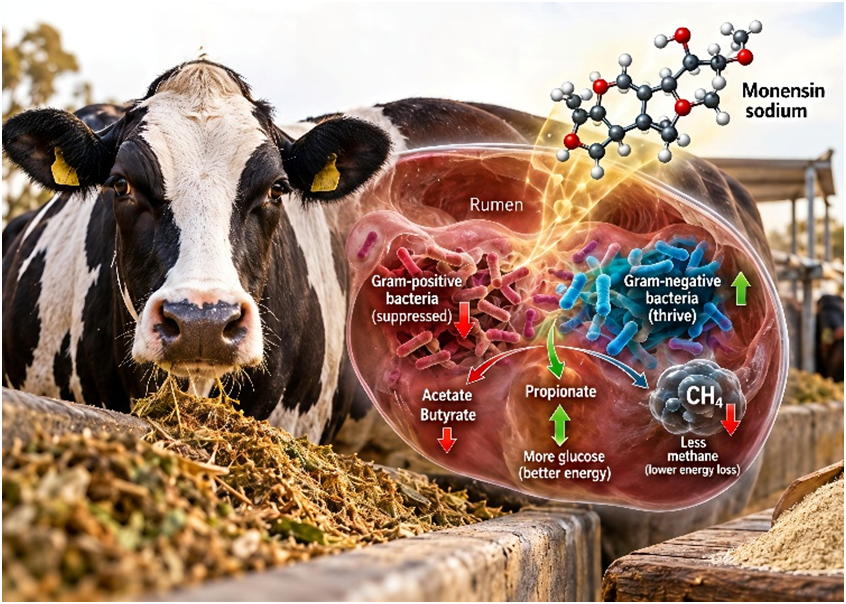
More glucose. Propionate absorbed from the rumen is converted to glucose in the liver. This improves the animal’s energy status and supplies the precursor for lactose synthesis in the mammary gland.
Protein sparing. Monensin limits the ruminal breakdown of valuable dietary protein to ammonia. Less ammonia means less urea cycling through the liver and less nitrogen lost in urine.
Effects on dietary fat. Monensin also interferes with the rumen’s biohydrogenation of polyunsaturated fatty acids such as linoleic acid. More unsaturated fat therefore escapes to the small intestine, where it can be absorbed and incorporated into body fat and milk.
Health benefits
Bloat. Monensin reduces the bacterial slime (mucopolysaccharides) and gas that stabilise the froth in bloat. Reported reductions in incidence reach up to 80%, with fewer deaths and milder cases. It is a preventive tool, however. In an acute legume bloat emergency, a fast-acting anti-foaming agent such as poloxalene is still needed.
Ketosis and negative energy balance. In early lactation, milk output peaks at around 4–6 weeks while dry matter intake does not peak until about week 10. The gap pushes cows to mobilise body fat, flooding the blood with non-esterified fatty acids (NEFAs) that are converted to ketone bodies such as β-hydroxybutyrate. By raising glucose supply, monensin eases this imbalance. Intraruminal controlled-release capsules, given over the 100-day high-risk window around calving, have been associated with an estimated 5:1 return on investment.
Coccidiosis. Monensin is both a coccidiostat and a coccidiocide. In calves it acts against Eimeria bovis and Eimeria zuernii, attacking free sporozoites and first-generation schizonts.
Performance figures
In growing animals, monensin typically gives:
| Parameter | Average change |
| Average daily gain | +2.5% |
| Dry matter intake | −3.0% |
| Feed conversion efficiency | +6.4% |
Intake falls slightly because the diet delivers more usable energy per kilogram. In heifers, producers also report faster frame development, a younger age at puberty and easier maintenance of optimal body condition.
Dosing guide
| Animal category | Daily dose (20% premix) | Inclusion in concentrate |
| Dairy cows and buffaloes | 0.75–2.25 g/animal/day | 100–150 g/MT |
| Calves and replacement heifers | 0.5 g/calf/day | 250–300 g/MT |
Safety: where monensin becomes dangerous
The margin between an effective dose and a toxic one is narrow enough that every feed mill, nutritionist and farmer must respect it.
- Do not exceed 660 mg of monensin active ingredient (3.3 g) per head per day.
- In cattle, the estimated LD50 ranges from 21.9 to 80 mg/kg body weight, the LD10 is about 11.2 mg/kg BW, and the LD1 is 5.5 mg/kg BW.
- Horses, donkeys and other equines are acutely sensitive, with fatal effects at only 2–3 mg/kg body weight. Signs include tachycardia, sweating, severe colic, hypotensive shock, acute heart failure and rapid death. Never let equines near monensin-containing feed, and keep mixing equipment and bags well away from them.
- Dogs that eat the feed can develop severe rhabdomyolysis and myoglobinuria.
- Drug interactions: avoid giving monensin together with pleuromutilins (tiamulin), macrolides (erythromycin, oleandomycin) and lincosamides, since they interfere with its metabolic clearance.
- Mixing: the premix must be blended uniformly in double-ribbon or paddle mixers. Poor mixing creates “micro-pockets” of high concentration, and one animal eating one such pocket can be poisoned even when the formulation is on paper correct.
Monensin shows how a small change in rumen microbial ecology can change energy partitioning in the whole animal. It improves efficiency, helps cows through the transition period, reduces bloat and controls coccidiosis. Used at the right dose, uniformly mixed and kept away from equines, it remains one of the most cost-effective tools in ruminant nutrition.