By Inge Peeters
Global Solution Manager – Feed Efficiency, Orffa Additives B.V., The Netherlands. Sopaphan Pruekvimolphan, Technical Manager, Orffa (Thailand) Ltd.
Poultry producers in Asia face challenging environmental conditions, characterized by high temperatures and humidity. Nutrition plays a crucial role for maintaining performance and profitability under these circumstances, and betaine has become an increasingly valued solution in tropical poultry systems.
Understanding Betaine and Its Role
Betaine, also known as trimethylglycine, is a naturally occurring compound found in sugar beet, wheat, and marine sources. In poultry nutrition, it is valued for its dual function as a methyl donor and an organic osmolyte. These properties make betaine particularly relevant for Asian production systems, where heat stress is not seasonal but a year-round challenge.
As a methyl donor, betaine supports essential metabolic processes in the liver, including methionine regeneration and lipid metabolism. This function helps improve nutrient efficiency and supports liver health, which is critical for both fast-growing broilers and high-producing layers. At the same time, betaine acts as an osmolyte, helping cells retain water and maintain normal function during heat stress and dehydration.
Betaine can replace both choline and methionine (partially) in poultry diets because it directly supplies methyl groups, a role otherwise fulfilled by choline (after its conversion to betaine in the liver) and methionine through the methionine cycle (Figure 1). Unlike choline, betaine does not require metabolic conversion to become active, making it a more efficient methyl donor. This methyl contribution provides a methionine-sparing effect, allowing more dietary methionine to be used for protein synthesis. Practical broiler trials with betaine have shown that partial replacement of choline chloride and DL-methionine can be achieved without compromising growth, while often improving feed conversion and gut health.
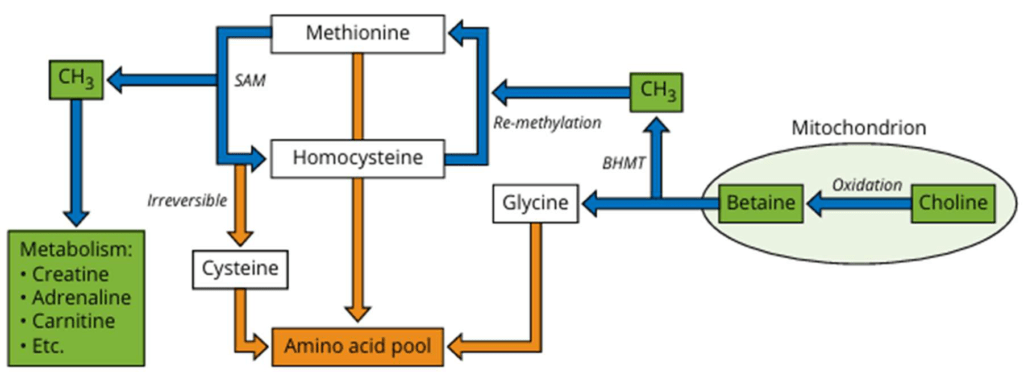
Figure 1. Methyl group metabolism
Broiler Performance in Hot Climates
Heat stress remains a significant challenge in Asian poultry production. Extended periods of elevated temperatures compromise gut integrity, elevate oxidative stress, and impair immune function. Betaine supports cellular hydration and stabilizes cell membranes, enabling birds to better withstand thermal stress.
Under hot and humid conditions, birds decrease feed intake and redirect energy toward cooling mechanisms such as panting. The inclusion of betaine reduces the metabolic energy required for maintaining cellular balance, thereby permitting greater allocation of nutrients for growth and development. Birds supplemented with betaine during heat stress typically show enhanced resilience and more consistent performance.
A broiler study conducted under hot environment (27-36°C) in India with a supplementation of betaine hydrochloride at 0.13% and 0.20% on top of a negative control (with reduced choline chloride and methionine). Betaine significantly reduced respiration rate (panting: Figure 2) and rectal temperature at 21 and 28 days of age (P < 0.05) and remained numerically lower at 35 days of age. Both betaine-fed groups had a significantly higher final body weight (P < 0.05: Figure 3).
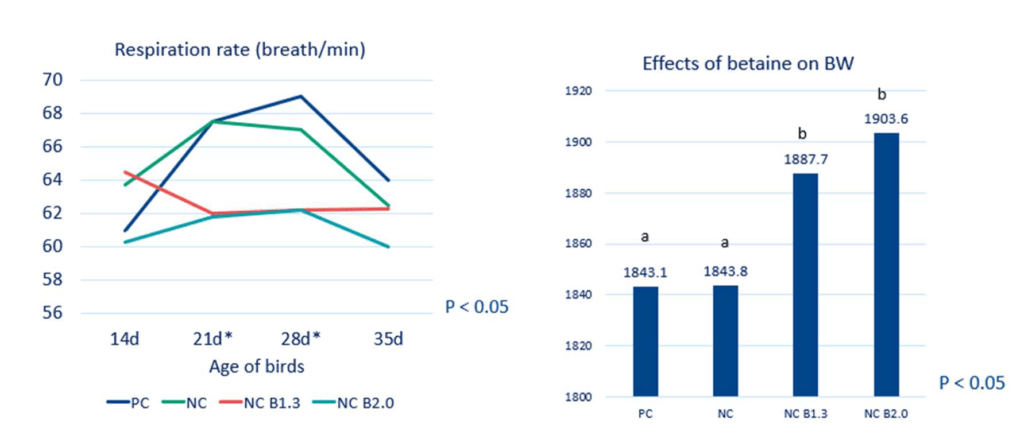
(Left) Figure 2. Respiration rate, breaths/minute
(Right) Figure 3. Final bodyweight at 38 days of age, grams
PC: Positive control
NC: Negative control (choline chloride and methionine were partially removed)
NC B1.3: Negative control with betaine 1.3 kg/MT feed
NC B2.0: Negative control with betaine 2.0 kg/MT feed
Improved broiler intestinal health was demonstrated in significantly lower litter and footpad lesion score in broiler group received 0.1% Excential Beta-Key on top of basal diet. Feed conversion ratio (FCR) improved by 6 points at 28 days of age and 2 points at 42 days of age. Based on literature review, supplementation of poultry diets with 0.04–0.15% betaine consistently increases breast, carcass yield and dressing percentage, while reducing fat percentage and abdominal fat.
Benefits for Layers
Heat stress in layers results in reduced feed intake, lower egg production, and poorer egg quality. By improving nutrient utilization and supporting liver metabolism, betaine helps maintain egg output and feed efficiency during periods of thermal stress. Its role in lipid metabolism is particularly important in reducing the risk of fatty liver, a common issue in high-producing layers under hot conditions.
The effect of betaine on laying hens from 32 to 48 weeks of age exposed to chronic heat stress (CHS: 11:00 to 15:00, 38°C ± 1, 55-65% Relative Humidity (RH) for 3 consecutive days per week) was studied. Betaine supplementation (1 kg/MT) on chronic heat stressed group significantly improved body weight, laying rate, egg weight, and egg mass (Figure 4), as compared to those without betaine supplementation.
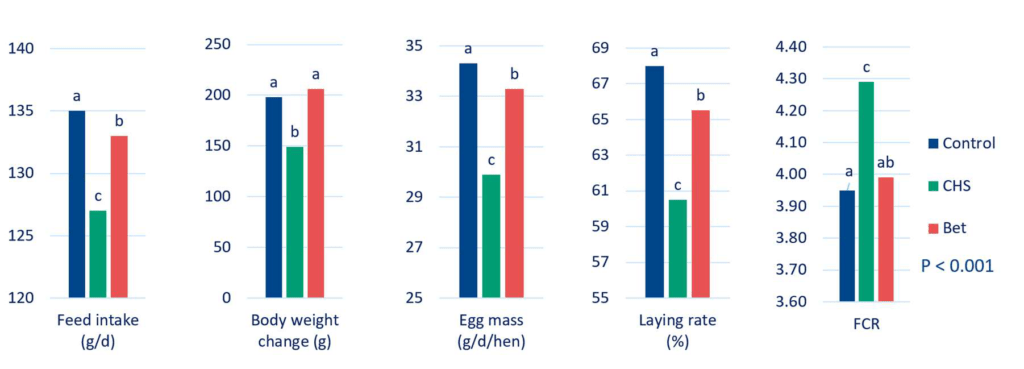
Figure 4. Effect of betaine on laying hens in heat stressed condition
Control: Normal temperature at 22-24°C and relative humidity (RH) of 45-55%
CHS: Chronic heat stress group at 38°C ± 1 and RH of 55-65%
Bet: CHS with betaine 1 kg/MT feed
Why Excential Beta-Key Outperforms Other Betaine Sources
Although all approved betaine sources ultimately deliver the same active molecule in the bird, clear differences in physical quality, consistency, and handling performance determine how well a product works under practical Asian conditions. Excential Beta-Key distinguishes itself through a combination of reliability, stability, and technical assurance that many competing products cannot match.
- Superior physical quality and flowability
Excential Beta-Key hydrochloride (HCl) is non-hygroscopic and free-flowing, ensuring easy handling in humid tropical climates where other betaine HCl products often cake, clump, or create mixing issues. The controlled crystallization process secures stable behaviour in feed mills and on farms.
- High purity and consistent analytical profile
Betaine analysis is technically complex. Excential Beta-Key maintains strict specifications for purity, moisture, ash, nitrogen, and chloride, preventing the variability or dilution sometimes seen in lower-grade products and ensuring predictable performance batch after batch.
- Flexible formats for different nutritional needs
With both betaine HCl (72.4% betaine) and betaine anhydrous (96% betaine), the Excential Beta-Key range offers options suited for nutrientdense formulations, chloride-sensitive diets, or situations requiring the highest concentration.
- Reliable and secure supply
While traditional betaine anhydrous from sugar beet processing is limited by seasonal availability and market fluctuations, Orffa provides both high-purity synthetic betaine HCl and anhydrous options, offering dependable supply without compromising quality and performance.
- Regulatory confidence and technical support
Excential Beta-Key comply with European feed additive regulations and is OMRI-LISTED for organic production. The product is backed by strong technical data and practical field experience, ensuring consistent support in challenging climates.
Key Takeaways
As climate pressure intensifies and production efficiency becomes increasingly critical, solutions that strengthen birds at the cellular level are gaining value. Betaine may be a small molecule, but in Asia’s demanding poultry environment, its impact can be substantial.
References available upon request