
Dr. Jayanta Bhattacharyya, Director – Techno-Commercial
In the era of sustainable poultry farming, the focus has shifted from killing pathogens to empowering the bird’s own natural defences. Modern poultry production faces a “double-edged sword”: genetic selection for rapid growth has created high-performing birds, but often at the cost of a fragile immune system. This review explores how immunomodulatory formulation, a specialized nutraceutical supplement, addresses this gap. By targeting multiple immune pathways—from antioxidant Défense to cellular communication—this strategic intervention helps birds maintain health and productivity even under environmental stress. We examine the biological mechanics of the avian immune system and present field trial data demonstrating significant improvements in growth, feed efficiency, and mortality rates.
Introduction:
In today’s poultry houses, a disease outbreak is rarely just about a “bad germ.” It is usually the result of a “perfect storm”: high metabolic demand, environmental stress (like heat), and a physical barrier—like the gut or skin—that has been weakened.
As the industry moves towards antibiotic free production, the pressure is on to find sustainable ways to keep flocks healthy. Modern broilers are like high-performance race cars; they grow incredibly fast, but their “internal cooling systems” (their immune response) can easily overheat and fail. Strategic immunomodulation is the practice of fine-tuning these defenses so the bird can fight off challenges without losing its edge in growth and performance.
How a Bird’s “Immune System” Works?
To understand how to help a bird, we must understand its three layers of defense:
The Physical Barrier: The skin and the gut lining. Think of this as the “city wall.” If the gut is damaged by poor feed or toxins, the wall crumbles.
Innate Immunity (The First Responders): These are cells like macrophages that patrol the body. They don’t need a specific target; they attack anything that doesn’t belong. They act within minutes of an infection.
Adaptive Immunity (The Specialized Forces): This includes B-cells and T-cells. They learn to recognize specific threats (like a specific virus) and remember them for the future. This is the biological “memory” that makes vaccines work.
Why Do Birds Get Infected?
Birds aren’t always at 100% strength. Several factors can crash their “security system”:
- Oxidative Stress: When a bird is stressed, it produces “free radicals”—unstable molecules that damage healthy immune cells.
- Nutrient Diversion: If a bird is growing at its maximum limit, it often “borrows” nutrients intended for the immune system to build muscle instead.
Environmental Pressure: Heat stress and poor air quality act as a constant drain on the bird’s energy reserves.
What is the Suitable Nutraceutical Approach for Better Immunomodulation?
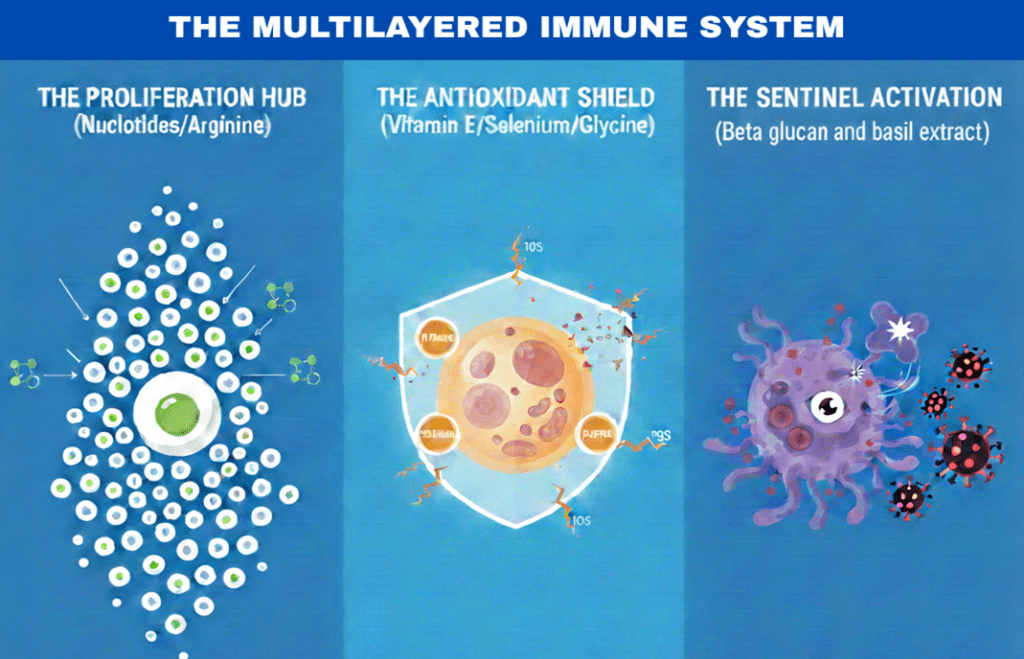
Beyond stringent biosecurity protocols, comprehensive immunization schedules, and balanced nutritional regimens, the strategic supplementation of immunomodulatory nutraceuticals is of paramount importance. Recent empirical studies have elucidated the potent immunomodulatory roles of various bioactive compounds, including yeast nucleotides, beta-glucans, and specific micronutrients such as Vitamin E and organic yeast-derived selenium. Furthermore, functional amino acids—specifically glycine, arginine, and betaine—alongside botanical derivatives like basil extract, have been identified as critical mediators in enhancing systemic immune competence.
| Component | Mode of Action (How it Works) |
| Yeast Nucleotide | Acts as the building blocks for DNA/RNA. They accelerate the rapid proliferation of lymphocytes (white blood cells) during an infection, ensuring a faster response. |
| Beta Glucan | Functions as a “biological response modifier.” It binds to specific receptors (Dectin-1) on macrophages, “priming” them to be more alert and effective at killing pathogens. |
| Vitamin E | A potent antioxidant that protects the lipid membranes of immune cells from oxidative stress, ensuring the cells remain intact and functional during an inflammatory flare. |
| Yeast Selenium | Incorporated into selenoproteins (like glutathione peroxidase) which neutralize free radicals, preventing damage to immune tissues and enhancing antibody production. |
| Arginine & Glycine | These amino acids serve as precursors for Nitric Oxide (NO) and glutathione. NO is a critical weapon used by macrophages to destroy invading bacteria. |
| Betaine | Acts as an osmoprotectant, keeping immune cells hydrated and stable under heat or metabolic stress, allowing them to continue their surveillance uninterrupted. |
| Basil Extract | Contains phytochemicals (like eugenol) that modulate cytokine production, helping to reduce excessive inflammation while stimulating the activity of Natural Killer (NK) cells. |
Field Evidence: Proving the Concept
A field trial conducted on Vencobb 430Y Commercial Broilers compared a control group, immunomodulator formulated based on yeast nucleotides, beta-glucans, and specific micronutrients such as Vitamin E and organic yeast-derived selenium. The result showed that better immunity led directly to better profits.
| Parameters | Control | Immunomodulator | Impact |
| Body Weight (g) | 2273g | 2299g | +26g Increase |
| FCR (Feed Conversion) | 1.43 | 1.37 | Significant Efficiency Gain |
| Mortality (%) | 2.31% | 1.19% | ~50% Reduction |
| Blood Glucose (mg/dL) | 364.83 | 186.75 | Better Metabolic Stability |
| Hemoglobin (mg/dL) | 11.63 | 12.26 | Improved Oxygen Transport |
| EEF (Efficiency Factor) | 445.79 | 474.28 | Superior Overall Performance |
What does this tell us?
The significant drop in mortality and the improvement in FCR suggest that birds on formulated immunomodulators weren’t just “surviving”; they were thriving. The lower glucose levels indicate a more efficient use of energy, and the higher hemoglobin suggests better overall physiological health.
Conclusion
Immunity is not an “on or off” switch. It is a complex balance that requires constant support. The trial data proves that when we support the immune system through multiple pathways—protecting cells, improving signalling, and providing building blocks—the birds reward the producer with lower mortality and better feed efficiency.
Formulated immunomodulator represents the shift from reactive medicine to proactive resilience. By strengthening immunity where it matters most, we ensure that poultry production remains sustainable, profitable, and antibiotic-responsible.
References
- Klasing, K.C. (2007). Nutrition and the immune system. British Poultry Science.
- Surai, P.F. (2016). Antioxidant systems in poultry biology. Journal of Animal Research and Nutrition.
- Kogut, M.H. (2019). The role of gut immunity in poultry health. Poultry Science.
- Abbas, A.K. et al. (2019). Cellular and Molecular Immunology. Elsevier.
- Yegani, M., & Korver, D.R. (2008). Factors affecting intestinal health in poultry. Poultry Science.