T. K. S. Rao, A. Singh*, H. P. Thakor**, Shashi Pal, Rajesh Kumar
College of Veterinary and Animal Sciences, Arrabari, DKAC campus KishanganjBihar Animal Sciences University, Patna
“Licking gesture is important to make friends and to maintain the herd-harmony, cows licks around head and neck to show affection and establish close bond”
Cows licking is natural grooming behaviour which promotes hygiene, stimulates blood circulation, friendship and enhancecare, trust and acceptance. It forms part of maternal care and reproductive behaviour i.e., bulls licking cows and cow licking cow in oestrus along with itching control and coat cleaning. Close bonding and stress releasing behaviour in dairy cow include licking, mutual grooming, cohesion, self-scratching etc. Licking causes, a repetitive motion which triggers release of endorphins, which have a calming and self-soothing effect. Licking improves wellbeing of animals along with health and comfort. Cows tended to prefer to groom other individuals of similar age and size, suggesting familiarity and mutual cooperation.Incidence of licking is reported up to 94% in grazing herd. In a cohesive group of cattle incidences of both fighting and licking is high. Older, pregnant and docile cows receive more licking as compared to new and open cows, moreover, social licking was higher in preferential mates (1.89 vs. 0.62) as compared to average herd. Preferred mates also showed greater number of agonistic interactions (Machado et al., 2020).Social licking may have a cleaning along with stress reducing and close bonding effect, authors also claimed that social licking increased with cohabitation in a particular place (Sato et al., 1991). Older cow habitually acting as “peacemaker” by grooming youngerone. Social licking associated with sound welfare status and licking frequency is four-fold higher in indoor as compared to outdoor cows (Tresoldi et al., 2015) shows the significance of proximity of living. Licking experience pleasure while receiving allogrooming may be deduced from behavioural indications such as stretching the licking site, raising of tail or half closing of eyes (Sato et al., 1991).
Reasons for licking in cattle:
- Social bonding:
- Maternal and expression of care:
- Hygiene:
- Fending off insects:
- Mineral intake:
- Self-grooming:
Social licking: Said gesture help reduce stress and improve trust on group members.
- Affiliation: Frequency of licking between two cows indicates a close positive relationship between individuals.
- Group cohesion:It is way to express group cohesion and establish peck order/ bunt order/ social hierarchy.
——————————————————————————————————–
* BUAT Banda UP, ** KU Gujarat
- Stress reduction: Licking reported to reducestress by reducing heart rate and inducing calming effect.
Types of Licking: In cattle licking refers to mainly two distinct behaviours such as social licking (allogrooming) for bonding and cleaning and licking as component of reproductive cycle i.e., estrus or heat signs.Other types of licking include calf grooming, self-licking, licking in order to fulfil mineral deficiency.
Hormone of bonding and licking: Licking is physical act and powerful stimulus that releases a mixture of hormones. Licking triggers several hormones primarily oxytocin promoting bonding trust, cuddling, licking.It also involves dopamine driving addictive behaviours.Oxytocin considered as hormone of bonding, it is released in large amount during calving and suckling suchas sniffing andlicking It stimulates maternal behaviour.Oxytocin known to be increased while a mother feed her young and has rewarding effect suckling is considered as one of the most hedonic maternal activities. Prolactin is also involved in maternal behaviour. Additionally, reduction in progesterone and increased estrogen around calving play crucial role in initiating affectionate bonding behaviours. Moreover, if maternal bonding protocol interrupted before licking of the calf, the likelihood of the cow rejecting the calf increases. Oxytocin is hormone of over production of milk. Thus, key hormones involved in licking include oxytocin, dopamine (make licking pleasurable), serotonin (influence mood & behaviour), glucocorticoids and melanin-concentrating hormones- MCH (affect food intake & duration of licking).
Social hierarchy: Include leadership, movement, positioning, resource access, dynamic nature of hierarchy in place of fixed type.
Factors influencing herd hierarchy: Factors influencing herd hierarchy include physical features, behaviour features and presence or absence of horns etc.
Salt or nutrient seeking as cause of licking: Sometimes cattle might lick for minerals well supported with social reasons.
Significance of licking in estrus detection: Licking is a secondary behaviour sign of estrus in cows, serving as an indicator of increased social and exploratory activity. It is valuable visual cue for farm workers and automated system to identify cow in estrus. Frequency of licking increased during estrus and become more focussed around head and anogenital regions of cows. Pheromones are commonly secreted from female cows in estrus. Pheromonal communication common in cows in estrus especially in urine, feces, fluids and saliva of cows in estrus. This chemosensory stimulus helps confirm a cow’s reproductive status and.
Testing behaviour in cow in estrus:Chin resting followed by licking serve as testing behaviour to identify receptive cow. Licking serves as important indicator to improve estrus detection efficiency especially in animals where primary signs are less pronounced or when visual observation time is limited.
Features of licking:
| Sl. No. | Features | Licking or Social grooming |
| 1. | Type of sign | Secondary indicator of heat |
| 2. | Occurrence | Frequently during estrus, also reported for social bonding or hygiene at other times |
| 3. | Reliability | Less predictive of the exact time for breeding if not supported by primary sign |
| 4. | Purpose | Social bonding, hygiene, a form of courtship behaviour |
Dam-calf bonding grows deeper with suckling: Activity of suckling dramatically increase bond between dam-calf bonding as compared to calves who spent same amount of time with mother without suckling.
Research findings:Cow licking a cow is social dynamics of a happy healthy and comfortable herd. Licking alone consistently makes up about 10% of total interactions regardless of housing types. Cows touched on neck showed less avoidance human approach test (Schmied et al., 2008). Cow licking is social behaviour indicating strong bond within the herd and stress reduction/ low heart rate i.e., calming effect in receivers implying the experience of positive affective states though performers heart rate can rise means calming effects during social licking were not identified (Laister et al., 2011). It is expression of well-being, comfort and social cohesion/ ties, not just cleaning and acting as a vital social glue. In low ranking cows the performance of allogrooming might even be stressful, especially when initiated by the dominant cows (Boissy et al., 2007).
Cows grooming individuals that had previously groomed them, moreover older cows grooming more as compared to the younger cows.
Excessive licking:Licking is a positive social behaviour; however, excessive licking is deviation from normal and it might be due to skin problems, parasitic infestation, stress, nutritional deficiency, boredom or behavioural disorder etc., Excessive etching and licking may be controlled by using antihistaminic, anti-inflammatory, probiotics etc.,
Licking stimulus:
- In addition to social licking in cow, licking mineral blocks is considered useful for cow health and welfare.
- Environmental contamination contributes to the spread of disease if cows are carrying pathogens.
Accelerometer: Tri-axialaccelerometer used extensively in research and commercial application to objectively monitor, detect and quantify licking behaviour in livestock and companion animal too.It is used to monitor the intake of mineral block supplements in grazing system. This technology is also used to study animal behaviour objectively and continuously even for difficult to observe wild animals. Accelerometer also work properly using sensor and commonly used to detect estrus in cow and detection of calving time.
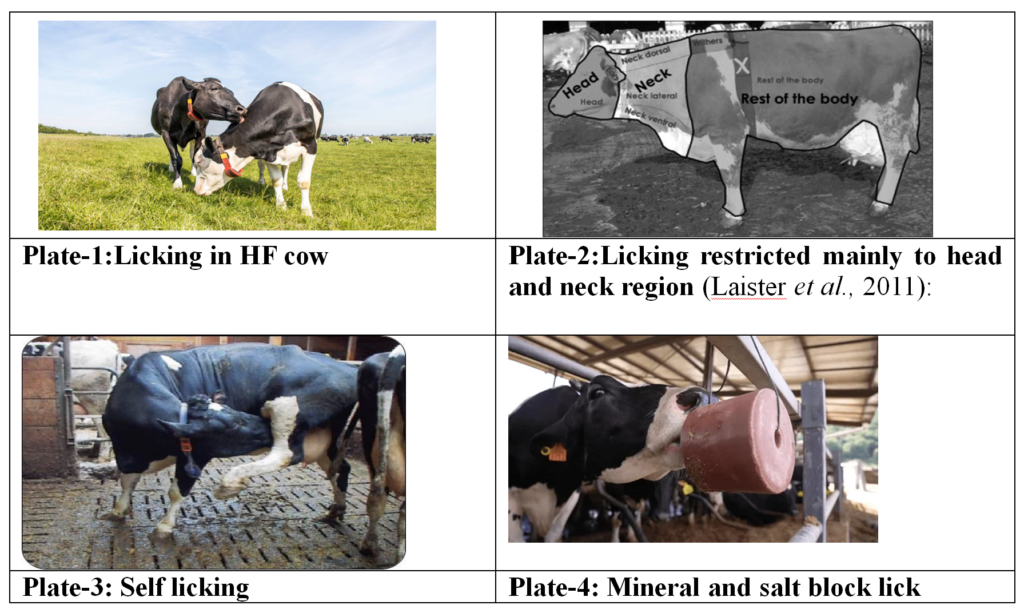
Self-licking: Cows lick themselves in order to remove dirt, dead hairs and parasites. Healthy cows are typically characterized by a clean, shiny coat maintained through regular self-licking.
Object licking: Cow frequently observed to lick inanimate objects like fences or mineral blocks. Licking salt blocks or minerals is natural drive to acquire necessary nutrients like sodium.
Abnormal licking behaviour: Frequent licking of objects (pica) or excessive self-grooming can sometimes indicate boredom stress or a dry barren environment.
Licking alternative: Grooming of animals using brush in place of direct lickingimprove cow scratching speed six times there by increase in blood circulation and milk production. Brush which are used for grooming include stationary, rotating and swinging brush type.
Inference:Licking is a complex behaviour in animals serve as vital, social, hygienic (dirt, dust, parasite removal) and physiological function. Licking can be used as a positive marker for within herd wellness.Types of grooming mainly include Social/allogrooming and maternal grooming. It is used to establish social bonds and reduce stress in animals. Licking directed mainly to head and neck regions. High level of social licking are positive sign of good animal welfare and stability. It creates calming in animal and good touch feel. Use of brush for grooming in place of direct lickingimprove cow scratching by six times there by increase in milk production. Brush which are used for grooming include stationary, rotating and swinging brush type. Reshuffling of group can be practiced by looking into licking pattern i.e., members of group if not licking each other, cluster may be reorganized keeping in view better management practices in place. Accelerometer commonly used for taking licking pattern and its recording.