By Roy Marissen, Global Technical Manager – Feed Efficiency, Orffa Additives B.V., The Netherlands. Sopaphan Pruekvimolphan, Technical Manager, Orffa (Thailand) Ltd.
High-producing cows need more metabolizable amino acids and stronger liver support, while heat stress, variable forage quality and lower dry-matter intake can widen the nutrient gap. The solution is not simply higher inclusion rate of feed additives. It is to deliver the right nutrient, in the right form, beyond the rumen. Methionine and choline are complementary, not interchangeable. Their pathways meet in methyl-group metabolism, but each has a different primary nutritional purpose.
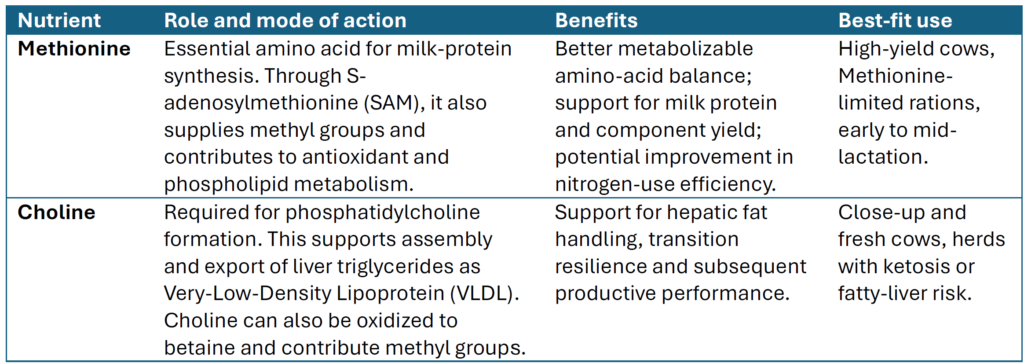
Effective delivery requires protection and release
Rumen microbes can use or degrade free methionine and extensively degrade unprotected choline, reducing the amount available beyond the rumen. Effective protection limits these losses, but protection alone is not enough: nutrients must also be released after leaving the rumen to become available to the cow. Effective delivery requires a balance: releasing nutrients too early leads to ruminal losses, while overprotection can limit post-ruminal availability. Key criteria for evaluating rumen-protected products are described in image below.
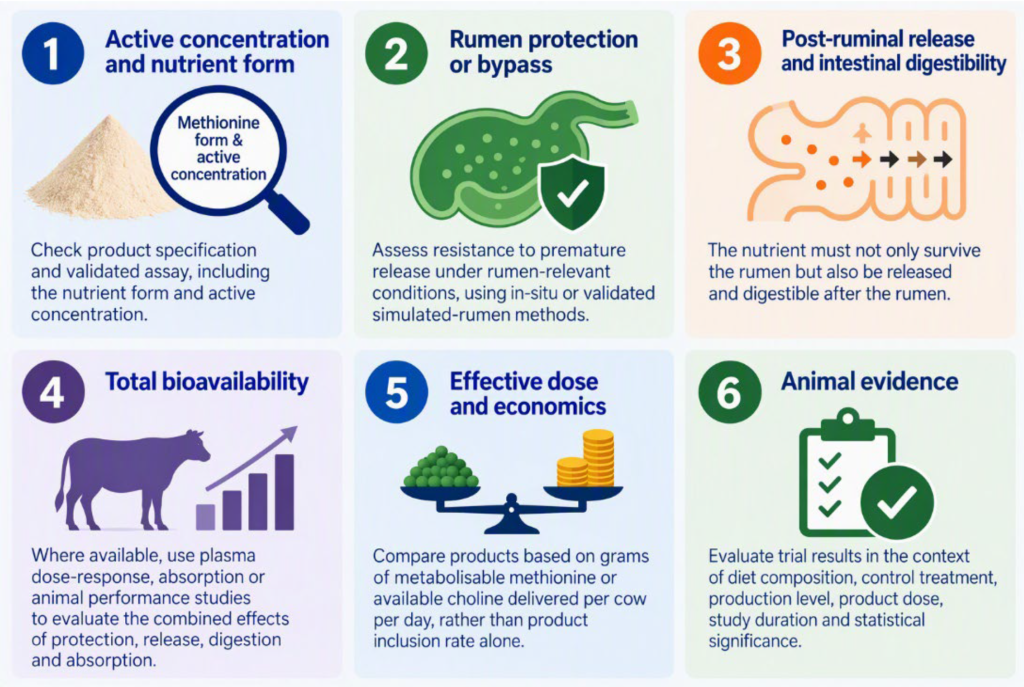
Key findings from scientific research
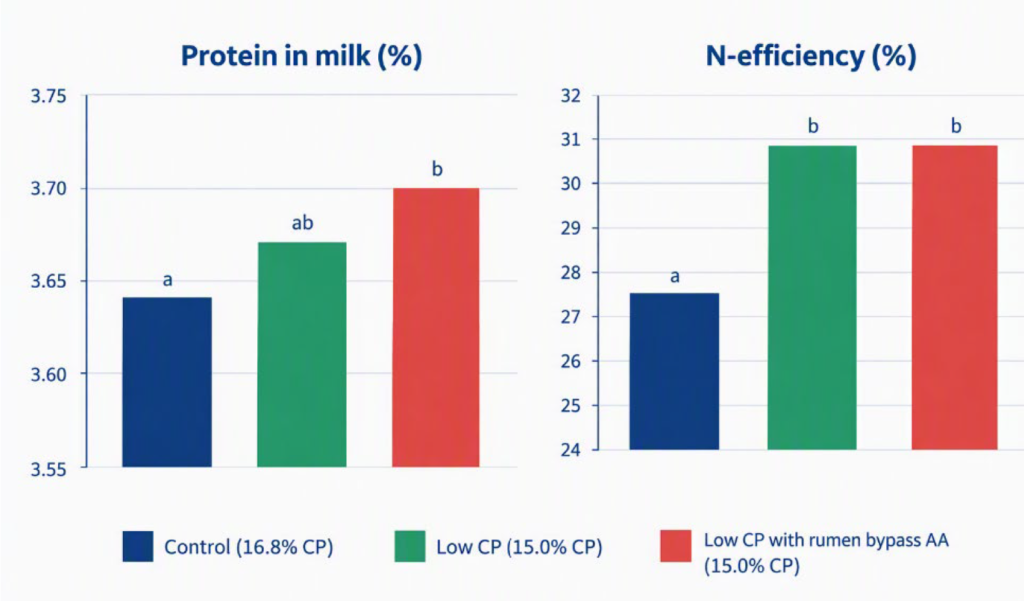
For methionine (Met), Patton, R.A. (2010) meta-analysis of 75 comparisons involving 1,040 dairy cows reported an average gain of 7.5 g of true milk protein per gram of additional metabolizable Met. Responses differed among commercial rumen protected methionine (RP-Met) products, emphasizing the importance of effective nutrient delivery rather than product dose alone. This finding provides a nutritional rationale for balancing low crude protein diets with RP-Met and rumen protected lysine (RP-Lys): supplying limiting amino acids can support milk-protein synthesis without relying solely on higher dietary crude protein. Consistent with this approach, Orffa study in Holstein Friesian cows found that Excential Rumenpass MET at 14.7 g/cow/d, combined with RP-Lys allowed dietary crude protein to decrease from 16.8% to 15.0% (less 0.5 kg soybean meal/cow/d), while maintaining milk production and increasing milk protein from 3.64% to 3.7% and nitrogen efficiency from 27% to 31%, providing feed costs reduction of lower dietary crude protein (Figure 1).
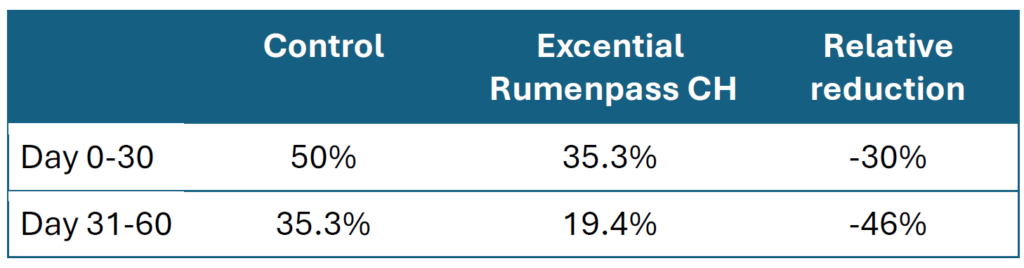
Choline’s liver-support role makes rumen-protected choline (RPC) product particularly relevant around calving, especially when metabolic pressure increases. In their review of 32 papers, Lunsin et al. (2024) suggested 45–50 g RPC products/cow/day from 3 weeks before to 8 weeks after calving as a potentially beneficial feeding approach. The review suggested that milk-yield increases by 10% or more, but may also depend on product characteristics, diet, and herd conditions. Orffa’s 2013 field trial also provides encouraging evidence for ketosis-risk management: cows receiving rumen-protected choline (Excential Rumenpass CH) had a lower proportion of milk fat % minus milk protein % > 1.25 percentage point (Table 1). This indicates a lower proportion of cows showing a milk-composition pattern associated with an elevated risk of subclinical ketosis.
Excential Rumenpass: delivery beyond the label claim
Excential Rumenpass MET
Specification: 60% DL-methionine, minimum, in a vegetable-fat protection matrix.
Practical dose: 10–20 g/cow/day.
Target use: Early to mid-lactation cows, especially for high producing animals and/or where low crude protein diet is practiced.
Measured delivery: Report conducted by Flanders Research Institute for Agriculture, Fisheries and Food (ILVO, Belgium) showed 95% rumen bypass and 77% digestibility of bypass methionine, which yielded 43.9 g intestinal digestible Methionine per 100 g Excential Rumenpass MET product), compared to specification of 90% and 70% minimum, respectively.
Excential Rumenpass CH
Specification: 25% choline chloride, minimum, in a vegetable-fat protection matrix.
Practical dose: 40-60 g/cow/day, providing 10-15 g/cow/day choline chloride.
Target use: Transition and early-lactation cows, especially where liver fat mobilization and metabolic pressure are concerns.
Measured delivery: Orffa has evaluated water dissolution, performance under simulated-rumen conditions, in-sacco incubation in fistulated cows and intestinal availability.
From biology to economic return
Precision nutrition beyond the rumen is about delivering usable nutrients, not simply adding more product. Rumen-protected methionine and choline offer complementary support for milk-protein production, nitrogen-use efficiency and liver fat metabolism. Realizing these benefits requires commercial products backed by scientific evidence of rumen protection, post-ruminal release and nutrient availability, applied according to production stage alongside sound management. Effective nutrient delivery can yield favorable returns when added milk and component income, feed savings or avoided health losses exceed supplementation costs.
Reference available upon request