• Feed Quality• Water Quality • Gut Health• Livability
Modern poultry production has evolved far beyond achieving rapid body weight gain. Today’s commercial broiler operations are expected to deliver superior feed efficiency, excellent livability, consistent flock uniformity, reduced antimicrobial dependence, and maximum economic returns despite increasing challenges such as heat stress, feed ingredient variability, pathogen pressure, and climate change.
Success under these conditions depends on four interconnected pillars:
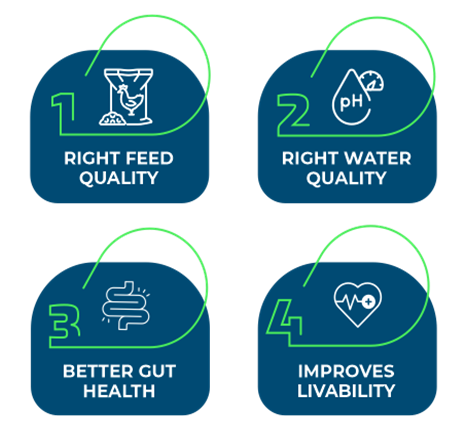
These pillars are not independent. An imbalance in any one of them can compromises the others, ultimately reducing production efficiency and profitability. Conversely, strengthening all four creates a resilient flock capable of expressing its full genetic potential.
1. Feed Quality: The Foundation of Productivity
Feed represents nearly 65–70% of total poultry production cost, making feed quality one of the strongest determinants of profitability.
However, modern poultry nutrition faces increasing challenges:
- Variable maize quality
- Fluctuating soybean meal protein
- Mycotoxin contamination
- Nutrient inconsistency
- Oxidized fats
- Poor pellet durability
- Anti-nutritional factors
Feed quality involves more than nutrient formulation.
It includes:
- Ingredient consistency
- Nutrient availability
- Digestibility
- Pellet quality
- Feed hygiene
- Free from contaminants
Proper storage
Suboptimal feed quality leads to:
- Reduced nutrient digestibility
- Gut inflammation
- Increased undigested nutrients reaching the hindgut
- Dysbiosis
- Wet litter
- Poor FCR
- Reduced growth performance
Maintaining stringent raw material quality control, precise feed manufacturing practices, and effective mycotoxin risk management is essential for maximizing bird performance. Equally important is optimizing feed moisture, as appropriate moisture levels preserve pellet quality, minimize processing losses and dust, improve palatability, and enhance nutrient stability, ultimately contributing to better feed efficiency and production performance.
2. Water Quality: The Most Overlooked Nutrient
Water is frequently underestimated as simply a hydration source, yet it plays a fundamental role in poultry health, productivity, and welfare. Broilers typically consume approximately 1.6–2.0 times more water than feed, and water intake increases substantially during heat stress. Poor water quality immediately affects feed intake, digestion, medication efficacy, and bird performance.
Water quality encompasses:
Physical parameters
- Temperature
- Turbidity
Chemical parameters
- pH
- Hardness
- Alkalinity
- Total Dissolved Solids (TDS)
Microbiological parameters
- Total bacterial count
- E. coli
- Coliform bacteria
Poor-quality drinking water can:
- Reduce feed consumption
- Lower pepsin activity at high pH
- Impair nutrient digestion
- Damage gut microbiota
- Reduce vaccine effectiveness
- Increase pathogen transmission
Recent research emphasizes that water management should integrate microbiological control, physicochemical stability, and functional support for gut health rather than relying on a single treatment strategy. Routine monitoring of water pH, microbial load, and sanitation should therefore be considered an essential component of flock health management.
3. Gut Health: The Biological Engine of Performance
The gastrointestinal tract is no longer viewed simply as a digestive organ. It functions as the largest immune organ, a metabolic centre, and the primary interface between the bird and its external environment. Approximately 70% of immune cells are associated with the intestinal tract,gut-associated lymphoid tissue (GALT) making gut integrity fundamental to disease resistance and nutrient utilization.
An ideal healthy intestine is characterized by:
- Gut integrity
- Gut immunity
- Gut microflora
Poor gut health results in:
- Dysbiosis
- Reduced nutrient digestibility
- Increased intestinal permeability (“leaky gut”)
- Greater pathogen colonization
- Poor FCR
- Wet litter
- Reduced growth rate
Modern nutritional strategies increasingly focus on maintaining microbial balance using probiotics, prebiotics, postbiotics, phytogenics, organic acids, enzymes, functional amino acids, and precision nutrition rather than relying solely on antibiotic growth promoters.
Healthy gut architecture directly translates into:
- Improved nutrient absorption
- Better feed conversion
- Enhanced immune function
- Increased resilience against stress
4. Livability: The Ultimate Measure of Flock Health
Livability represents the percentage of birds that survive and remain productive throughout the production cycle. While body weight and FCR are important economic indicators, livability reflects the cumulative success of nutrition, management, biosecurity, immunity, environmental control, and disease prevention.
Every percentage increase in mortality results in:
- Reduced saleable birds
- Increased production cost per kilogram of meat
- Poorer European Production Efficiency Factor (EPEF/EPI)
- Lower overall profitability
High livability is associated with:
- Strong immune competence
- Better vital organ support
- Lower incidence of metabolic/infectious diseases
- Reduced cellular stress
- Improved welfare standards
Modern poultry production therefore aims not merely to keep birds alive but to maintain healthy, productive birds capable of reaching their genetic growth potential.
Connecting the Four Pillars for Peak Performance
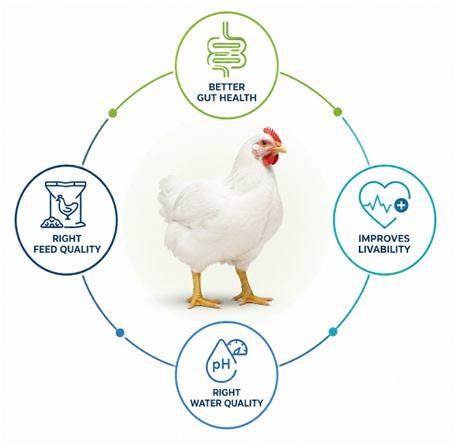
Right Feed quality, Right water quality, Better gut health and improved livability constitute an integrated biological system rather than independent management components. Each pillar influences the others through complex nutritional, physiological, microbial, and immunological interactions, collectively determining flock health, productivity, and profitability.
Feed quality provides the nutritional foundation for gastrointestinal development and function. Consistent ingredient quality, optimal nutrient availability, and high digestibility support intestinal integrity, maintain a balanced gut microbiota, and minimize the flow of undigested substrates to the hindgut. Conversely, poor-quality feed predisposes birds to dysbiosis, intestinal inflammation, reduced nutrient utilization, and impaired growth performance.
Water quality directly complements feed quality by facilitating digestion, nutrient transport, enzymatic activity, and metabolic processes. Microbiologically safe, chemically balanced water maintains intestinal microbial homeostasis, reduces pathogen exposure, supports water-administered therapeutic interventions, and enhances nutrient utilization. In contrast, contaminated or poor-quality water promotes biofilm formation, increases enteric pathogen load, compromises gut barrier function, and adversely affects flock performance.
Gut health represents the central biological interface linking feed and water quality with bird performance. An intact intestinal epithelium, balanced microbiota, efficient digestive function, and robust mucosal immunity optimize nutrient absorption while limiting pathogen colonization and inflammatory responses. Consequently, gut health acts as the primary mediator through which feed and water quality are translated into productive performance.Livability is the ultimate indicator of the successful integration of these three pillars. High livability reflects efficient nutrient utilization, optimal gastrointestinal function, effective immune competence, reduced disease incidence, and improved resilience to environmental and management stressors.
Conversely, disruption of feed quality, water quality, or gut health initiates a cascade of physiological disturbances that reduce growth performance, impair feed efficiency, increase mortality, and compromise overall flock productivity.
Therefore, sustainable poultry production requires a holistic management approach in which feed quality, water quality, gut health, and livability are recognized as interdependent components of a single biological continuum. Optimizing each pillar simultaneously creates synergistic improvements in health, welfare, production efficiency, and economic return, whereas failure in any one component inevitably compromises the integrity and performance of the entire production system.
Conclusion
Modern poultry production is no longer defined solely by rapid growth or excellent feed conversion. Sustainable success is achieved by strengthening the four fundamental pillars—Water Quality, Feed Quality.Gut Health and Livability
When these pillars function together, they create healthier birds, greater resilience against production challenges, improved nutrient utilization, enhanced flock performance, and superior economic returns. Ultimately, the future of poultry production belongs not to farms that simply grow birds faster, but to those that build stronger birds through integrated management of these four essential pillars.