Prof. Dr. R.N.S.Gowda*
In 2025, India’s poultry industry is characterized by strong growth projections and a stable outlook, driven by rising income, urbanization, and a preference for protein-rich foods. The market is expected to see revenue growth of 8-10% in FY2025, supported by investments in value-added products and backward integration. Challenges remain, including managing feed prices and disease outbreaks, but the industry is poised for resilience and growth through technological advancements, sustainable practices, and potential export opportunities. The chicken business has a significant impact on the in supplying the quality animal protein at a cheaper rate. Chicken eggs and chicken meat are both helped along by the industry’s commitment to quality control. The industry’s players are worried about the health care of the birds because of the rising food safety concerns. The poultry sector is able to keep better tabs on the well-being of its chickens, thanks to recent technology breakthroughs. With the use of Internet of Things (IoT)-based wearable sensing devices like accelerometers and gyro devices, avian diseases and chicken health may now be diagnosed via video surveillance, voice observations, and feces inspections.
Novel technologies for treating diseases in poultry include advanced genetics, microbiome manipulation, new-generation vaccines, and innovative diagnostic tools. These approaches are moving the industry beyond traditional antibiotics to address pressing issues like antimicrobial resistance, emerging pathogens, and improved animal welfare.
Genetic editing for disease resistance
Gene-editing technologies like CRISPR/Cas9 allow for the development of genetically resistant poultry, a permanent and highly effective solution for preventing viral infections.
- Avian Influenza resistance: Scientists have used CRISPR to alter the ANP32A protein in chickens, a crucial host factor for the avian influenza virus (AIV). Edited chickens show significant resistance to infection and limited viral spread.
- Avian Leukosis Virus (ALV) resistance: The NHE1 gene, which serves as a receptor for ALV subgroup J, can be precisely edited using CRISPR to make chickens resistant to the virus.
- New vaccine development: CRISPR is also used to engineer multivalent recombinant vaccines, which can protect against several different diseases at once.
Technological Advancements:
The industry is adopting advanced breeding techniques, automated feeding systems, and climate control in environmentally controlled (EC) sheds to improve efficiency and reduce mortality.
Latest poultry technologies focus on Artificial Intelligence (AI) for monitoring and prediction, automation and robotics for tasks like feeding and waste removal, Internet of Things (IoT) sensors for real-time data on environment and health, and blockchain for supply chain transparency and safety. Other advancements include gene editing to eliminate male chick culling, precision feeding systems, advanced waste management, and sustainable energy solutions to reduce environmental impact. Biosensors and wearable sensors are emerging as essential tools for detecting poultry diseases like avian influenza, Newcastle disease (ND), and infectious bronchitis.
Omics technologies, including genomics, transcriptomics, proteomics, and metabolomics, offer comprehensive molecular insights into poultry health and disease by studying entire sets of DNA, RNA, proteins, and metabolites (fig.1).
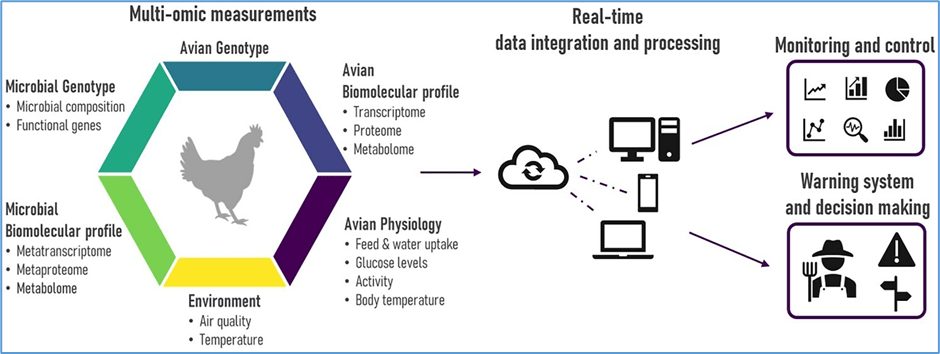
Fig:1. Overview of future integration of multi-omics measurements in precision livestock farming (PLF) technologies. (Source: Goossens, E., Dehau, T., Ducatelle, R., & Van Immerseel, F. (2022). Omics technologies in poultry health and productivity – part 2: future applications in the poultry industry. Avian Pathology, 51(5), 418–423. https://doi.org/10.1080/03079457.2022.2085545)
- Microbiome manipulation: Targeting the gut microbiome is a key strategy for enhancing immunity and preventing infections, particularly as an alternative to antibiotics. Microbiome manipulations are a promising approach for poultry disease diagnosis by using the microbiota’s response to disease as an indicator of infection and to predict outbreaks. By analyzing changes in the microbiome, researchers can identify a “dysbiotic state” (a perturbed microbial community) associated with specific diseases. Novel diagnostic tools are being developed to map the microbiome, enabling rapid and comprehensive data acquisition to assess health risks, sanitation, and the efficacy of treatments.
- Probiotics and prebiotics: The administration of beneficial microorganisms (probiotics) and their food sources (prebiotics) can improve the competitive exclusion of pathogens like Salmonella and Clostridium perfringens. This promotes a healthier gut, better nutrient absorption, and stronger immune response.
- Synbiotics and postbiotics: Research is also exploring synbiotics (combinations of probiotics and prebiotics) and postbiotics (non-viable microbial cells or their components), which offer similar health benefits without the viability challenges of live cultures.
- Phage therapy: Phages, which are viruses that kill bacteria, offer a targeted and natural alternative to antibiotics for treating bacterial infections.
- Targeted approach: Because phages are highly specific to their bacterial hosts, they can eliminate pathogens like Salmonella, Campylobacter, and E. coli while preserving the bird’s beneficial gut flora.
- Combinatorial treatments: Phage therapy can be delivered as a “cocktail” of different phages to prevent bacteria from developing resistance. It can be administered orally, through sprays, or as a feed additive.
- Improved food safety: Phages can also be used as a biocontrol agent on farms and in processing plants to reduce contamination of poultry products.
New-generation vaccines
Advances in vaccine technology offer more potent, stable, and convenient solutions for controlling infectious diseases.
- Vector vaccines: These “Trojan horse” vaccines use a harmless virus (the vector) to deliver protective genes from a pathogen, stimulating a strong and safe immune response. Examples include trivalent vaccines that protect against Marek’s, infectious bursal, and Newcastle diseases in a single shot.
- DNA and mRNA vaccines: These nucleic acid-based vaccines instruct the bird’s cells to produce specific antigens, triggering an immune response. They are quicker to produce than conventional vaccines, and mRNA versions are particularly high-potency.
- Nanostructures in vaccines: Nanoparticles are being explored as delivery systems to ensure the controlled release of antigens and enhance the immune response, offering improved efficacy and longer-lasting protection.
Precision poultry farming
Precision farming technologies enable real-time health monitoring and early disease detection, allowing for rapid intervention.
- Biosensors and wearable sensors: Biosensors provide accurate diagnostic information about specific pathogens, while wearable sensors can track physiological and behavioral changes—such as body temperature and movement—to alert farmers to potential infections like avian influenza.
- Vocalization analysis: Artificial intelligence (AI) can analyze flock vocalizations to detect subtle changes indicating respiratory infections like Newcastle disease or infectious bronchitis.
Conclusion
Novel technologies for poultry disease treatment include targeted therapies like bacteriophage therapy for bacterial infections, advanced vaccine technologies using recombinant DNA for broader protection, and biosensor systems for rapid diagnostic and early disease detection. Artificial intelligence and IoT sensors offer real-time monitoring for early detection, while natural compounds such as botanicals and essential oils are being explored as alternatives to synthetic drugs. Nanoparticles and microencapsulation are also used to improve the stability and delivery of these therapeutic agents. (Author Acknowledges the Google support ) *Former and Founder VC, KVAFSU, Bidar, Former Director IAH^VB ,Bangalore, Former Prof &HOD .Dept. of Pathology. Veterinary College UAS, Bangalore.