


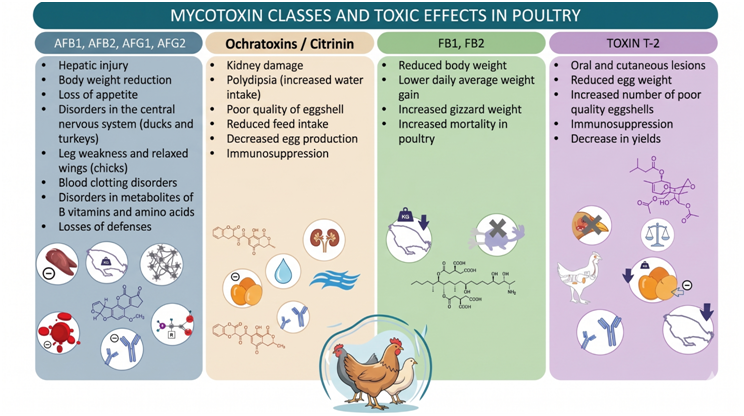
Mycotoxin exposure is nearly impossible to avoid because fungal growth and subsequent toxin production can occur at multiple stages of the feed chain: during field crop production, grain storage, transportation, or feed processing. Due to their high thermal stability, these toxins often remain within feed ingredients even after the fungal source has been eliminated. Consequently, they can enter the food chain through animal products such as meat, eggs, and milk (Devegowda et al.,2005)
The relationship between fungi and toxins is complex; a single fungal species can produce multiple types of toxins, and conversely, the same mycotoxin can be synthesized by different fungal genera. For instance, aflatoxins are primarily produced by Aspergillus flavus and Aspergillus parasiticus, while Ochratoxin A can originate from both Aspergillus and Penicillium species. Based on when contamination typically occurs, these toxins are generally classified into two broad categories: field-based and storage-based, though some may develop during both phases.
Conditions Favoring Mycotoxin Production:
The production of mycotoxins is influenced by both abiotic and biotic factors.
Abiotic Factors:
Fungal growth and mycotoxin production are mainly influenced by moisture, temperature, pH, and atmospheric conditions. Water activity (aw) is the most critical factor, with storage fungi such as Aspergillus and Penicillium producing aflatoxins and ochratoxins, while Fusarium and Alternaria require higher moisture and mainly contaminate crops in the field. Temperature also plays an important role, and climate change is increasing aflatoxin occurrence in temperate regions. Most mycotoxigenic molds grow best at pH 4.5–6.8, while low oxygen and CO₂ levels above 40% can suppress fungal growth and toxin production.
Water Activity and Temperature Requirements:
The relationship between water activity (aw) and temperature for the production of major mycotoxins is summarized in the table below:
| Mycotoxin | Water Activity Range (aw) | Optimum aw | Temperature Range (°C) | Optimum Temperature (°C) |
| Aflatoxins | 0.82–1.00 | 0.96–0.99 | 10–40 | 25–30 |
| Ochratoxin A | 0.80–1.00 | 0.96–0.99 | 10–35 | 20–30 |
| Fusarium | 0.92–1.00 | 0.97–1.00 | 10–35 | 18–28 |
Source: Vet Topics. Management of mycotoxins in animal production (2020) by Antonio Ramos Girona, Sonia Marín Sillué and Pepi et al (2022)
Biotic Factors:
The amount of fungal inoculum present in fields or storage facilities is directly related to toxin concentration. Interactions among fungal species may be synergistic or antagonistic, influencing both mold growth and toxin production. Interestingly, not all fungal strains are toxigenic, which has enabled the use of non-toxigenic strains as biological control agents in agriculture. Crop variety and host susceptibility also significantly influence contamination levels.
Pesticide Residues in Animal Feed:
In addition to mycotoxins, pesticide residues are emerging as another major concern in poultry production systems. India faces a significant pesticide contamination challenge despite relatively low pesticide usage (600 g/hectare) compared to developed countries (3000 g/hectare). Among 293 registered pesticides, more than 100 are still used despite international restrictions or bans. Chlorpyrifos and cypermethrin are among the most frequently detected compounds (Keshri et al., 2025).
More than 95% of applied pesticides fail to reach their intended targets, contaminating soil, water, and air. These chemicals subsequently bioaccumulate within the food chain and may appear in livestock products such as meat, milk, and eggs. Chronic exposure can lead to immunosuppression, reproductive failure, endocrine disruption, developmental abnormalities, and cancer (Kumar et al.,2019 and Keshri et al., 2025)
Common pesticide residues in animal feed pose various health risks, categorized by class. Organophosphates (OPs), such as malathion, diazinon, and Chlorpyrifos, are widely used compounds commonly found in cereal grains and processed feeds; they inhibit acetylcholinesterase activity, causing neurotoxicity and metabolic disturbances. Organochlorines (OCPs), including DDT, endosulfan, lindane, and aldrin, are persistent and bioaccumulative chemicals contaminating oilcakes and fodder, leading to neurotoxicity and reproductive disorders. Less stable carbamates (e.g., carbaryl and aldicarb), found in forage crops, are associated with acute toxicity and tremors, while pyrethroids (like cypermethrin and deltamethrin), common in stored feed, cause mucosal irritation and nervous disorders.
| Pesticide Class | Representative Compounds | Feed Sources | Health Effects | Remarks |
| Organochlorines | DDT, Endosulfan, Lindane, Aldrin | Oilcakes, fodder | Neurotoxicity, reproductive disorders | Persistent and bioaccumulative |
| Organophosphates | Malathion, Diazinon, Chlorpyrifos | Cereals, green fodder | Acetylcholinesterase inhibition | Widely used |
| Carbamates | Carbaryl, Aldicarb | Forage crops | Tremors, acute toxicity | Less stable |
| Pyrethroids | Cypermethrin, Deltamethrin | Stored feed | Mucosal irritation, tremors | Common in feed storage |
| Herbicides/Fungicides | Atrazine, Mancozeb | Silage and fodder | Liver and hormonal effects | Rarely monitored |
Summary of Common Pesticides in Animal Feed (Kumar et al.,2019 and Keshri et al., 2025):
Prevention and Mitigation Strategies:
There is currently no highly effective treatment for acute mycotoxicosis; therefore, prevention remains the most practical strategy (Pepi et al .,2022 and Attia et al., 2025)
Key strategies for prevention include:
- Implementing rigorous grain drying and storage protocols
- Regulating moisture levels and temperature within storage facilities
- Continuously tracking water activity
- Applying biological control agents and fungicides
- Managing atmospheric conditions during storage
- Conducting routine screenings of raw feed components
- Incorporating dietary additives designed for toxin sequestration
Toxin-binding feed additives play a vital role in modern poultry nutrition by managing mycotoxins, bacterial toxins, pesticide residues, and other chemical contaminants. Advanced ingredients such as activated phyllosilicates and Polyvinylpyrrolidone homopolymer (PVPP) utilize high surface area, adsorption capacity, and charge density to bind toxins through chemisorption and physisorption. The inclusion of organic acids and surfactants further enhances binding efficiency by increasing surface activation and polarity within the gastrointestinal tract.
A multi-functional formulation combining activated phyllosilicates, PVPP, organic acids, surfactants, hepatic stimulants, and biotransforming agents offers comprehensive dual-phase toxin management. This approach integrates Combined Toxin Adsorbent (CTA) and Continuous Activation Mechanism (CAM) technologies to manage toxins before and after absorption. CTA technology provides broad-spectrum adsorption of mycotoxins and chemical pollutants, while CAM technology stabilizes and enhances binding activity. Hepatic stimulants and biotransforming agents further support detoxification by promoting liver function and toxin excretion. This integrated 360-degree strategy supports gut integrity, liver health, feed efficiency, and poultry productivity under multi-toxin exposure.
The efficacy of this formulation was validated through both in vitro and in vivo evaluations. In vitro testing involved 10 mg of product against aflatoxin (200 ppb), ochratoxin A (2 ppm), zearalenone (200 ppb), fumonisin (2 ppm), T2 toxin (2 ppm), malathion (200 ppb), and fipronil (200 ppb). HPLC analysis at pH 3.0 and 6.5, simulating gastrointestinal conditions, confirmed effective binding of all tested mycotoxins and pesticides.
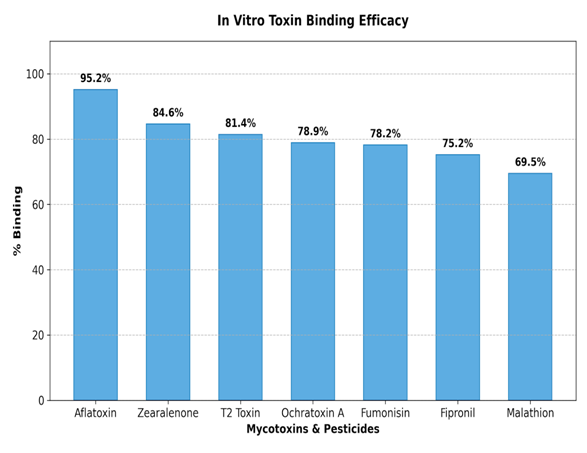
A residue depletion study under high malathion contamination (50 ppm) further demonstrated complete elimination of detectable malathion residues from liver and thigh tissues, confirming the formulation’s strong detoxification and residue reduction capabilities.
Conclusion
The presence of pesticide residues and mycotoxins poses substantial risks to the safety of food products, poultry productivity, and bird health. While the ongoing issue of persistent pesticide contamination remains a global challenge for livestock sectors, the synthesis of toxins is heavily dictated by environmental variables, including temperature, moisture levels, and specific storage protocols. Successfully mitigating these risks necessitates a comprehensive strategy that encompasses consistent monitoring, optimized feed storage, the use of biological control methods, and enhanced farming techniques. Furthermore, employing toxin binders that incorporate pesticide-binding capabilities offers a 360-degree protective shield. Robust feed safety initiatives are vital for sustaining poultry performance and ensuring the safety of animal-derived foods for human consumption.
Reference will be available on request.