
Environmental changes cause immuno-suppression and make the birds more prone to viral infections. These viral challenges namely Newcastle disease (ND), avian influenza (AI), infectious bronchitis (IB), and others—continue to impose a significant threat to the poultry industry worldwide, resulting in substantial economic losses through high mortality rates, reduced productivity, increased operational costs, and market disruptions.

While vaccination remains a cornerstone of prevention programs, the industry increasingly recognizes that vaccines alone cannot guarantee full protection, especially when antigenic drift, immunosuppressive stressors, and variability in field exposure undermine immunization efficacy. Hence, the poultry sector is steadily integrating nutritional strategies that strengthen birds’ natural defence systems. Among these, feed-based solutions aimed at enhancing mucosal defence have emerged as a powerful, sustainable, and cost-effective approach.
Understanding the Role of Mucosal Immunity
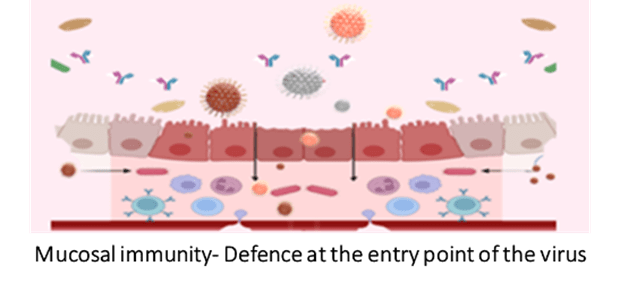
Nearly all kinds of viruses invade the animal’s body through the mucous membrane.The mucosal surfaces of poultry—including the gut, respiratory tract, and reproductive system—serve as the first line of defence against pathogens. To reinforce the mucous immunity system means to effectively inhibit viral invasion and infection.
Unlike humoral immunity, which becomes active only after an antigen enters the bird’s body through vaccination or when pathogens reach the bloodstream, mucosal immunity works at the point of entry. By neutralizing pathogens before they cross epithelial barriers, mucosal immunity significantly reduces both the incidence and severity of infections.
Key components of mucosal immunity include:

- Mucus layer: Forms the first protective barrier at mucosal surfaces. Mucin, a structural protein (lubricant) in the mucus layer secreted by goblet cells entraps viral particles and inhibit epithelial adhesion and penetration.
- Secretory IgA (sIgA): The most important antiviral antibody at mucosal sites. sIgA binds to viral antigens, neutralizes them extracellularly and intracellularly, and prevents attachment and entry into epithelial cells.
- Tight junction proteins: Tight junction proteins (claudins, occludin, ZO-1) function as selective permeability regulators that prevent paracellular leakage. Viral pathogens frequently disrupt TJ integrity to facilitate epithelial invasion. Enhanced TJ expression strengthens the mucosal barrier, limiting viral penetration and subsequent viremia.
Collectively, these components ensure rapid, localized immune responses, thereby enhancing disease resistance and overall flock resilience.
Importance of Feed-Based Mucosal Defence Approaches
Vaccination remains vital, but it mainly stimulates systemic (humoral) immunity. For pathogens that enter through mucosal sites—such as Newcastle disease virus, avian influenza, IBV, and enteric viruses like rotaviruses, reoviruses —vaccine response alone may not be enough to prevent initial infection or viral shedding. Compounding factors such as heat stress, mycotoxins, poor gut health, high stocking density, and poor litter conditions further compromise mucosal barrier function.
Feed-based mucosal defence solutions offer several advantages:
- Sustained immunological support throughout the production cycle
- Modulation of mucosal cytokine expression and lymphocyte activation
- Non-invasive and stress-free administration
- Synergy with vaccination, improving both mucosal and systemic responses
- Reduced viral replication and shedding, lowering infection pressure in flocks
- Improved gut health, supporting nutrient absorption and performance
These attributes justify the integration of functional feed additives in comprehensive disease prevention programs.
VAP™ Premix- The Next-Gen Feed-Based Mucosal Defence Strategy
VAP™ (Versatile Adhesion Polypeptide) is a scientifically designed natural non-toxic functional feed additive that enhances mucosal immunity through multiple pathways:
- Activates B-cells (IgA production) and T-cells (memory & phagocyte response) for early protection, synergizes with M-cells for stronger defense.
- Assists the immune system in targeting environmental viruses, making it less susceptible to viral mutations.
- Activates the immune system early, before the virus replicates extensively within the body, effectively reducing the damage to the bird.
Research Evidence and Field Validation
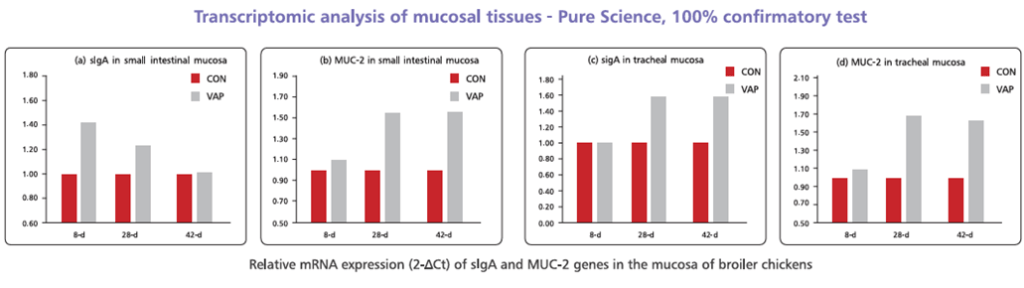
A recent broiler trial at Agrivet Research & Advisory, Kolkata (ARAPL Trial ID: 290-GLB-1/June-25) revealed that supplementation with VAP™ Premix at 250 mg/kg feed effectively enhanced broiler growth performance with upregulation of local mucosal defence mechanisms (sigA and MUC-2), coupled with maintained or improved vaccine responses, significantly higher livability, and lesser COP per kg live wt.
Several other trials in Taiwan showed VAP™ intake improved T-cell count and reduced intestinal inflammation in Zebrafish and significantly increased IgA response in mice.
Another very interesting study conducted at National Laboratory Animal Centre, Taiwan showed VAP™ supplemented mice, experimentally challenged with AI viruses (H5N1 and H7N9, a 1:1 virus mixture with a viral load of about 50,000 viruses per ml. of liquid)) did not develop any respiratory symptoms even after 96 hours, indicating strong antiviral mucosal protection.
These collective findings highlight VAP™ Premix as a promising nutritional intervention to work as a shield against virus with strengthened immunity and ensure support health and productivity.
Way forward
In the face of escalating viral challenges and the growing emphasis on welfare-focused poultry production, strengthening mucosal immunity through precision nutrition is no longer optional—it is essential. Feed-based mucosal defence solutions such as VAP™ Premix offer a vital bridge between nutrition and immunology, enabling proactive protection rather than reactive interventions. By reinforcing mucosal immunity—the bird’s first line of defence—producers can safeguard flock health, enhance productivity, and build resilience against emerging viral threats. Ultimately, this approach supports a more sustainable, responsible, and profitable poultry production system for the future.