Harnessing the power of plant-based micro-encapsulated technology for enhanced milk yield and farm profitability
In the ever-evolving landscape of agriculture, dairy farming remains a cornerstone of global food production, providing essential nutrients to millions of people. However, with fluctuating milk prices, rising operational costs, and increasing pressure to adopt sustainable practices, the economic viability of dairy farms is now more closely tied than ever to maximizing milk yield. Achieving higher yields per cow is not merely a matter of increasing productivity; it has a direct impact on the profitability and long-term sustainability of dairy operations. By leveraging advanced breeding techniques, optimizing feed quality, and implementing innovative herd management strategies, farmers can significantly enhance milk production, ensuring their businesses thrive in an increasingly competitive market. This article explores the critical factors influencing milk yield and the economic benefits that result from strategic improvements in dairy farming practices.
Insulin’s Role in Dairy Cow Metabolism
Insulin plays a crucial role in the metabolism of dairy cows, acting as a key regulator in the partitioning of nutrients between body reserves and the mammary gland. Under normal physiological conditions, insulin promotes the uptake and storage of glucose and other nutrients in body tissues, such as muscle and fat. However, during lactation, the cow’s metabolic priorities shift to support milk production. A downregulation of insulin sensitivity, particularly in peripheral tissues, can lead to a greater allocation of nutrients like glucose and amino acids toward the mammary gland, rather than being stored in body reserves. This metabolic adaptation is beneficial for dairy cows, as it enhances feed efficiency by directing more nutrients to milk synthesis, ultimately improving milk yield. By understanding and managing insulin dynamics, farmers can optimize feeding strategies to support higher milk production without compromising the cow’s overall health. Such strategy can be used to ensure the optimal start during early lactation but also to extend the peak of lactation and boost productivity during mid-lactation.
Innovative Feed Additives for Enhanced Milk Production
Recently, a pioneering feed additives company (NUQO©) introduced a new technology (hereafter ‘NQ Technology’), which leverages advanced micro-encapsulation manufacturing and the combination of different fractions from spices, rich in in capsaicin, a potent active molecule. This product is designed to enhance milk yield in dairy cows by safely delivering active ingredients specifically to the lower gut, and ensuring effective nutrient utilization. Unlike other spicy products, this formulation is safe to handle and targets milk production by improving feed efficiency.
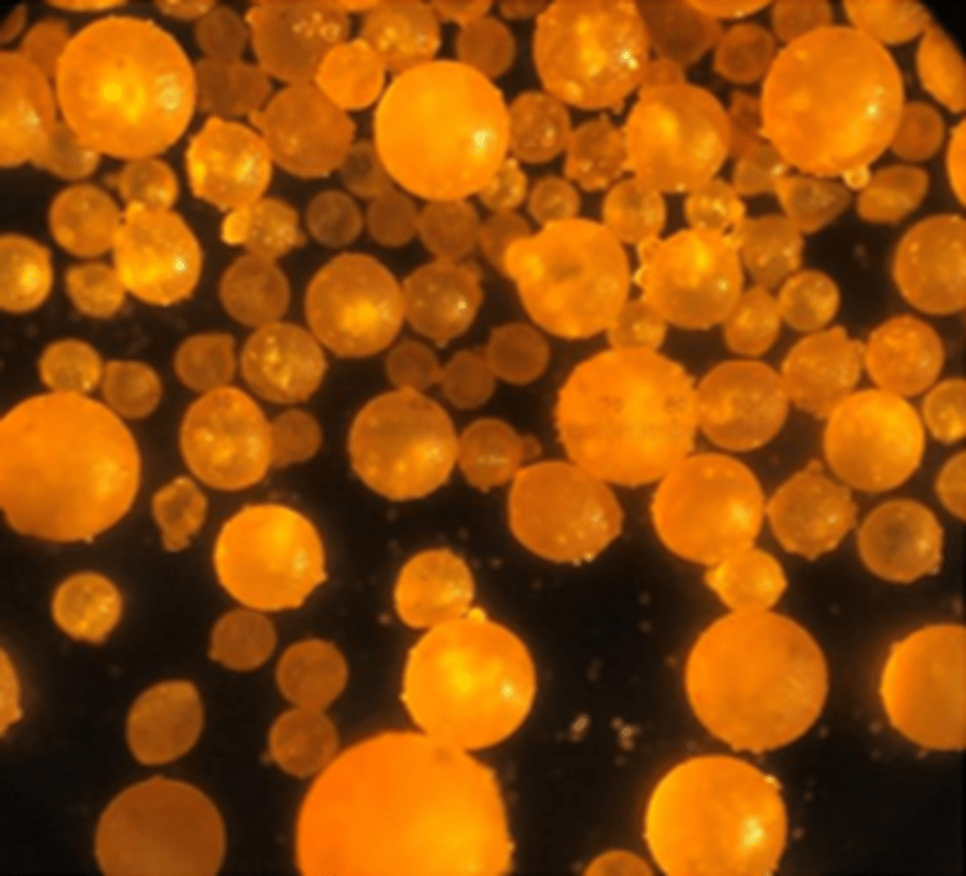
NQ Technology has shown consistent effectiveness in improving feed efficiency and milk yield, driving up the profitability of dairy farms. Compared to other spice-based technologies or feed additives, NQ Technology offers several advantages: it is safer for users, more stable, and more cost-effective due to its innovative micro-encapsulation process. This process ensures the optimal protection and release of active ingredients throughout the product’s journey. The technology’s ease of use, low inclusion rate, and compatibility with other ingredients make it a practical and economically attractive option for dairy farmers. Nutritionists and feed formulators have found that it combines well with other technologies and additives, allowing for customized solutions that address various aspects of dairy cow health and productivity.
A silver bullet to secure Early Lactation and boost mid-lactation
During the transition phase and early lactation, dairy cows undergo significant metabolic changes. They must mobilize resources and nutrients to increase milk production while maintaining overall health. Often, dry matter intake is inadequate during this period, forcing cows to rely on their own reserves to fuel milk production, leading to reduced body condition scores (Hoffmann et al. 2000). Nutrient supply, particularly glucose, becomes a limiting factor for supporting milk production (Piepenbrink & Overton, 2001). Effective management of this phase is critical to ensure a successful transition to increased milk production. Understanding how to promote the flow of nutrients, especially glucose, to support lactation demands is essential for maintaining productivity, during early but also later during mid-lactation
NQ Technology, with its high content of protected capsaicinoids, offers a novel approach to nutrient partitioning in dairy cows. Capsaicinoids are known to decrease serum insulin levels without altering glucose levels, as observed in both rats (Halloran 2020) and in cows (Oh 2017). Lower serum insulin levels result in a diminished uptake of glucose by peripheral tissues and an increase in liver gluconeogenesis. This metabolic shift enables the mammary gland, which is not insulin-sensitive, to utilize available glucose more effectively for milk production. By reducing insulin secretion, capsaicin helps redirect glucose utilization towards milk synthesis, enhancing feed efficiency in lactating dairy cows. Studies consistently show that capsaicin reduces insulin secretion by activating TRPV1 receptors, which in turn increase the expression of CGRP neuropeptide. CGRP affects pancreatic β-cells, leading to decreased insulin secretion. This interaction within the small intestine ultimately modulates glucose metabolism and nutrient flow among different body tissues, prioritizing milk production without compromising overall glucose levels.
Field Trials and Results
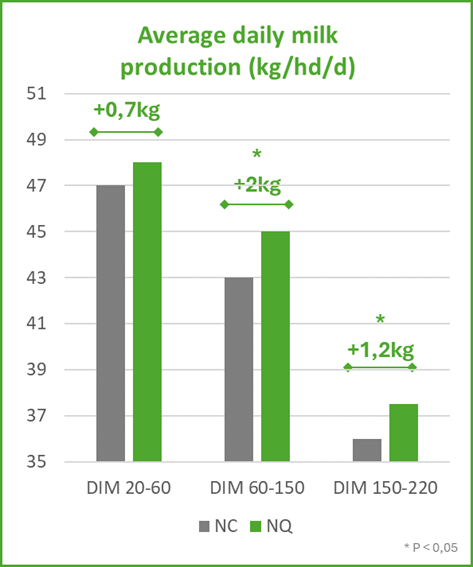
Several trials across the world have confirmed the efficacy of NQ Technology in enhancing the performance and profitability of dairy cows. For instance, in a recent winter 2024 trial at a Belgian dairy farm, two similar groups of cows were paired and fed either a standard diet (NC) or the same diet supplemented with 0.5g/hd/d of NQ Technology (NQ). Over six weeks, milk production and quality were measured daily, and body condition scores were assessed at the start and end of the study.
The results showed that cows fed NQ Technology produced an average of 1.5kg/hd/d more milk than those on the control diet. The most significant increase was observed in cows between 60 and 150 days in milk at the start of the trial, with these cows producing an additional 2kg/hd/d. NQ Technology was particularly effective in extending the lactation peak, with milk from cows fed NQ Technology also showing a higher average fat percentage compared to the control group. Despite the increased milk production, there was no dilution of milk quality, and protein percentages remained similar between groups. Additionally, there were no significant differences in body condition scores between the groups, indicating that the higher milk yield did not come at the expense of cow health.
Conclusion
As the dairy industry faces increasing challenges, including economic pressures and the need for sustainable practices, technologies like NQ Technology offer a promising solution for maximizing milk yield. By enhancing feed efficiency and supporting nutrient partitioning, NQ Technology helps farmers achieve higher milk production without compromising cow health. With its innovative mode of action, safety, and cost-effectiveness, NQ Technology is becoming an essential tool for dairy nutritionists seeking to improve the profitability and sustainability of dairy operations. In a competitive market, embracing such technologies is not just beneficial; it is imperative for the long-term success of dairy farming.

Dr Stephanie Ladirat
R&D Director, NUQO©