Parminder Singh
Consultant-Precision Livestock Nutrition Ludhiana
The success of livestock farming is largely dependent on the continuous supply of good quality nutritious feeds at competitive price. Feed alone constitutes about 60-65 per cent of total cost of production of livestock products. Therefore, it needs more attention though other factors are also important for remunerative return from livestock enterprises. Dairy branded feed is catering to only20-22 percent of potential in India because most of the farmers make homemade feed or get the feed customized according to their choice of ingredients. In contrast 85% broiler and 35%-layer branded feed is being used pan India, resulting in production of 2 kg plus broilers with FCR around 1.5 in 35 days and above 300 eggs per annum in commercial flocks. So there are ample opportunities to start new feed mill so that scientific feed is made which in turn will reduce the cost of rearing by increasing the performance and side by side reduction in diseases.
India’s animal feed industry, which is currently at $25 billion, is poised to double and touch $ 40 billion in the next five years to cater to the growing protein requirements of the country, a report published by Yes Bank. The per capita meat and milk consumption is growing, especially in China and India, and is projected to remain high in the European Union, North America, Brazil and Russia. With changing income levels and more people eating fish, meat and chicken, there will be a higher requirement of processed dairy, aqua and poultry products, which in turn will result in higher feed requirement.
With multinational companies eyeing the lucrative Indian markets, the animal feed industry in India will have to increase their capacities keeping in mind the quality issues to leverage on the growing demand for compound feed. According to estimates by leading industry sources, the demand for animal protein and dairy products in India will increase the compound feed consumption volumes to 45 million tons by 2030. In India, at present, cattle accounts for 11.5 million tons, aqua industry consumes 4 mt while the poultry industry consumes around 19 mt of the feed, with soy meal and corn being the prime consumables. In volume terms, at present, an estimated 36 mt of feed is required in the country. Policy measures also needed to be taken to improve milk productivity of cattle which stood at 7-10 liters against 25-30 liters globally. The feed sector in India is at an inflection point with the emergence of modern dairies ranging from 50 animals to upwards of 500 animals.
Punjab produces 14.01 million ton of milk per annum. The annual growth rate of milk production is around six percent and the per capita availability of milk is 1172 g per day. To produce this amount of milk, there is need of around 88.2 and 5.5 million ton of green fodder and concentrate respectively. There is deficit of 23.7 percent in fodder and 35.6 percent in concentrate availability. This gap between demand and supply is likely to widen further due to increased pressure to grow more food grains, oilseeds, pulses and commercial crops resulting into no increase in area under forage crops.Similarly, there are 76 lakh broilers and over one crore layers in Punjab producing 3350 million eggs per annum. Poultry alone needs 6.0 million ton of feed per annum.
Financial Assistance
NABARD is an apex institution for all matters relating to policy, planning andoperations in the field of agricultural credit. For feed processing plant with very large outlay, adetailed project reports will have to be prepared. Banks provide financial assistance for thefollowing purposes.
(a) Construction of factory building, godowns for raw materials as well as for finished products,office, canteen, generator room, essential quarters,etc.
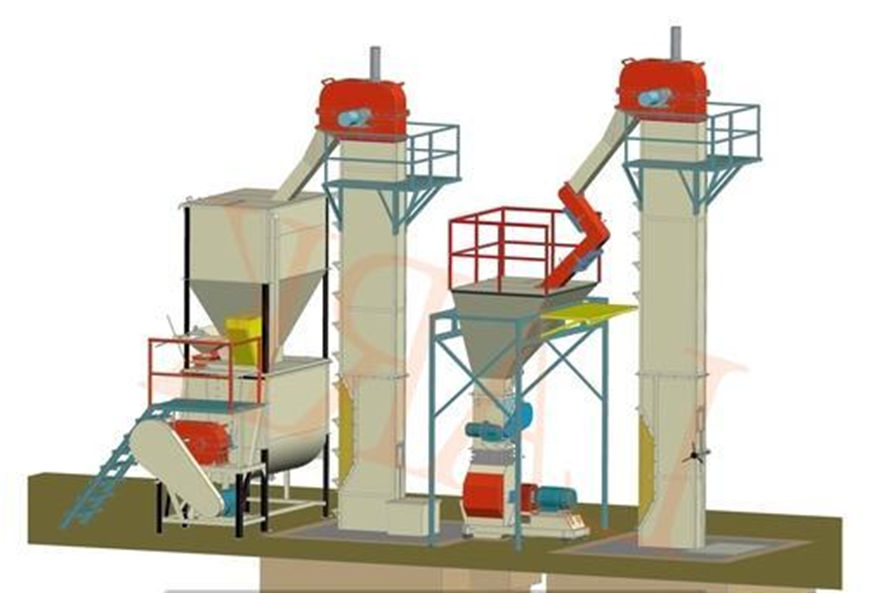
(b) Purchase of equipments such as grinder, feed mixer, pelletizer, elevators, feed packing units,etc.
(c) Miscellaneous equipments such as transformer, generators, weighing scales vehicles etc.
(d) Margin money for working capital requirement for one cycle of operation. The cost of land is not considered for loan. However, if land is purchased for establishing a feed processing plant, land cost can be treated as party’s margin money up to a maximum of 10 per cent of the total cost of project.
(a) Technical Feasibility:
This would briefly include:
(i) Availability of raw material such as grains, brans, oil cakes, mineral mixture, molasses, vitamins, etc.
(ii) Feed formulation and technical norms
(iii) Infrastructure available for feed testing, procurement of raw material, marketing of different feeds, experience of the entrepreneur.
(b) Financial Viability:
This would briefly cover:
(i) Project outlay, sources of funds and loan requirement
(ii) Raw material cost, expenses on fuel, labour, transport commission to be paid and other overheads
(iii) Output costs i.e. quantity and sale price of different feeds, number and sale price of empty gunny bags.
(iv) Income Expenditure statement and annual gross surplus
(v) Cash flow analysis – Benefit cost ratio(BCR), Net present worth (NPW) and Internal rate of return (IRR)
(vi) Repayment Schedule i.e. Repayment of principal loan amount and interest Other documents such as loan application forms, security aspects, margin money requirements,etc. are also examined.
A field visit to scheme area is undertaken for conducting techno economic feasibilitystudy for appraisal of the scheme.Sanction of Bank loan and its disbursement: After ensuring itstechnical feasibility and financial viability, the scheme is sanctioned by the Bank. The loan isdisbursed in two or three stages against construction of various civil structures, purchase of plantand machinery, miscellaneous fixed assets and margin money for working capital requirements. Constant follow up and supervision of the scheme is done by the Bank.
LendingTerms
i) Unit Cost: The Unit Cost depends upon the capacity of the feed mixing unit, type of feeds to be manufactured and also the infrastructure required.
ii) Margin Money:In case if the feed mixing unit is integral part of the commercial poultry or dairy scheme, the down payment is based on the category of beneficiary. However, in respect of feed processing plant of larger size, the margin money is normally 25 per cent of the total cost of theproject.
iii) Interest Rate:It depends upon the RBI guidelines and also the individual banks. The present rate of interest for 2.00 lakhs and above is linked to primary lending rates of banks which vary with the type of investment, beneficiary and also the credit rating.
iv)Security:
Security will be as per RBI guidelines issued from time to time.
v) Repayment period of loan: It depends upon the gross surplus generation in the scheme. The loan will be repaid in suitable monthly or quarterly installments usually within a period of 5-7 years. Wherever required, the grace period is also considered.
vi) Insurance: The building and other assets such as poultry sheds, equipments may be insured against natural calamities.
Format of bankable project for feed plants
It should cover the name of the company, location of plant, activities, products, capacity of plant andproject outlay.
Company: It should cover the location of registered office, date of formation, registration and authorized share capital. It should also cover the date of incorporation and commencement of business, the objectives, areas of operation, subscribed share capital.
Promoters and their background: Name and address of promoters, their background, experience and net worth.
Management of the company: Persons looking after the day-to-day management, their background, experience,etc. should be covered.
ProjectProfile:
i) Land and location: This should cover the area of land, location of the plant, distances from nearby town, availability of approach roads, power and water supply and other communication including schools, banks, hospitals,etc.
ii) Civil Structures:Name of the Architect, type of structures proposed, drawings and detailed cost analysis of various civil structures along with the present position of implementation may be indicated.
iii) Plant and Machinery:The major plant and machinery (imported and indigenous separately), sources of supply, specifications and quotations for various items of equipment need to be given.
iv) TechnicalCollaboration: The name of the technical collaborators for monitoring and marketing of the products along with their addresses and the type of collaborations should be indicated. Technical collaboration fee/royalty to be paid should also be indicated.
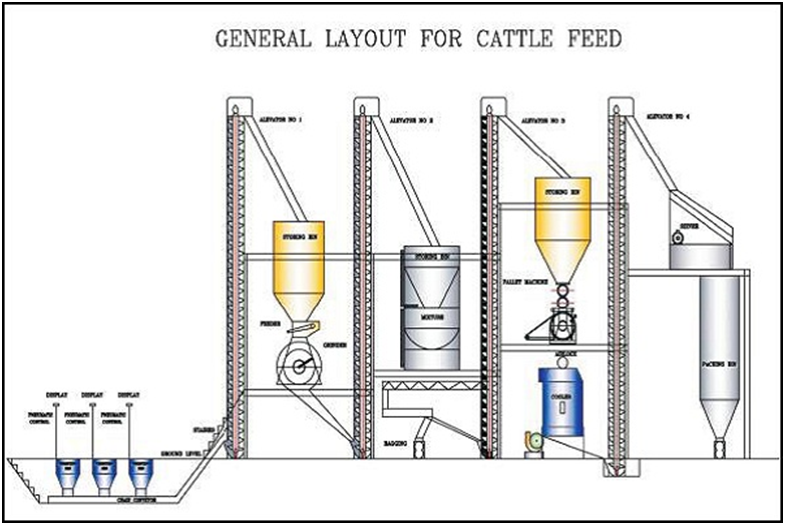
v) Manufacturing process: It should cover the manufacturing process of feed (mash/ pelleted feed) in the form of flow chart, proportion of various feeds to be manufactured and the composition of the different feeds.
vi) Infrastructural facilities:
a) Raw Material:
The feed ingredients (grains, cakes, brans, fish meal, molasses, vitamins, minerals.), source and method of procurement, basis of price fixation, agreements if any for regular supply of raw material may be indicated.
| b) Packing material: The type of packing material required (jute/plastic bags), source of supply, capacity and price of bag, approximate quantity required per month and method of purchase need tobe furnished. c) Utilities: * Power: The total power requirement of the unit, source of power supply, position of power supply in the area and stand by arrangements made by the company, whether permission is obtained or applied to the State Electricity Board for power connection. * Water:The source of supply, quantity available vis-a-vis daily requirement and arrangements made for supply of water. * Fuel: The requirement of coal, diesel and gas, source of supply, adequacy of availability and cost of material may be mentioned. * Steam: Quantity required, source and capacity of boiler. |
* Transportation: The mode of transportation of raw material as well as feed, whether owned or hired vehicles, availability of vehicles and cost per kilometer. * Laboratory: Whether the company is planning to set up a laboratory for testing the raw material as well as feed, specification of laboratory equipment, quality and cost, the proposed tests to be carried out and the adequacy of man power for carrying out these tests. |
vi) Pollution Control: The type of measures proposed for controlling the air pollution inside the unit and also for the employees of the company.
vii) Man power: It should cover the technical skill and unskilled laborersrequired their availability and source, method of recruiting them and also their salary structures/wage rates should be mentioned.
Marketing and Business Prospects:
a) The product mix, capacity of the plant, year-wise capacity utilization and actual quantity of products produced per year.
b) Areas of marketing of the product and strategies i.e. Talukas, district or state-wise quantities proposed for sale, methods of sale, agencies/contractors, method of transportation of products, incentives or commission proposed to be paid, expenditure on publicity and brand name should be indicated. It should also cover the proposed marketing network in terms of staff and material.
c) Market survey for raw materials as well as for the products to be sold covering the demand/supply position, other sources of supply of products, the average price of products for the last 4-5 years and also the potential for selling the products should also be covered.
Socio-Economic Benefits:
The number of villages, farmers and number of animals benefited and also number of persons employed either directly or indirectly in this activity.
Poultry feed will continue to be a leader but livestock and aqua feed will be game changer. Continued growth of Indian industry is expected in the coming decades, mainly due to increase in domestic demand for milk, egg, meat and aqua products. Therefore, future of this industry is bright. Branded feed is expected to produce around 54 million tons of all types of feed.