
(Product Manager-Nutrition)
Stallen South Asia Pvt.Ltd.

(Chief Operating Officer)
Stallen South Asia Pvt.Ltd.
Abstract
This study evaluates the efficacy of PEPIGRO, a Bacillus licheniformis-based probioticand postbiotics as antimicrobial peptide (AMPs), on the growth and health performance of commercial broilers under field conditions. A total of 36,000 straight-run broiler chicks were assigned to control and treatment groups, with the latter receiving PEPIGRO supplementation at 300 g/ton of feed. The trial was conducted over 42 days during extreme heat (42–45°C), and assessed body weight, feed intake, feed conversion ratio (FCR), weekly gain, and mortality. PEPIGRO supplementation resulted in an 8.18% increase in body weight, a 6.59% rise in feed intake, and a 6.22% improvement in weekly gain compared to the control, alongside a 1.68% enhancement in FCR. Mortality was notably reduced by 28.08%, indicating improved survivability. These findings demonstrate that dietary inclusion of PEPIGRO effectively enhances broiler growth performance, feed efficiency, and health, supporting the role of Bacillus licheniformis as a promising antibiotic alternative under commercial field stressors.
1. Introduction
The widespread use of antibiotics in animal husbandry for growth promotion and disease control has led to serious concerns, including antibiotic resistance and environmental contamination (Tang et al., 2017). Consequently, restrictions on antibiotic growth promoters (Organization, 1999) have accelerated the search for safer alternatives. Among these, bioactive feed additives, such as probiotics, antimicrobial peptides, plant extracts, acidifiers, and essential oils—have shown potential in improving growth, immunity, oxidative balance, and gut health (Xu et al., 2021; Yi et al., 2017; Pearlin et al., 2020; Montassier et al., 2021).
Probiotics, particularly Bacillus licheniformis, have gained attention due to their safety and multifunctional benefits (Ningsih et al., 2023). This spore-forming bacterium enhances nutrient digestion through enzyme production, modulates gut microbiota, suppresses pathogens, and improves immune responses (Giri et al., 2019). It also produces antimicrobial compounds and enhances antioxidant activity, contributing to better intestinal integrity and performance (Jia et al., 2018; Chen and Yu, 2020).
Necrotic enteritis (NE), caused by Clostridium perfringens, is a major poultry disease causing significant economic losses (Wade and Keyburn, 2015). Probiotics like B. licheniformis have demonstrated potential in mitigating NE by improving gut barrier function, modulating immunity, and stabilizing microbiota (Wang et al., 2017; Lin et al., 2017).
2. Antimicrobial Peptides (AMPs)
Antimicrobial peptides (AMPs) are small, naturally occurring bioactive molecules found in diverse organisms and play a key role in innate immunity as a first line of defense. They exhibit broad-spectrum activity against bacteria, fungi, parasites, and viruses, contributing significantly to host protection (Huan et al., 2020).
Antibacterial Substances Produced by Bacillus licheniformis
The endospore-forming bacterium Bacillus licheniformis produces a wide range of antimicrobial compounds with diverse structural and functional properties, typically ranging from 1.4 to 20 kDa. These include bacteriocins, licheniformins, bacitracin, and surfactin (Shleeva et al., 2023).
2.1. Bacteriocins
Bacteriocins are ribosomally synthesized antimicrobial peptides or proteins that exhibit bactericidal or bacteriostatic activity against closely related bacteria. Bacillus licheniformis produces various bacteriocins (1.4–55 kDa), influenced by environmental conditions, growth phase, and strain genotype. For example, strain B116 secretes a ~4 kDa bacteriocin active against both Gram-positive and Gram-negative bacteria, including Staphylococcus aureus, Escherichia coli, and Salmonella spp. This compound is heat- and pH-resistant but is inactivated by pronase and partially affected by papain and lipase, suggesting a lipid component (Shleeva et al., 2023).
2.2. Licheniformins
Licheniformins are lipopeptide antibiotics produced by Bacillus licheniformis, often occurring as closely related variants. The licheniformin from strain MS3 has a molecular mass of ~1.438 kDa, while the main forms—licheniformins A, B, and C—range from 3.8 to 4.8 kDa with similar amino acid compositions. Despite structural similarity, they differ in antibacterial potency and toxicity due to variations in side chains and lipid modifications (Shleeva et al., 2023).
2.3. Bacitracin
Bacitracin is a well-known polypeptide antibiotic non-ribosomally synthesized by certain strains of B. subtilis and B. licheniformis. It is composed of 12 amino acids, with four of them—glutamic acid, aspartic acid, phenylalanine, and ornithine—present in their D-isomer forms. The molecular mass of bacitracin is approximately 1.42 kDa. Bacitracin functions by interfering with bacterial cell wall synthesis, making it a clinically important peptide used to inhibit Gram-positive pathogens(Shleeva et.al.2023).
2.4. Surfactin
Bacillus licheniformis produces cyclic lipopeptides such as surfactin and its analoglichenysin, known for strong surface-active and antimicrobial properties. Strain HSN221 secretes nine variants of these compounds under optimal culture conditions (glucose, ammonium chloride, and yeast extract). The surfactin monomethyl ester homologues have molecular masses of ~1.048–1.063 kDa (ESI-MS) and exhibit potent antimicrobial and emulsifying activities with applications in pharmaceutical, agricultural, and environmental biotechnology (Shleeva et al., 2023).
3.Mechanism Of Action
Bacilluslinchiniformis promote gut health through complementary competitive and immunological mechanisms. First, they competitively exclude pathogens by adhering to intestinal mucosa, thereby occupying ecological niches and preventing pathogen attachment and invasion. They also compete for nutrients by secreting extracellular enzymes that efficiently utilize available macro- and micronutrients, limiting resources required for pathogenic growth. In addition, Bacillus produces antimicrobial metabolites, including lipopeptides, bacteriocins, polyketides, and short-chain fatty acids (SCFAs), which directly inhibit pathogenic microorganisms. Furthermore, oxygen consumption by Bacillus reduces intestinal oxygen levels, creating a favorable hypoxic environment for beneficial anaerobic and fermentative bacteria such as lactic acid bacteria.
Simultaneously, antimicrobial peptides (AMPs) contribute to host defense through direct antimicrobial and immunomodulatory activities. AMPs regulate cytokine and chemokine production and modulate immune cells, including macrophages, dendritic cells, and lymphocytes, maintaining immune homeostasis. Mechanistically, AMPs disrupt microbial membranes via barrel-stave, carpet, or toroidal pore-forming models, leading to membrane destabilization and lysis. Additionally, they can penetrate cells and inhibit intracellular processes such as nucleic acid and protein synthesis, enzyme activity, and cell wall formation, thereby ensuring effective pathogen clearance and enhanced innate and adaptive immune responses.
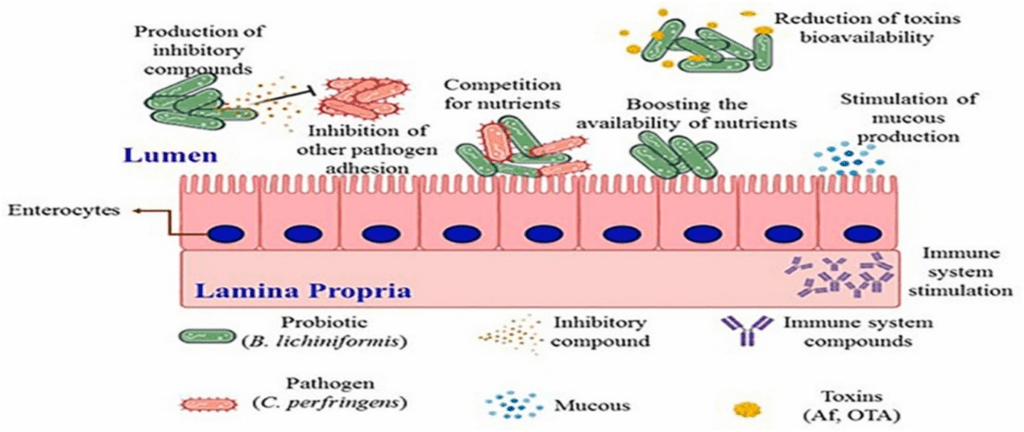
Fig.1. Probiotic Bacillus employs multifactorial competition mechanism to restrict the expansion of pathogens through four pathways.
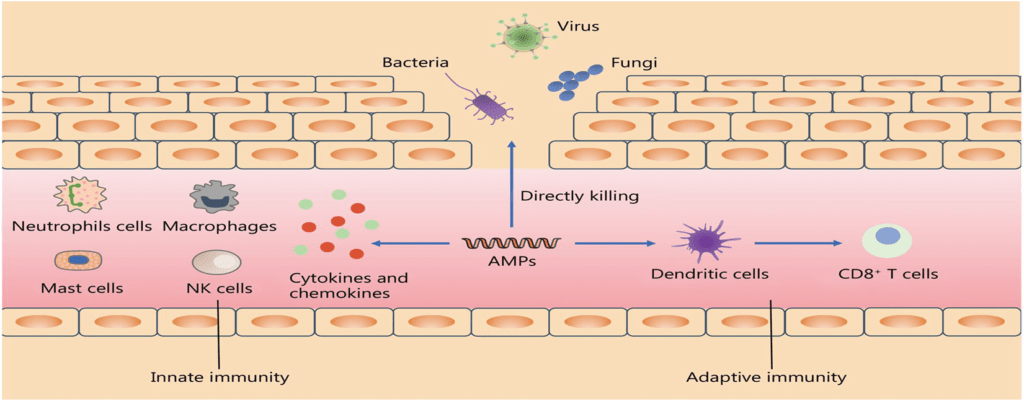
Fig.2. Models of antibacterial mechanisms of AMPs.
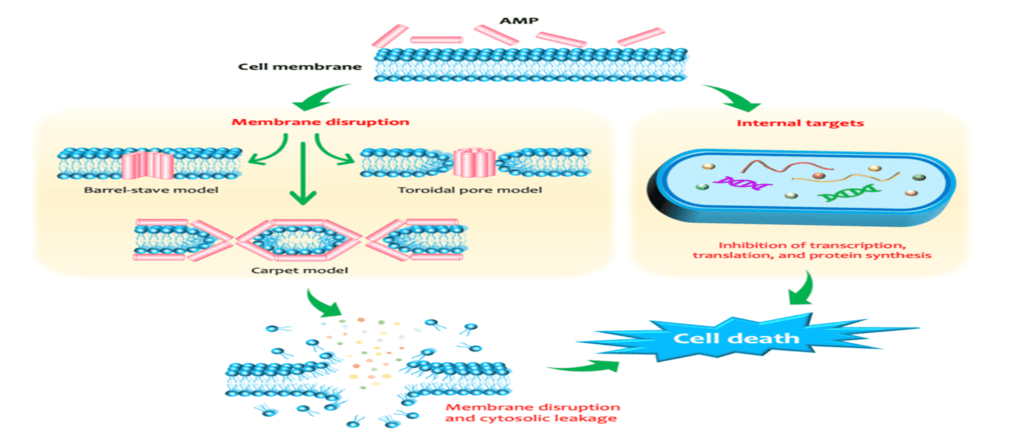
Fig.3. The membrane-disruptive and non-membrane-disruptive antibacterial mechanisms of antimicrobial peptides (AMPs).
4.MATERIALS AND METHODS
4.1. Experimental Design and Management
The trial was conducted at Harsh Broiler House -Bilaspur using Vencobb 430 straight run chicks (not sexed at hatchery) in three treatments of around 12000 birds in each treatment. A total of 36000 birds were considered for trial purpose. Feed Formulation used was same for all treatment groups except in T3 where PEPIGRO (Bacillus lincheniformis 3*109) was added at 300 gm per ton feed respectively in all stages. (Table.1). In the study, the energy level was equivalent to the standard requirements of broilers recommended in the Vencobb 430. The trial was carried out over a period of 42 days. The birds were fed ad lib feed and water was available all the time. Care was taken to provide good conditions by adopting strict biosecurity measures. The housing and vaccination procedures were same in both groups.
Table 1. Composition of basal diet for broiler chicks in control group for 3 phases.
| Broiler Feed Formulation (Control) | |||
| Raw Materials | Pre-starter | Starter | Finisher |
| Maize | 625.15 | 652.75 | 686.65 |
| HiPro Soya | 335 | 300 | 260 |
| Soya Crude Oil | 6 | 14 | 23 |
| Limestone Powder | 8.5 | 8.5 | 8 |
| Dicalcium Phosphate | 10 | 10 | 8 |
| L Lysine HCI | 2.7 | 2.4 | 2.3 |
| DL Methionine | 3.3 | 3 | 2.7 |
| L Threonine | 1 | 1 | 1 |
| Salt | 2.5 | 2.5 | 2.5 |
| Soda Bi Carb | 1.5 | 1.5 | 1.5 |
| Choline Chloride 60% | 1 | 1 | 1 |
| Organic TM | 0.5 | 0.5 | 0.5 |
| Broiler Vitamin Premix | 0.5 | 0.5 | 0.5 |
| Coccidiostat | 0.5 | 0.5 | 0.5 |
| AGP | 0.05 | 0.05 | 0.05 |
| NSP Enzyme | 0.1 | 0.1 | 0.1 |
| Phytase 5000 | 0.1 | 0.1 | 0.1 |
| Feed Acidifier | 1 | 1 | 1 |
| Toxin Binder | 0.6 | 0.6 | 0.6 |
*The figures are in Kilograms.
The premix provided the following per kilogram of the diet: vitamin A, 6000 IU; vitamin D3, 2500 IU; vitamin B1, 1.75 mg; vitamin B2, 5.5 mg; vitamin B6, 4 mg; vitamin B12, 0.18 mg; vitamin E, 25 mg; vitamin K3, 2.25 mg; Cu, 7.5 mg; Mn, 60 mg; Fe, 75 mg; Zn, 60 mg; Se, 0.15 mg; biotin, 0.14 mg; NaCl, 3.7 g; folic acid, 0.8 mg; pantothenic acid, 12 mg; phytase, 400 U; nicotinic acid, 34 mg; chloride, 350 mg. *Nutrient levels were all calculated values.
4.2. Treatment Details-
T1: Control group fed basal diet
T3: Control group fed basal diet + PEPIGRO @300 g PMT
4.3. Parameters Studied-
- Body Weight gain was recorded weekly
- Feed Consumption recorded daily and leftover feed was adjusted in the other day quota to know actual intake.
- Mortality was recorded daily
- EEF calculated post harvesting of the flock
- FCR was calculated every week and post harvesting of the flock.
5.Result:
Effect of Pepigro on growth performance parameter in broiler.
Fig.1. Effect of different dietary treatments on Body Weights (g)
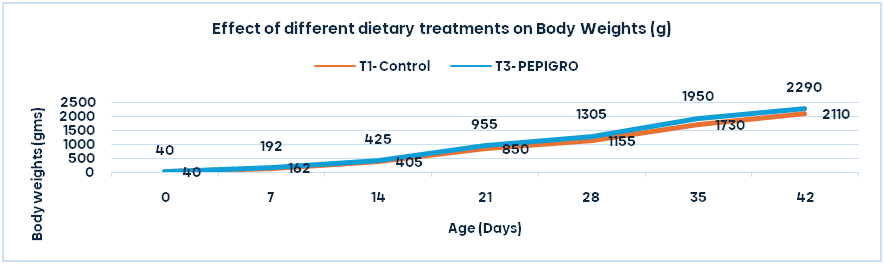
Conclusion: PEPIGRO supplementation at 300g/ton of feed (T3) resulted in a statistically significant 8.18% increase in broiler body weight compared to the control (T1), indicating improved growth performance.
Fig.2. Effect of different dietary treatment on Feed intake (g)
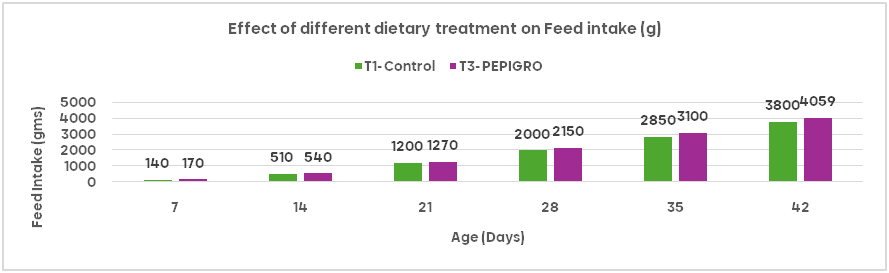
Conclusion: The broiler supplemented with PEPIGRO (T3) at 300g/ ton of feed had a feed intake of 4059 g, which is 6.59% higher than the control group (T1) with 3800 g feed intake. This increase in feed intake indicates that PEPIGRO supplementation positively influenced the birds’ feeding behaviour, likely by enhancing the palatability or nutrient availability of the diet.
Fig.3. Effect of different dietary treatment on Weekly Gain (g)
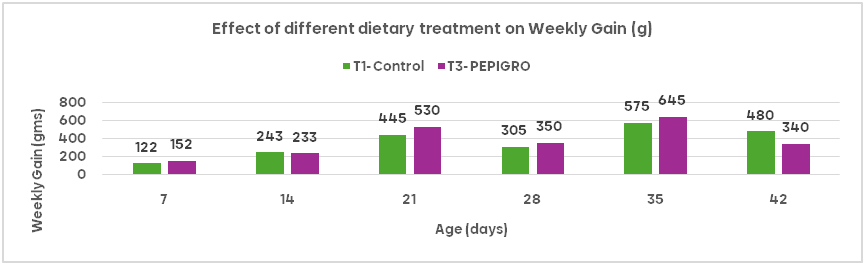
Conclusion:PEPIGRO (T3) supplementation in broiler diet at 300g/ton of feed resulted in the average percentage difference in weekly gain between T1 (Control) is approximately 6.22%. This indicates that PEPIGRO supplementation had a positive overall effect on growth performance, enhancing weight gain efficiency in broiler chickens.
Fig.4. Effect of different dietary treatment on Feed conversion ratio
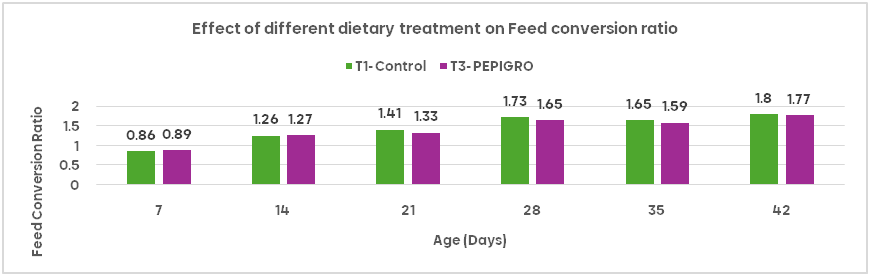
Conclusion:PEPIGRO (T3) supplementation in broiler diet at 300g/ton of feed resulted in a 1.68% improvement in feed conversion ratio (FCR) compared to the control group (T1), indicating enhanced feed efficiency and better growth performance.
Fig.5. Effect of different dietary treatment on Weekly mortality (%)
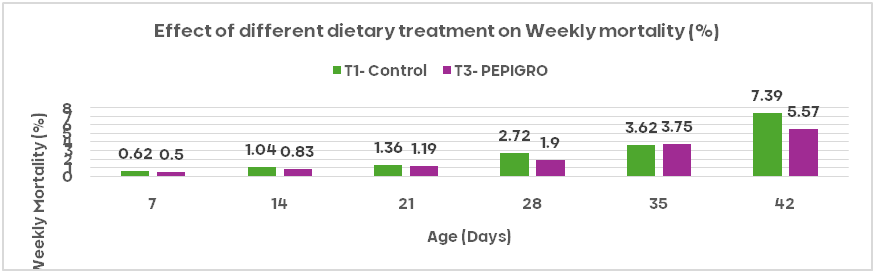
Conclusion: PEPIGRO supplementation at 300g/ton of feed reduced mortality in broiler poultry from 7.39% in the control group to 5.57%, reflecting a 28.08% decrease. This suggests that PEPIGRO may contribute to improved bird health and survivability during the rearing period.
Table 2. Summary of the Report
| Parameters | T1- Control | T3- PEPIGRO | % Difference |
| Body Weight (g) | 2110 | 2290 | 8.18 |
| Feed Intake (g) | 3800 | 4059 | 6.59 |
| FCR | 1.8 | 1.77 | 1.68 |
| CFCR | 1.77 | 1.69 | 4.62 |
| Mortality (%) | 7.39 | 5.57 | 28.08 |
6. Discussion
The discussion for this article highlights the significant positive effects of PEPIGRO, a Bacillus licheniformis-based probiotic, on the growth performance, feed efficiency, and health status of commercial broilers under field conditions. The 8.18% increase in body weight and 6.59% increase in feed intake, along with improvements in feed conversion ratio (FCR), align well with previous studies showing Bacillus probiotics enhance nutrient digestibility, modulate gut microbial populations, and improve intestinal morphology (Pan et al., 2022; Hung et al., 2019). These effects are especially valuable in the context of rising restrictions on antibiotic growth promoters (Tang et al., 2017), pushing for safer and sustainable alternatives.
The notable 28.08% reduction in mortality observed in this study suggests enhanced resilience of broilers to environmental stressors, likely owing to improved gut barrier integrity and immune modulation. Bacillus licheniformis produces antimicrobial peptides, enzymes, and metabolites such as bacteriocins and surfactins that inhibit pathogens like Clostridium perfringens, a major agent of necrotic enteritis (NE) in poultry (Shleeva et al., 2023; Wade and Keyburn, 2015). PEPIGRO’s capacity to maintain intestinal health and microbial balance may underlie the reduced pathogenic infections and inflammation, consistent with findings that show Bacillus supplementation upregulates tight junction proteins and mucins while enhancing beneficial microbes like Lactobacillus (Chen and Yu, 2020; Wang et al., 2017).
Moreover, the probiotic’s ability to stimulate the host immune system by inducing cytokine production and activating phagocytic cells further supports its protective role in the gut environment (Babakuliyev et al., 2022). This immunomodulatory effect is critical for mitigating subclinical infections and improving overall flock welfare, which translates into better productivity under commercial rearing conditions.
Additionally, PEPIGRO contributes to antioxidant status improvement by elevating enzyme activities such as superoxide dismutase and glutathione peroxidase, reducing oxidative stress that commonly compromises poultry health under heat stress conditions (Jia et al., 2018). This antioxidant benefit complements its antimicrobial and immunomodulatory functions.
In conclusion, this study reinforces the role of Bacillus licheniformis as a multifunctional probiotic that enhances growth performance, feed efficiency, and health in broilers. It offers a sustainable alternative to antibiotics, aligning with global efforts to reduce antibiotic use in animal production. Future studies should explore optimal dosing strategies, combinations with other feed additives, and long-term effects on microbiota composition and immune function to fully harness the benefits of PEPIGRO in commercial poultry systems.
7. Conclusion-
The trial was conducted in the extreme heat season where average temperature in the surrounding was around 42-45 degree Celsius.The T3 (PEPIGRO) group showed notable improvements compared to the T1 (Control) group. Body weight in T3 (PEPIGRO) increased by 8.18% compared to T1 (Control), indicating better growth performance. Both Feed Conversion Ratio (FCR) and Corrected Feed Conversion Ratio (CFCR) in T3 (PEPIGRO) improved, showing reductions of 1.68% and 4.62%, respectively, compared to T1 (Control), indicating more efficient feed utilization. Additionally, mortality rate in T3 (PEPIGRO) decreased significantly by 28.08% compared to T1 (Control), reflecting better overall health and survival.These results suggest that PEPIGRO supplementation positively impacts growth, feed efficiency, and mortality compared to Control.
References:
B. Rossi, A. Toschi, A. Piva, E. Grilli,Single components of botanicals and nature-identical compounds as a non-antibiotic strategy to ameliorate health status and improve performance in poultry and pigs Nutr. Res. Rev., 33 (2020), pp. 218-234
B.V. Pearlin, S. Muthuvel, P. Govidasamy, M. Villavan, M. Alagawany, M. RagabFarag, K. Dhama, M. Gopi, Role of acidifiers in livestock nutrition and health: a review J. Anim. Physiol. Anim. Nutr. (Berl.), 104 (2020), pp. 558-569
Babakuliyev, Alisir& Porwal, Prateek & Maiti, Niladri & Singh, Gyan & Khan, Shahbaz & Singh, Gajender & Chanchal, Dilip Kumar. (2022). Design, synthesis, and structural activity relationship of antimicrobial peptides against multi-drug-resistant organisms. International journal of health sciences. 10.53730/ijhs. v6nS2.8211.
E. Montassier, R. Valdés-Mas, E. Batard, N. Zmora, M. Dori-Bachash, J. Suez, E. Elinav, Probiotics impact the antibiotic resistance gene reservoir along the human GI tract in a person-specific and antibiotic-dependent manner Nat. Microbiol., 6 (2021), pp. 1043-1054
K. Luo, Y. Liu, G. Qin, S. Wang, C. Wei, M. Pan, Z. Guo, Q. Liu, X. Tian ,A comparative study on effects of dietary three strains of lactic acid bacteria on the growth performance, immune responses, disease resistance and intestinal microbiota of Pacific white shrimp, Penaeus vannamei, Fish Shellfish Immunol., 136 (2023), Article 108707
K.L. Tang, N.P. Caffrey, D.B. Nóbrega, S.C. Cork, P.E. Ronksley, H.W. Barkema, A.J. Polachek, H. Ganshorn, N. Sharma, J.D. Kellner, W.A. Ghali, Restricting the use of antibiotics in food-producing animals and its associations with antibiotic resistance in food-producing animals and human beings: a systematic review and meta-analysis, Lancet Planet Health, 1 (2017), pp. e316-e327.
Le, Mi & Kawada-Matsuo, Miki &Komatsuzawa, Hitoshi. (2022). Efficiency of Antimicrobial Peptides Against Multidrug-Resistant Staphylococcal Pathogens. Frontiers in Microbiology. 13. 10.3389/fmicb.2022.930629.
M. Roselli, A. Finamore, M.S. Britti, P. Bosi, I. Oswald, E. Mengheri, Alternatives to in-feed antibiotics in pigs: evaluation of probiotics, zinc or organic acids as protective agents for the intestinal mucosa. A comparison of in vitro and in vivo results,Anim. Res., 54 (2005), pp. 203-218
M. Tian, X. He, Y. Feng, W. Wang, H. Chen, M. Gong, D. Liu, J.L. Clarke, A. van. Eerde Pollution by antibiotics and antimicrobial resistance in livestock and poultry manure in China, and counter measures; Antibiotics, 10 (2021), p. 539.
N. Ningsih, A. Respati, D. Astuti, T. Triswanto, L. Purnamayanti, A. Yano, R. Putra, A. Jayanegara, A. Ratriyanto, A. Irawan, Efficacy of Bacillus subtilis to replace in-feed antibiotics of broiler chickens under necrotic enteritis-challenged experiments: a systematic review and meta-analysis, Poult. Sci., 102 (2023), Article 102923.
Pan X, Cai Y, Kong L, Xiao C,Zhu Q and Song Z (2022) Probiotic Effects of Bacillus licheniformis DSM5749 on Growth Performance and Intestinal Microecological Balance of Laying Hens. Front. Nutr. 9:868093. doi: 10.3389/fnut.2022.868093.
Quette Grant, Cyril G. Gay & Hyun S. Lillehoj (2018): Bacillus spp. as directed microbial antibiotic alternatives to enhance growth, immunity, and gut health in poultry, Avian Pathology, DOI: 10.1080/03079457.2018.1464117
S. Abullais Saquib, N.A. AlQahtani, I. Ahmad, S. Arora, S. Mohammed Asif, M. Ahmed Javali, N. Nisar, Synergistic antibacterial activity of herbal extracts with antibiotics on bacteria responsible for periodontitis. J. Infect. Develop. Count., 15 (2021), pp. 1685-1693
S. Giri, E. Ryu, V. Sukumaran, S.C. Park, Antioxidant, antibacterial, and anti-adhesive activities of biosurfactants isolated from Bacillus strains. Microb. Pathogen., 132 (2019), pp. 66-72
Shleeva MO, Kondratieva DA, Kaprelyants AS. Bacillus licheniformis: A Producer of Antimicrobial Substances, including Antimycobacterials, Which Are Feasible for Medical Applications. Pharmaceutics. 2023 Jul 5;15(7):1893. doi: 10.3390/pharmaceutics15071893. PMID: 37514078; PMCID: PMC10383908.
W.H. Organization, Containing Antimicrobial Resistance: Review of the Literature and Report of a WHO Workshop on the Development of a Global Strategy for the Containment of Antimicrobial Resistance. Geneva, Switzerland, 4-5 February 1999 (1999),
Y. Xu, Y. Yu, Y. Shen, Q. Li, J. Lan, Y. Wu, R. Zhang, G. Cao, C. Yang, Effects of Bacillus subtilis and Bacillus licheniformis on growth performance, immunity, short chain fatty acid production, antioxidant capacity, and cecal microflora in broilers, Poult. Sci., 100 (2021), Article 101358
Yuchen Huan 1, Qing Kong 1,*, Haijin Mou 1, Huaxi Yi 1, Antimicrobial Peptides: Classification, Design, Application and Research Progress in Multiple Fields, Front Microbiol. 2020 Oct 16; 11:582779. doi: 10.3389/fmicb.2020.582779
Zhu, Jiajia& Chen, Yunsheng& Imre, Kálmán & Arslan Acaroz, Damla &Istanbullugil, Fatih & Fang, Yuwen & Ros, Gaspar & Zhu, Kui &Acaröz, Assoc Prof Dr Ulas. (2023). Mechanisms of probiotic Bacillus against enteric bacterial infections. One Health Advances. 1. 10.1186/s44280-023-00020-0.