
Dr. Srinivas
Veterinarian and Owner of Pragathi
Hatcheries at Bengaluru (Karnataka)
A veterinarian’s data-driven discipline and Envu’s precision science restore order in one of Karnataka’s leading breeder operations.
When the Night Looked Calm but the Numbers Fell
By midnight, the sheds were still. Fans turned steadily, and the rhythmic sound of feeders filled the air. Yet every morning, the spreadsheets on Dr. Srinivas’s desk told another story. Egg counts had dropped again, hatchability had slipped, and several technicians were complaining of sleepless nights.
Bed bugs, red mites, and houseflies—small, persistent, and mostly invisible—were quietly eroding performance at a 1.2 lakh-bird breeder farm near Dodballapur in Bengaluru Rural District. For Dr. Srinivas, a veterinarian who had built his enterprise on measurement and discipline, the losses were more than operational. “Everything looked normal until we saw the data,” he said. “The losses came from what we could not see.”
He had entered poultry farming in 1994 after a short stint in veterinary sales, determined to apply scientific management to an industry often guided by habit. Over three decades, he created a closed-loop enterprise of brooding, growing, and laying units on raised platforms, supplying hatchable eggs and day-old chicks across southern India and the Northeast. Success for him had always meant predictability: healthy birds, efficient feed conversion, and consistent customer satisfaction.
When Hidden Threats Disrupted a Perfect System
The problems began after a major upgrade. In 2002, the farm shifted from deep-litter to cage systems. The change improved hygiene but also created hidden joints and crevices where ectoparasites could thrive. Within months, the numbers faltered.
Production, which should have remained near 8,400 eggs per 10,000 birds, fell to about 6,000. Hatchableegg selection, once 96–97%, dropped to 78–80%. Feed conversion, normally ≈ 285 g per hatchable egg, worsened by 20–30% even though feed accounts for around 80% of total cost. Mortality rose from 2–3% to 8–11%. Birds became restless, fertility declined, and many workers left after nights of insect bites.
Conventional fixes brought little relief. Chemical dosing through drinking water reduced infestation briefly but lowered production by 10–15%. Generic sprays achieved less than 5% control. “I had lost confidence,” Dr. Srinivas recalled. “Every product promised results, yet none solved the problem.”
Losses spread across every key measure—feed efficiency, hatchable quality, and labour stability. The solution, he realised, required a change in method that would address the source rather than the symptoms.
Precision Control and the Return of Order
Relief arrived through an encounter at an industry exhibition. Envu specialists suggested that instead of internal dosing, the farm needed precision external spraying with verified coverage. They recommended Temprid, a contact adulticide, together with detailed application protocols and post-spray audits.
Dr. Srinivas agreed to a controlled trial. Within 24 hours, nearly 90% of bed bugs were eliminated. After a second spray, the sheds stayed clear for months. Calm returned among birds, and confidence returned among workers. “That first spray was a turning point,” he said. “It proved that science, applied correctly, could restore stability.”
He then formalised a system that targeted every life stage of the pest. Adult insects were managed with Temprid for immediate and residual control. Larval breeding sites in litter and manure were treated with Bilarv, a larvicide that achieved 100% control within a day. Pre-monsoon preventive rounds and post-treatment inspections became part of routine operations. The results were measurable and sustained.
Performance Before and After Envu Solutions
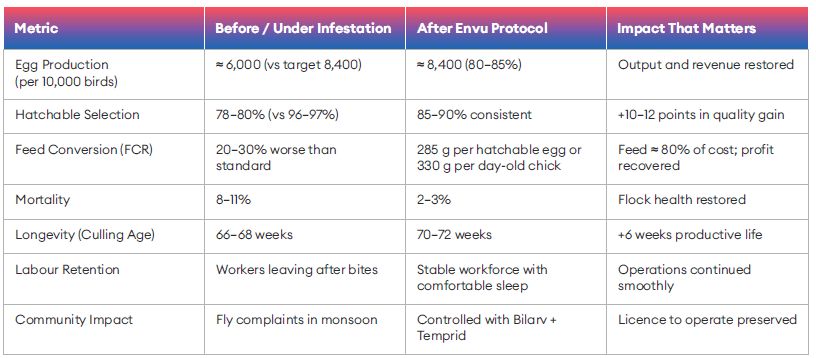
Feed efficiency alone reshaped profitability. In breeder production, where feed represents four-fifths of total cost, recovering the FCR margin changed viability within a single cycle. Hatchable quality returned to benchmark levels, mortality normalised, and longevity extended to 70–72 weeks, adding six weeks of profitable lay. Workers returned, and customers reported stronger chick quality and a reliable supply.
Lessons from a Difficult Season
For Dr. Srinivas, the episode confirmed that unseen problems demand close observation. “If the numbers look fine by day but hatchability keeps falling, check again at night,” he now tells other farmers. “That is when the real story shows.”
He treats ectoparasite control with the same seriousness as feed formulation and vaccination. Each flock is inspected after dark and audited after every treatment. Every adjustment now follows inspection records rather than routine habit.
The experience also changed how he views partnership. “What mattered was the combination of good products and continuous follow-up,” he said. “The visits, data checks, and training ensured that each application was correct.”
Nearby farms have faced similar fly pressures, and Dr. Srinivas believes that systematic adult and larval control can help them prevent those seasonal surges. He often summarises his learning simply: “Precision means targeting pests, not birds, and applying products only where they are needed.”
Vigilance and the Next Frontier
Even after recovery, vigilance remains essential. Red mites continue to challenge the industry. They are smaller, spread faster, and are harder to detect. Dr. Srinivas follows Envu’s ongoing research on new molecules and resistance management, convinced that future progress in breeder health will depend on continued innovation in pest science. His team now performs pre-monsoon inspections and keeps digital records of pest sightings to anticipate outbreaks rather than react to them.
Today the sheds are quiet again. Birds feed normally, workers rest through the night, and production remains steady at target levels. The calm reflects discipline, training, and scientific consistency. For Dr. Srinivas, the lesson is clear: knowledge and structure remain the best defence against unseen threats.
Powered by Envu. Be a Force With Nature.