As India accelerates its journey toward safer, more sustainable livestock and aquaculture systems, strengthening antimicrobial stewardship has become a national priority. Reflecting this forward-looking approach, the Confederation of Indian Industry Food and Agriculture Centre of Excellence (CII FACE) in collaboration with the Indian Federation of Animal Health Companies (INFAH) as Knowledge Partner has initiated the AMR Stewardship Drive 2025, a nationwide campaign engaging stakeholders across the value chain to advance responsible antimicrobial use, promote viable alternatives, and strengthen awareness in both rural and industrial settings.
The first three sessions of the Drive were successfully conducted at ICAR-National Institute of Veterinary Epidemiology and Disease Informatics (NIVEDI), Bengaluru; Nagpur Veterinary College, Nagpur; and Bihar Animal Sciences University (BASU), Patna. The concluding and fourth session of the year was held on 20 November 2025 New Delhi, witnessing participation from veterinarians, researchers, academicians, fisheries professionals, startups, industry leaders, and policymakers.
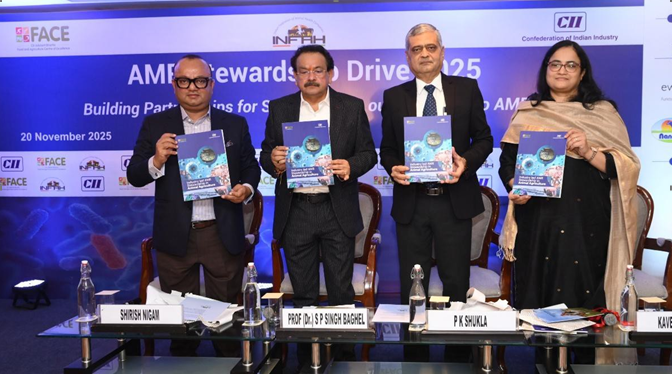
The event commenced with welcome remarks by Dr. Shirish Nigam, Chairman, Sub Committee on Public Policy, Advocacy & CSR and Past President, Indian Federation of Animal Health Companies (INFAH) and Managing Director, EW Nutrition India, He emphasized that the AMR Stewardship Drive represents a shared commitment to strengthening animal health systems, fostering innovation, and building a resilient ecosystem where science, policy, and industry converge to secure a healthier future.
Prof. (Dr.) S. P. Singh Baghel, Minister of State for Fisheries, Animal Husbandry & Dairying, Government of India, as the Chief Guest delivering the inaugural address, emphasised the pressing need to advance AMR stewardship efforts. He highlighted the need for responsible antimicrobial use, improved animal health systems, and widespread awareness to safeguard livestock-based livelihoods. He reiterated that a collaborative ‘One World, One Health’ approach—bridging veterinary, human health, and environmental sectors – is essential to develop effective, sustainable AMR solutions.
Setting the context for the day, Prof. (Dr.) P K Shukla, President, Indian Poultry Science Association and Head, Department of Poultry Science, DUVASU, Mathura, stressed the critical importance of prudent antimicrobial use. He noted that no new antibiotic molecule has emerged in the last two decades, making judicious use of existing drugs a national priority. He urged participants to become ambassadors of responsible antimicrobial practices, stating that awareness remains the strongest tool in this fight.
The inaugural session concluded with a Vote of Thanks by Dr. Shirish Nigam.
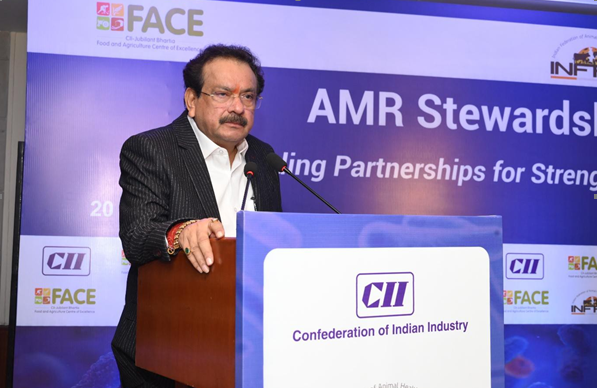
November 2025 at New Delhi
A key highlight of the event was the release of the CII FACE report titled “Industry-led AMR Stewardship in Animal Agriculture”. This report compiled learnings from extensive multi- stakeholder consultations and highlighted the drivers of antimicrobial use in dairy, poultry, and aquaculture, emerging risks, gaps in current practices, and context-specific solutions for responsible antimicrobial usage. The report outlined actionable recommendations for policymakers, industry players, academia, startups, and farmer organizations, providing a roadmap to enhance stewardship, safeguard food safety, protect animal productivity, and ensure environmental sustainability.
Another report titled “Indian Animal Healthcare Antimicrobial Usage 2024” was also released during the event. INFAH (Indian Federation of Animal Health Companies), which represents nearly 85% of India’s organized animal health industry, has been systematically compiling national antibiotic usage estimates since 2022. The newly released report presents category- wise antimicrobial usage (AMU) in the country for the year 2024.
The technical session on “Ground-Level Strategies for AMR Mitigation” emphasized the need to translate national AMR policies into practical, field-level actions across the livestock and aquaculture sectors. Experts highlighted the growing relevance of ethnoveterinary medicine and herbal alternatives in reducing antimicrobial use, while underscoring the importance of responsible antibiotic practices, including adherence to withdrawal periods, record-keeping, and the strengthened role of veterinarians and para-veterinarians. The session also focused on the deployment of rapid field diagnostics, integration of surveillance systems, and the adoption of innovative solutions such as probiotics, vaccines, immunomodulators, and precision nutrition to reduce reliance on antibiotics. Speakers further stressed policy-level interventions such as One Health integration, public–private partnerships, and alignment with global food safety standards to build a sustainable AMR stewardship framework. Together, these discussions provided a clear roadmap for advancing practical, science-led, and collaborative strategies to mitigate AMR across India’s animal agriculture value chains.
The event concluded with a Vote of Thanks by Ms. Kavery Ganguly, Principal Lead, Food & Agriculture Centre of Excellence (FACE), Confederation of Indian Industry (CII). She highlighted the key achievements of the AMR Stewardship Drive to date and reaffirmed CII FACE’s commitment to deepening ground-level engagement and strengthening India’s collective response to AMR.
The AMR Stewardship Drive 2025 reaffirmed that only a coordinated approach – integrating policy reforms, industry innovation, academic research, and grassroots awareness – can sustainably combat AMR. CII FACE remains committed to strengthening this One Health – aligned national movement and advancing AMR stewardship across India in the years ahead.