Kanwarpal Singh Dhillon¹* and Bikramjit Singh²
¹Assistant Professor (Animal Science), Krishi Vigyan Kendra, Amritsar
²Associate Director (Training), Krishi Vigyan Kendra, Amritsar
Punjab Agricultural University, Ludhiana – 141004
E-mail: kanwardhillon55@pau.edu
The will to earn and succeed is the driving force behind every hardworking individual. S. Karamjit Singh, a well-educated and progressive farmer from village Ramana Chakk, district Amritsar, has set new benchmarks in the field of poultry farming. With only three acres of ancestral land, he faced challenges in sustaining his family through traditional agriculture. Motivated to improve his livelihood, he ventured into poultry farming by establishing Mand Poultry Farm (broiler unit) with a capacity of 5,000 birds in 2023. Initially, due to limited technical knowledge, he faced high mortality and disease outbreaks. His turning point came after enrolling in a seven-day vocational training on “Scientific Poultry Farming” at Punjab Agricultural University’s Krishi Vigyan Kendra (KVK), Amritsar, in 2024. Guided by KVK experts, he applied scientific practices in breed selection, feed management, housing, vaccination, and biosecurity. Subsequently, he expanded his farm to a capacity of 20,000 birds. Improved feed conversion ratio (FCR), reduced mortality, and better management practices resulted in a monthly profit of about Rs. 3 lakh per batch. Today, he provides employment to village youth and serves as a role model for other farmers. His success demonstrates how scientific interventions and technical guidance can transform small-scale farmers into successful entrepreneurs.
Keywords: Krishi Vigyan Kendra, scientific poultry farming, entrepreneurship, benefit-cost ratio, success story
Situation analysis
In Punjab, declining landholdings and increasing input costs have made farming less remunerative, particularly for small and marginal farmers. S. Karamjit Singh (aged 40) from village Ramana Chakk, district Amritsar, owned only three acres of land, which limited his income from traditional cropping. After observing successful poultry ventures in nearby villages, he decided to diversify his livelihood through broiler farming. In 2023, he established Mand Poultry Farm with 5,000 birds under a contract arrangement with the private company “Sampoorna,” which supplied chicks, feed, and medicines. Initially, due to lack of technical knowledge in feed, breed, and disease management, he experienced high mortality rates and poor profitability despite approaching several agencies for support.
Plan, implementation and support
During this period, Karamjit Singh learned about a vocational training course on “Scientific Poultry Farming” at PAU’s Krishi Vigyan Kendra, Amritsar. On the advice of KVK experts, he joined the seven-day programme in 2024. The training covered scientific management of poultry housing, breeds, feed formulation, vaccination and deworming schedules, and exposure visits to successful farms. He also participated in a method demonstration on egg candling and joined the “KVK Poultry Farming” WhatsApp group for continuous advisory support. Regular on-farm visits and mentoring by KVK scientists helped him implement recommended scientific practices and boosted his confidence.
Output
After receiving the training and according to the guidance provided by KVK expert, he modified and expanded his poultry farm capacity from 5,000 to 20,000 poultry birds. Now, his birds (broiler) reach to the marketable weight earlier due to improvement in FCR (Feed Conversion Ratio) and he sells more broiler birds to the company than before with higher benefit cost ratio (Table 1). After a gap of 15 days, now he brings a new batch of birds and again sells them after they reach the marketable weight and this cycle keeps on repeating. Now, he properly follows the deworming and vaccination schedule, and biosecurity measures without fail, due to which mortality rate decreases in his poultry farm. He also established an Azolla cultivation unit on his farm, providing fresh Azolla as a natural feed supplement for the birds. This practice not only significantly reduced the overall feed costs but also enhanced the birds’ health and immunity, promoting better growth and productivity.
His family members also provide him helping hands in routine farm work, thus reducing labour cost at their farm. Due to carrying out the practices in a scientific manner, he is preparing and selling 6 batches in a year and earning good profit around Rs. 15 lakh/year in this enterprise.
Table 1. Performance before and after KVK intervention
| Parameter | Before intervention (2023) | After KVK intervention (2024) |
| Number of birds | 5,000 | 20,000 |
| FCR | 1.72 | 1.48 |
| Mortality (%) | 7.20 | 3.42 |
| No. of batches/year* | 5 | 6 |
| Gross cost (Rs. /batch) ** | 61,400/- | 2,04,000/- |
| Gross income (Rs. /batch) | 1,36,100/- | 5,12,050/- |
| Net return (Rs. /batch) | 74,700/- | 3,08,050/- |
| Benefit–Cost Ratio | 2.22 | 2.51 |
| Annual Net Income | ₹2.5 lakh | ₹15 lakh |
* Each batch has a duration of approximately 35 days.
**Includes cost of labour, electricity, bedding, and other miscellaneous inputs; excludes cost of birds, feed, medicine, and transportation as provided by the company under contract farming.
Outcome
Within months, S. Karamjit Singh was recognized as one of the best poultry farmers in Amritsar district by Sampoorna Company. He now earns around ₹3,00,000 per batch after deducting all expenses and has generated local employment opportunities. His farm is regularly visited by farmers, extension workers, and dignitaries for exposure visits and Farmer Field Schools. His remarkable progress earned him the “Award of Honour” from Punjab Agricultural University, Ludhiana, during the Kisan Mela at KVK Amritsar (March 2025). Today, he serves as a guest speaker in KVK’s vocational trainings, sharing his experiences with aspiring poultry farmers. His future plans include expanding to 50,000 broilers, establishing a layer-cum-fish integrated unit, and exploring value addition in poultry meat.
Impact
S. Karamjit Singh’s journey illustrates how hard work combined with scientific knowledge and institutional support can transform livelihoods. He remains actively engaged with KVK Amritsar through meetings, trainings, and Kisan Melas, inspiring over 50 fellow farmers and relatives to adopt poultry farming as a profitable enterprise. He exemplifies a new generation of educated farmers who bridge traditional wisdom with modern practices, contributing to food security, rural employment, and economic growth in Punjab.
CONCLUSION: Poultry farming is one of the fastest-growing agro-industries and offers a viable avenue for small and marginal farmers to enhance their socio-economic conditions. The success of S. Karamjit Singh demonstrates that scientific management, technical guidance, and perseverance can turn challenges into opportunities. His transformation from a small farmer to a successful entrepreneur underscores the crucial role of Krishi Vigyan Kendras in empowering rural communities through knowledge-based interventions.
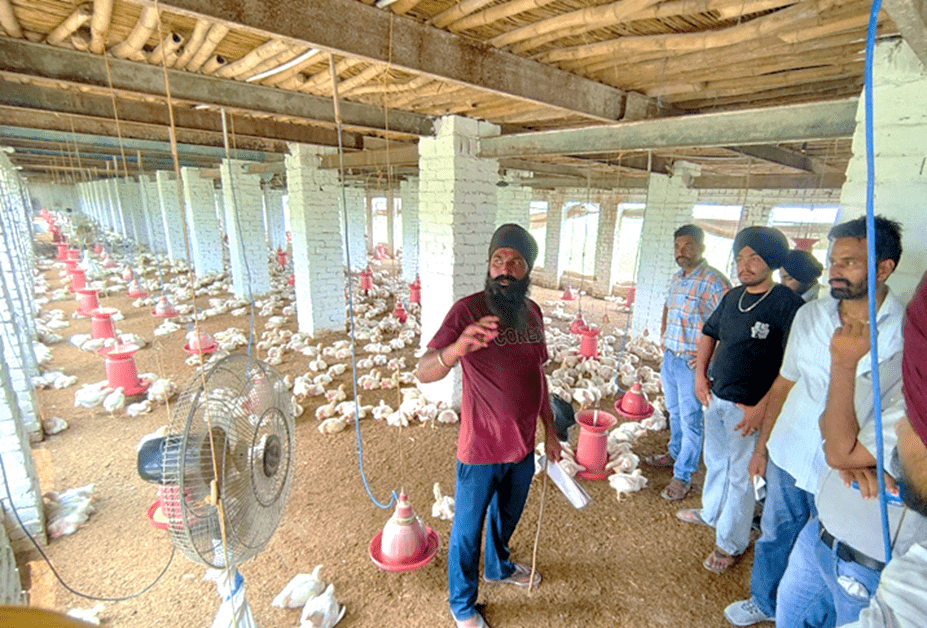
S. Karamjit Singh at his broiler poultry unit
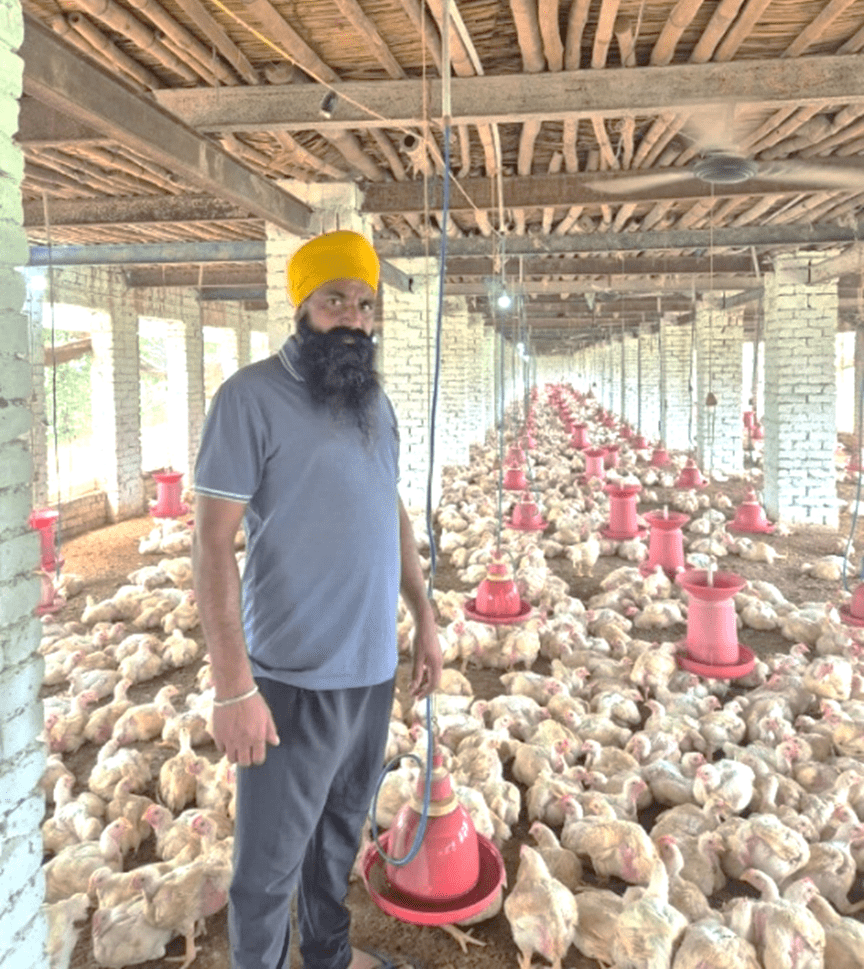
20,000-bird poultry farm setup after intervention by PAU–KVK Amritsar
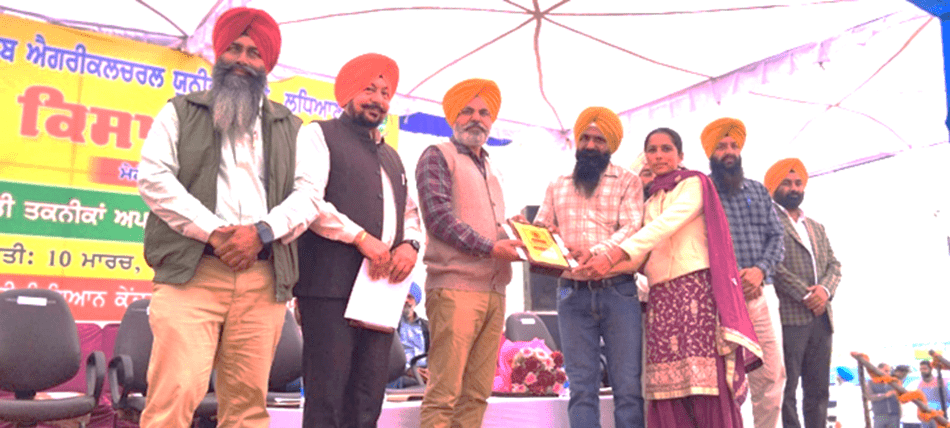
Receiving the “Award of Honour” from Punjab Agricultural University during Kisan Mela, March 2025
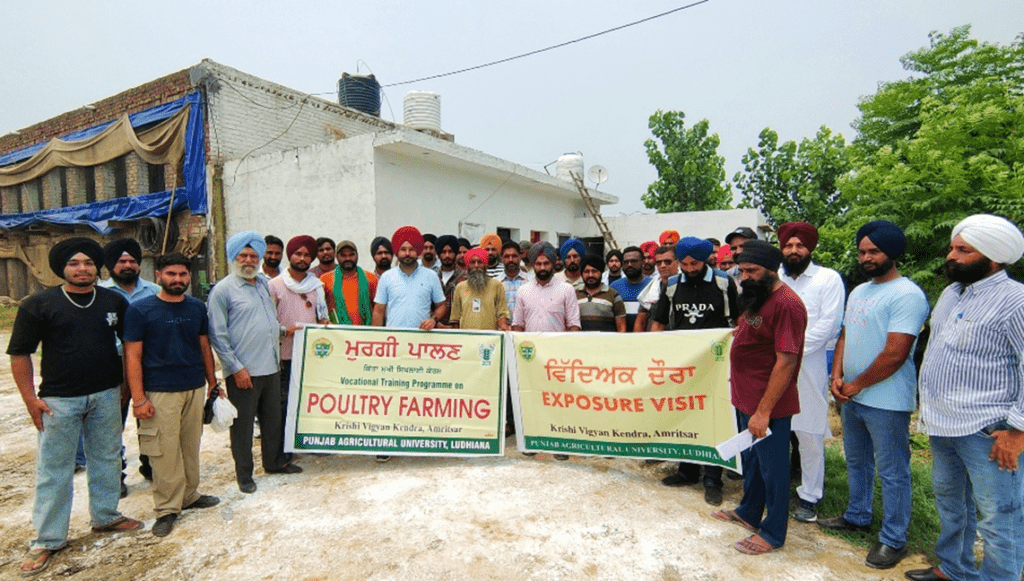
Trainees of the Poultry Farming Training at KVK Amritsar visited Mand Poultry Farm for an exposure visit.