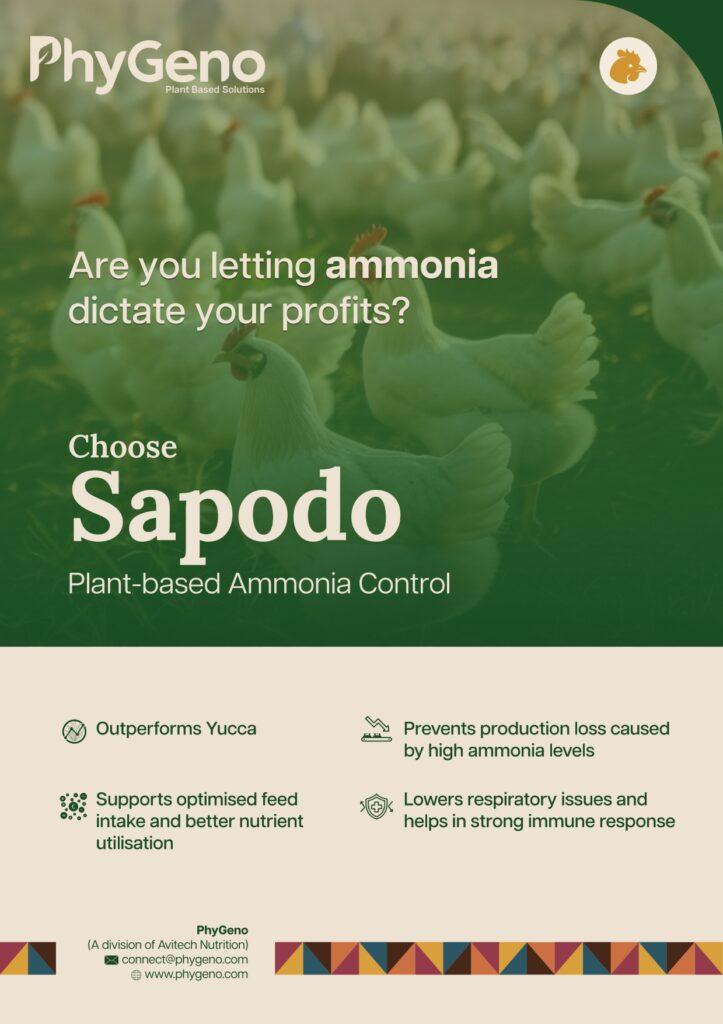
Going beyond Yucca for ammonia management
PhyGeno, the plant-based feed ingredient division of Avitech Nutrition is dedicated to enhancing the safety and nutritive value of animals through plant-based innovations. Drawing on its legacy of working with animals and combining ancient Ayurvedic knowledge with modern evaluation and manufacturing techniques, PhyGeno offers solutions that lead to healthier products for human consumption and minimal environmental impact. Sapodo, a polyherbal formulation is rapidly emerging as a natural choice to address critical ammonia challenges in poultry farming.
Understanding the Impact of Ammonia in Poultry Production
Ammonia, a natural byproduct of animal waste and decomposition, poses significant threats in poultry farms when present at high concentrations. Elevated ammonia levels are harmful to both animal health and the environment, leading to a cascade of negative effects on poultry production. These include reduced body weight gain, impaired feed conversion, decreased survivability, and a weakened immune response. Furthermore, high ammonia can cause respiratory illness, eye irritation, increased susceptibility to pathogens, and compromised immune responses in birds, ultimately impacting overall performance and profitability for farmers. Effectively controlling ammonia is therefore crucial for fostering healthy living conditions and improving bird performance.
Sapodo: A Comprehensive Strategy for Ammonia Management
Sapodo is a natural phytogenic feed additive specifically formulated for efficient ammonia control. It is a polyherbal formulation containing saponins and glycosides, among other bioactive compounds, which collectively enable a multi-pronged approach to ammonia management. Sapodo’s strategy involves two key mechanisms:
• Direct Binding: Sapodo contains bioactive compounds that directly bind lower gut and environmental ammonia levels. This immediate action helps to neutralize existing ammonia, reducing its toxic effects on animals and improving air quality within the farm.
• Urease Inhibition: Beyond direct binding, Sapodo’s bioactive compounds also control ammonia production by inhibiting the urease enzyme. Urease is responsible for converting urea into ammonia, so by inhibiting this enzyme, Sapodo addresses the root cause of ammonia generation, providing a more sustainable and long-term solution.
This dual-action approach ensures a comprehensive reduction of ammonia in the poultry environment, creating a healthier and more productive setting for animals.
Unlocking Superior Ammonia Management: Sapodo’s Proven Advantage Over Yucca Schidigera Products
Comparative Efficacy: Sapodo’s Demonstrated Superiority
To validate Sapodo’s effectiveness, comprehensive in-vitro evaluations were conducted at the Avitech Centre for Nutrition Science (ACNS), comparing its ammonia binding capability against a commercially available Yucca product. The results unequivocally demonstrate Sapodo’s superior performance.
Study 1: Quantitative Evaluation (B50 Value)
The first trial focused on estimating the B50 value, a key indicator quantifying the amount of an ammonia-binding substance needed to reduce ammonia concentration in an aqueous solution by 50%. A lower B50 value signifies a stronger ability of the product to bind ammonia.
• Methodology:
The ammonia control agent was weighed, mixed with phosphate EDTA buffer, stirred for 10 minutes, and centrifuged. The supernatant was then used to prepare aliquots for B50 estimation. Samples were treated with ammonium sulfate solution, nitroprusside, and hypochlorite, followed by incubation, and optical density measurement at 630 nm to determine the percentage of free ammonia.
• Results:
The study revealed that only 3.6 mg of Sapodo was required to achieve a 50% reduction in ammonia in the solution, compared to 5.4 mg of Yucca. This critical finding indicates that Sapodo is 50% more effective in binding ammonia than Yucca.
Study 2: Qualitative Evaluation (Colorimetric Study)
The second trial employed a colorimetric study, utilizing the salicylate method based on the Berthelot reaction, to visually assess ammonia binding efficiency at different dosages.
• Methodology:
Stock ammonia solution was prepared. A reaction mixture was used to assess ammonium concentration with varying levels of ammonia binder (25 mg, 50 mg, 100 mg, and 150 mg). The color variation was then compared against an ammonia color chart.
• Results:
◦ At 25 mg and 50 mg dosages, Sapodo-containing test tubes exhibited a light-yellow hue, indicating a significant decrease in ammonia levels, whereas Yucca tubes showed a light green hue.
◦ More strikingly, at 100 mg and 150 mg dosages, the Sapodo test tubes demonstrated a complete reduction of ammonia concentration, evidenced by a dark yellow color. In contrast, Yucca only showed a slight reduction, presenting a light-yellow hue at these higher concentrations.
The color variation clearly shows that Sapodo is more effective as an ammonia control agent compared to Yucca at different concentrations, demonstrating a superior performance in reducing ammonia production.
Beyond Binding: The Multifaceted Benefits of Sapodo for Poultry Productivity
Sapodo’s superior ammonia control translates into a multitude of benefits for poultry farmers, directly impacting productivity and animal welfare:
• Improved Nutrition: Optimizes feed intake and ensures better nutrient utilization.
• Enhanced Health: Reduces susceptibility to respiratory infections and decreases the incidence of Ascites. Sapodo addresses issues more effectively than Yucca, improving bird performance.
• Increased Productivity: Improves overall performance and efficiency, leading to enhanced growth and productivity.
• Farm Hygiene: Significantly improves air quality and reduces offensive odor generated by manure.
Furthermore, Sapodo is 100% natural and safe, cost-effective, and compatible for inclusion in premixes or complete feeds, demonstrating excellent stability through pelleting and extrusion processes.
Conclusion: A Cleaner, Healthier Future with Sapodo Sapodo’s proven superior efficacy in binding and inhibiting ammonia, as demonstrated by rigorous in-vitro trials, positions it as the premier plant-based solution for ammonia management in poultry farming. By effectively addressing ammonia-related challenges, Sapodo not only safeguards animal health and the environment but also significantly boosts farm productivity and profitability. With Sapodo, PhyGeno offers a clear path towards clean feed, a clean conscience, and a clean planet for generations to come.