Dr. Prasanna Venkatesh
M.V.Sc (Animal Nutrition), Senior Technical Manager-Key Clients, Rossari Biotech Limited
The Global Pivot: Navigating the Post-AGP Landscape
The global poultry industry is currently undergoing a fundamental transformation that transcends simple regulatory adherence. For decades, Antibiotic Growth Promoters (AGPs) were the cornerstone of production efficiency; however, the strategic landscape has shifted toward a precision physiological model. Transitioning away from AGPs is no longer merely a response to a regulatory burden, but a critical evolution necessary for maintaining global competitiveness. Producers who move beyond traditional antibiotics are not just complying with the law—they are securing their position in a market where “clean” production is the new baseline for commercial viability.
The Five Drivers of Changes
The shift away from traditional AGPs is mandated by several critical factors:
Consumer Demand for Clean Meat: Modern consumers are increasingly sophisticated and demand protein raised without traditional antibiotics.
Export Market Access: Major global regions, including the EU, Middle East, and South Asia, now enforce strict “Zero Tolerance” policies regarding AGP use.
Antibiotic Efficacy and AMR: The preservation of antibiotic efficacy for human and veterinary medicine is a global priority to combat Antimicrobial Resistance (AMR).
Regulatory Bans: We are seeing a progressive global phase-out of critical substances, such as
Colistin and Bacitracin Methylene Disalicylate (BMD) etc.
Elimination of Withdrawal Periods: Transitioning to alternatives eliminates the legal “withdrawal period” required before processing, greatly enhancing farm logistical efficiency.
To innovate the future, we must first master the history. We cannot effectively replace AGPs until we understand exactly why they were so successful for so long.
The “Unquestionable Results” of Traditional Growth Promoters
The success of AGPs was never in doubt because the results were measurable on the balance sheet. For several decades, the poultry industry has relied on AGPs to deliver consistent production results, specifically in improving Feed Conversion Ratios (FCR), enhancing nutrient utilization, and ensuring effective disease control. These benefits collectively contribute to better litter quality, carcass quality, and overall farm profitability.
The Big Question:
We have seen these results for decades, but do we actually understand the science of how they were achieved?
Traditional Model: The traditional “Textbook Model” of AGPs assumed they worked entirely through microflora management: killing pathogens to reduce microbial “nutrient theft” and toxins, resulting in a thinner intestinal wall and enhanced nutrient uptake. Modern genomic and physiological evidence has presented several paradoxes that render this model obsolete:
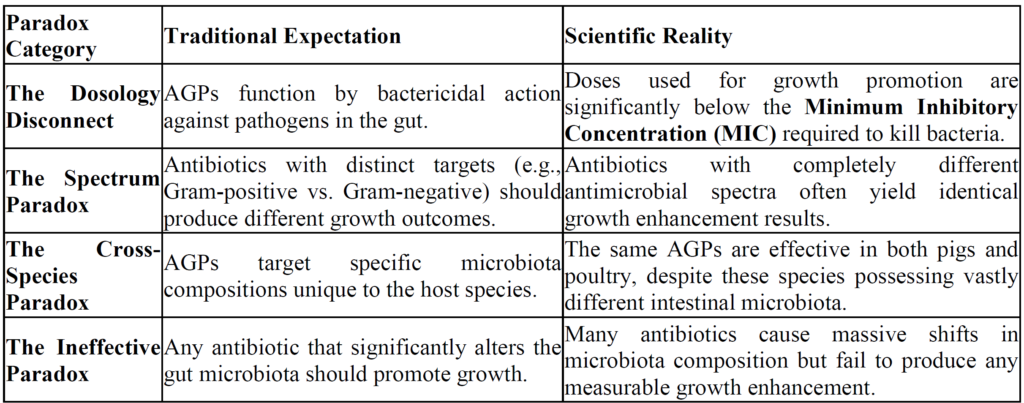
The Eubiosis Trap The industry often pursues “eubiosis”—a theoretical microbial balance—as a strategic goal. However, “eubiosis” is frequently a marketing construct rather than a biological reality. The exact composition of a “perfect” microbiota is unknown and completely undefined. Furthermore, genomic evidence confirms that major microbial shifts occur naturally during growth phases regardless of intervention. Relying on microflora management alone is a strategic trap;
This realization, coupled with the global imperative for Antimicrobial Resistance (AMR) stewardship, is driving the industry toward “Total AGP Replacers.” The goal is not merely to eliminate antibiotics to meet consumer demand for “clean meat,” but to ensure the Preservation of Antibiotic Efficacy for human and veterinary medicine by mitigating the selection pressure that creates resistant pathogens
Advanced Mechanism of Action: Host-Centric Physiological Modulation
The new scientific consensus indicates that AGPs work primarily as physiological modulators of the bird
rather than simple bactericides.
A. Immune Pacification and Anti-Inflammation
AGPs act as potent anti-inflammatory agents. At sub-therapeutic doses, they are selectively taken up by and accumulate inside local gut inflammatory cells (e.g., macrophages and heterophils). They down-regulate pro-inflammatory cytokines (IL-1, TNF-alpha) at the source, cooling the “inflammatory fire”. This modulates the gut immune system to a quiescent resting state, redirecting metabolic energy that would have been wasted on inflammation back into growth and production.
B. The Nrf2 Pathway and Physical Barrier Protection
Sub-therapeutic doses of certain antibiotics (e.g., BMD, Tetracyclines) trigger a mild production of Reactive Oxygen Species (ROS). This acts as a cellular stress signal that releases Nrf2 (Nuclear factor erythroid 2- related factor 2) from its tether (KEAP1). Nrf2 then moves into the nucleus to initiate the transcription of critical antioxidant enzymes like Superoxide Dismutase (SOD), Catalase, and Glutathione Peroxidase (GSH-Px). These endogenous antioxidants protect the structural integrity of the gut wall by shielding tight junction proteins (Claudins and Zonula Occludens-1), thereby preventing “Leaky Gut Syndrome”
2 C. Bile Salt Hydrolase (BSH) Inhibition
Certain AGPs physically bind to and inhibit the BSH enzyme produced by bacteria like Clostridium perfringens. In an antibiotic-free environment, high BSH production leads to unconjugated bile acids, which impairs fat absorption. AGPs preserve the Conjugated Bile Acid (CBA) pool, ensuring optimal lipid digestion and absorption.
D. Mitochondrial Hormesis and the “Cellular Vaccine”
AGPs cause a small, temporary slowdown in mitochondrial energy (ATP) production. This mild disruption triggers the Mitochondrial Unfolded Protein Response (UPRmt) and the production of mitokines. These signals permanently raise the bird’s systemic threshold for future immune and inflammatory responses, acting as a form of cellular “vaccination” that optimizes cell health. This occurs within the “Hormetic Zone”, where low-level stressors act as beneficial signals for intestinal resilience.
Anti-Virulence Mechanisms: Disrupting Gut Pathogens
When AGPs interact with bacteria, they do so by disarming them/reduces their virulence rather than eradicating them.
Quorum Sensing (QS) Inhibition: Pathogens like C. perfringens use QS to sense population density via autoinducers. AGPs disrupt the synthesis or binding of these signals, forcing bacteria to act as isolated individuals rather than a coordinated army, preventing synchronized attacks on gut tissue.
Toxin Gene Downregulation: Sub-lethal AGP concentrations stall bacterial ribosomes, altering mRNA stability. This suppresses the transcription of plc genes, directly reducing the production of alpha-toxin and NetB toxin, which are the primary drivers of Necrotic Enteritis.
Impairment of Adhesion and Motility: AGPs cause flagellar paralysis (turning off genes for bacterial “propellers”) and fimbrial mutilation (disabling the “velcro” hooks used for anchoring). Lacking these, pathogens are safely swept out of the gut by normal peristalsis.
The Challenge of Alternatives: Searching for Consistency
Many tools have been trialed to replace AGPs, primarily focusing on “Eubiosis” (gut balance). These include Probiotics, Prebiotics, Organic Acids, Enzymes, Bacteriophages etc, However, the central frustration of modern veterinary science is that “variable results are the norm.” Most alternatives fail because they only address one side of the dual-action mechanism. A “Total AGP Replacer” must be efficient, consistent, and reproducible.
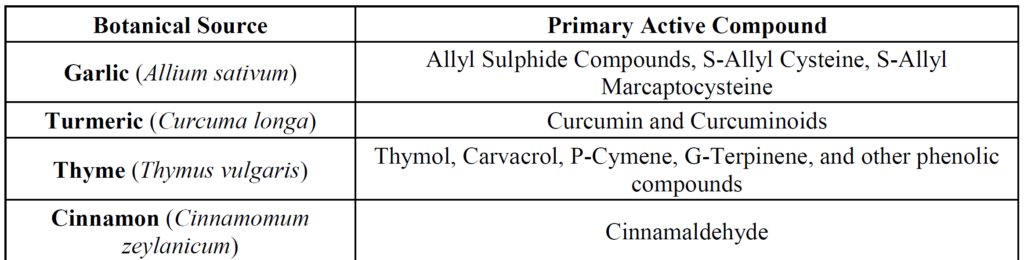
The future lies in Phytobiotics—specialized plant-based compounds that target multiple pathways simultaneously. Key ingredients in the innovator’s toolkit include:

Molecular Targets
The active compounds of Garlic, Turmeric, Thyme, Cinnamon and Indian Barberry can exhibit all the functions of AGP which includes the immune pacifiers, Nrf2 regulators,mitochondrial hormesis, BSH inhibition and also reduces the virulence of the bacteria by inhibiting the quorum sensing and also downgrade the toxin and mobility genes
Berberine employs multiple molecular mechanisms to inhibit C. perfringens spore germination (interfering with germinating receptors and blocking Ca-DPA efflux) and vegetative growth (inhibiting DNA replication, RNA transcription, and protein synthesis).
Our Product Soultion
PhyGuard AR is a next-generation phytogenic solution developed by the Rossari Biotech R&D division. It serves as a comprehensive, viable alternative to traditional Antibiotic Growth Promoters (AGPs) in poultry production.
By utilizing a proprietary, synergistic blend of bioactive botanical extracts—including Garlic, Turmeric, Thyme, Cinnamon, and Indian Barberry—PhyGuard AR replicates the complete biological efficacy of AGPs. This advanced formulation shifts the therapeutic paradigm away from a narrow “kill-only” antimicrobial mechanism. Instead, it adopts a host-centric, multi-modal approach.
And because PhyGuard AR target a vast array of essential proteins and enzymes simultaneously rather than a single specific target, it is incredibly difficult for bacteria to evolve resistance.
This strategic shift ensures the consistent, reproducible performance metrics required for modern, intensive, antibiotic-free production cycles, directly supporting global mandates for clean meat production.
Reference:
1. Miyakawa, M.E.F., Casanova, N.A. and Kogut, M.H., 2024. How did antibiotic growth promoters increase growth and feed efficiency in poultry?. Poultry science, 103(2), p.103278.
2. Niewold, T.A., 2007. The nonantibiotic anti-inflammatory effect of antimicrobial growth promoters, the real mode of action? A hypothesis. Poultry science, 86(4), pp.605-609.
3. Geng, W. and Lin, J., 2016. Bacterial bile salt hydrolase: an intestinal microbiome target for enhanced animal health. Animal health research reviews, 17(2), pp.148-158.
4. Naeem, M., 2026. Combating necrotic enteritis in poultry through nutritional interventions: a review of alternatives to antibiotics. Animal Diseases, 6(1), p.16.
5. Yu, Q., Lepp, D., Mehdizadeh Gohari, I., Wu, T., Zhou, H., Yin, X., Yu, H., Prescott, J.F., Nie, S.P., Xie, M.Y. and Gong, J., 2017. The Agr-like quorum sensing system is required for pathogenesis of necrotic enteritis caused by Clostridium perfringens in poultry. Infection and Immunity, 85(6), pp.10-1128.
6. Keyburn, A.L., Bannam, T.L., Moore, R.J. and Rood, J.I., 2010. NetB, a pore-forming toxin from necrotic enteritis strains of Clostridium perfringens. Toxins, 2(7), pp.1913-1927.
7. Fathima, S., Hakeem, W.G.A., Shanmugasundaram, R. and Selvaraj, R.K., 2022. Necrotic enteritis in broiler chickens: a review on the pathogen, pathogenesis, and prevention. Microorganisms, 10(10), p.1958.