Hatching eggs with hairline cracks pose a hidden threat, reducing the embryo’s ability to hatch and increasing the risk for contamination. A normal hatching egg leaves the hen without cracks. From the moment of lay, the egg is exposed to manual or automated egg collection, sorting, packing, and movement on the breeder farm, followed by transportation to the hatchery, and, in some cases, transfer from plastic or pulp trays to setter trays.
During this journey, rough egg handling may cause hairline cracks in the egg shell and possibly disrupt the underlying shell membranes. These hairline cracks may not be immediately visible to the naked eye and do not leave a trace of the exact moment of impact. Because of this, hairline cracks are often missed when doing quality checks during egg collection at the breeder farm. On arrival at the hatchery, hairline cracks that have occurred on the breeder farm are visible, but not consistently recognized, removed, and discarded. Egg quality analysis, conducted by Aviagen incubation specialists at customer hatcheries, revealed that the percentage of hairline cracks can be as high as approximately 7% for certain flocks.
This article focuses only on hairline cracks. It does not address body-checked eggs that were cracked and repaired inside the hen’s reproductive tract. These eggs typically have a crack covered by a layer of calcium, making the crack appear as a ridge or band (Figure 1).
HOW TO FIND HAIRLINE CRACKS?
Hairline cracks only become apparent after a few days when moisture from the air has had time to penetrate the crack and produce a faint gray line at the shell surface. When searching for hairline cracks in an egg pack, pick up and inspect each egg with a flashlight, as the crack may be located at the bottom or on the other side. A flashlight makes it easier to detect the moisture that has entered the crack becomes illuminated (Figure 1).
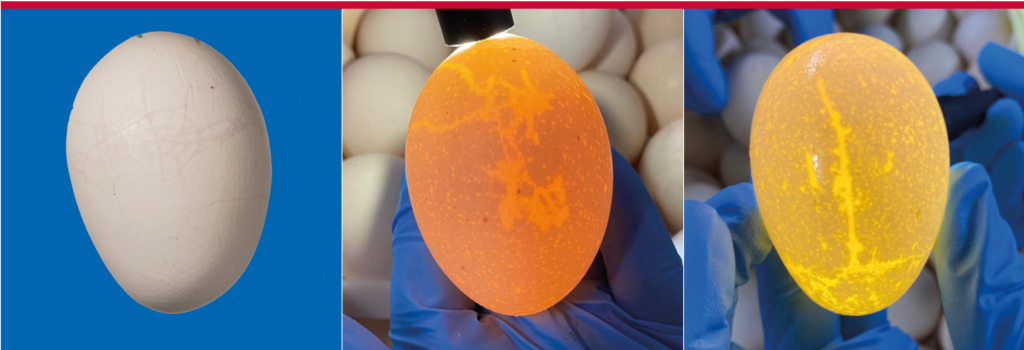
FIGURE 1: Examples ofa body-checked egg (left) and illuminated hairline cracks (right).
HOW TO LOCATE THE POINT OR LOCATION OF IMPACT?
Hairline cracks are often caused by collisions with other eggs or hard materials in the egg collection system. Whether an eggshell crack depends on the speed of the impact and the quality of the eggshell. High impact speed (G-force) and weak shells increase the likelihood of cracks.
The location of impact can be found in several ways. A quick check can be done by using your eyes and ears to detect the sight and sound of colliding eggs before or during egg collection, and by looking for sharp edges or rough transitions. Start from the laying nest and work down the egg collection system. Another method is to collect eggs after each transition point, store them for two days, and examine them for hairline cracks using a flashlight.
However, modern technology allows us to use a more sophisticated approach. An artificial egg with G-force sensors inside can be used to track the egg’s journey from laying until arrival at the hatchery. Each transition point should be checked several times, and real-time data provides information on the range of impact and the corresponding time. There are several artificial eggs on the market, for example: Wireless Egg Node, Cracklessegg, Mach-sens Egg Tracker and Gregg Smart Egg (Figure 2).
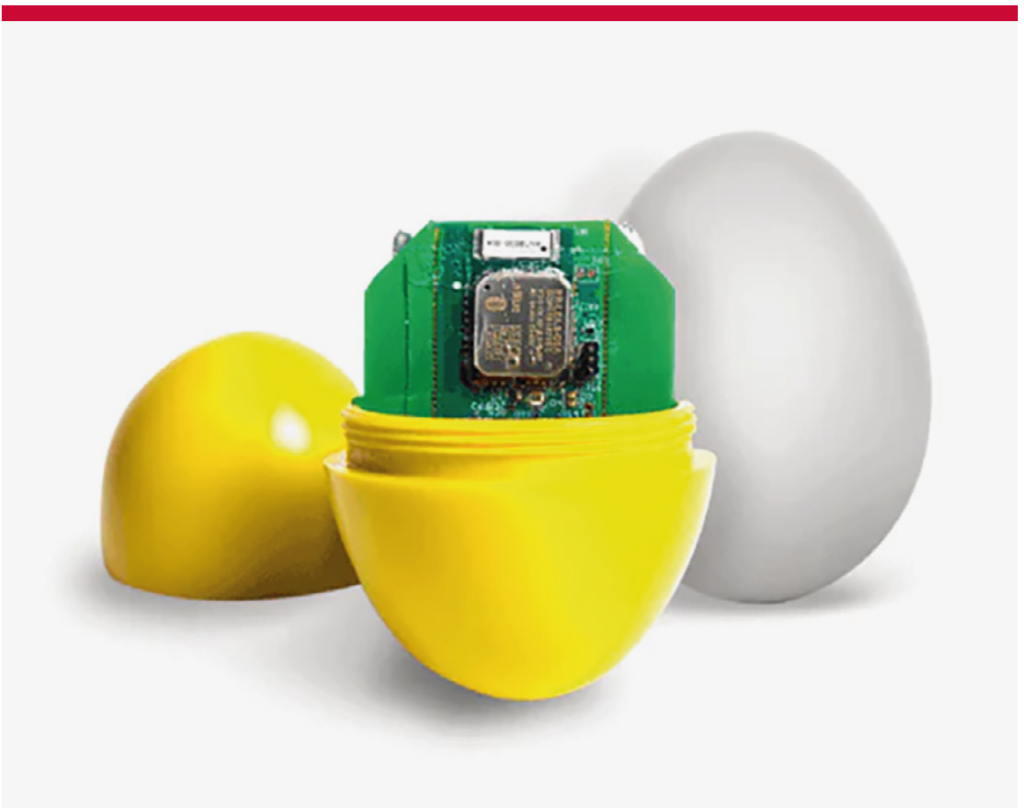
FIGURE 2: An artificial egg with a G-force sensor inside(crack/essegg.com).
HAIRLINE CRACK PREVENTION
Gentle egg handling
Minimize the use of harsh or overly automated equipment, and train staff and drivers on the importance of delicate egg handling.
Transport safeguards
Use shock-absorbent materials and avoid jarring motions during egg transportation from the farm to the hatchery.
Routine hatchery inspection
Candle samples from every batch of eggs immediately upon arrival at the hatchery, and track the hairline crack trends over time.
Routine breeder management evaluation
Any condition that makes the egg shell weaker will increase the likelihood of cracks. This could berelated to heat stress, nutrition, water quality, disease, or bird age.
Routine egg journey inspection at the breeder farm
Check the basics. Every nest must have a nest mat in good condition and, in the case of automation, a nest mat that is positioned correctly so that the eggs roll gently onto the belt without colliding with the nest walls or conveyor belt structures. The collection frequency should be a minimum of 4 times per day to prevent egg-to-egg collisions on the conveyor belt.
CONSEQUENCES OF HAIRLINE CRACKS
CONTAMINATION RISK
A cracked egg leaves the door open for bacteria to penetrate and possibly cause contamination. This risk increases when a hairline crack is caused while the egg is still in the cooling-down phase, just after lay, combined with a (slightly) dirty eggshell. Egg contents shrink when cooling down from the hen’s body temperature to storage temperature. This shrinking process facilitates bacterial penetration through cracks, as the slight under pressure pulls anything outside the egg into the egg. Usually, the shell and inner membrane act as a natural barrier for microbes or bacteria; however, when the shell and membrane are cracked and disrupted, the embryo is at risk. Eggshell cleanliness, affected by breeder house management, plays an important role in determining whether an egg with a hairline crack has to face a bacterial challenge. Research shows that losses due to contamination increase by a factor 5 to 6 (Figure 3).
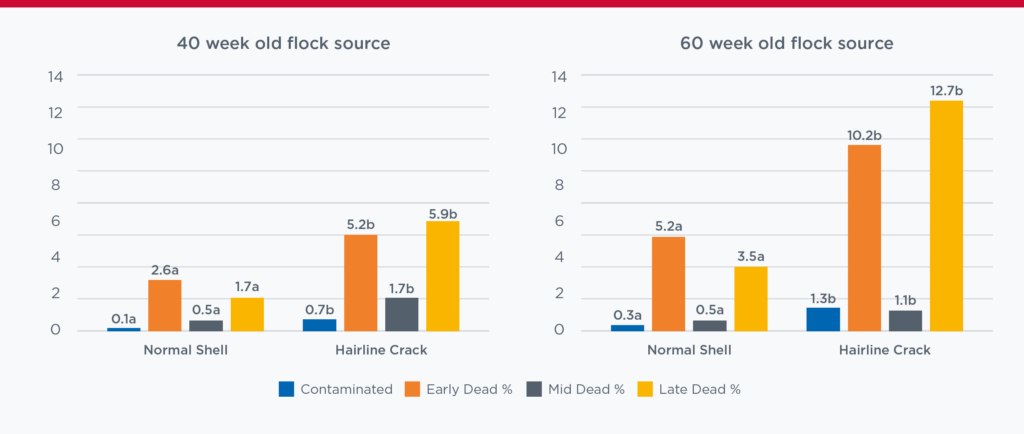
Figure 3: Hatch debris analysis (Aviagen trials 2025 and 2026). Letters show statistical di erences between normal eggshells compared to shells with a hairline crack.
REDUCED HATCHABILITY
Eggs with hairline cracks have reduced hatchability, as they are more vulnerable to contamination and dehydration. Reduction in embryo viability doubles or triples across all stages of incubation compared to a normal shell (Figure 3). A cracked egg will lose more weight due to increased moisture loss during incubation. Egg weight loss is, therefore, higher, and this will consequently lead to a lower chick yield (Figure 4). Chick yield is, however, less affected, as late dead embryos and dehydrated cull chicks are not included in the chick yield parameter. Overall, chicks hatched from cracked eggs have a lower quality, if they manage to hatch, resulting in more culled chicks (Figure 5). However, results may differ if using in-ovo vaccination.
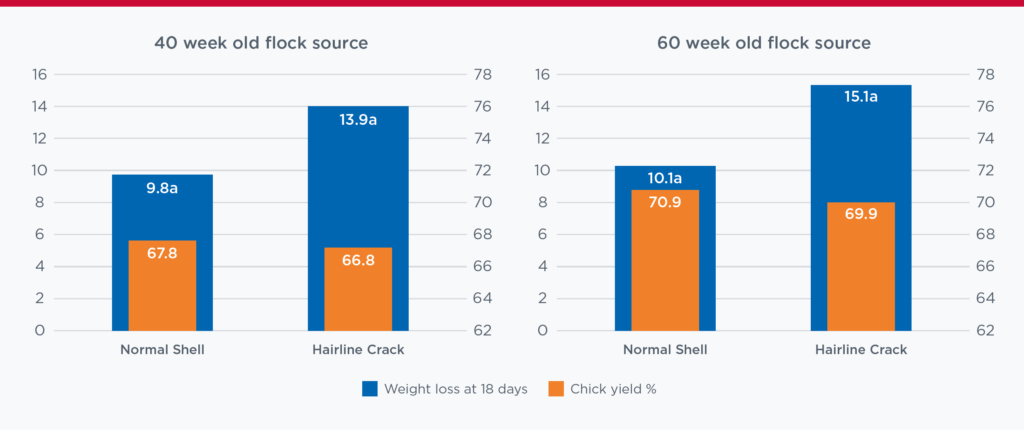
FIGURE 4: Weight loss and chick yield % (Aviagen trials 2025 and 2026). Letters show statistical differences for weight loss of normal eggshells compared to shells with a hairline crack. No significant difference was seen for chick yield, as all trayswere close to or within target, and incubation time was variable.
The Aviagen research presented below, with an average specifi c gravity above 1,080 for both fl ock ages (Figure 5), illustrates the drop in hatchability when comparing clean, normal eggs to those with hairline cracks. Experiments conducted by other researchers, for example, Barnett et al. (2004), show significantly larger drops in hatchability, which may be related to the origin of the eggs and eggshell cleanliness.
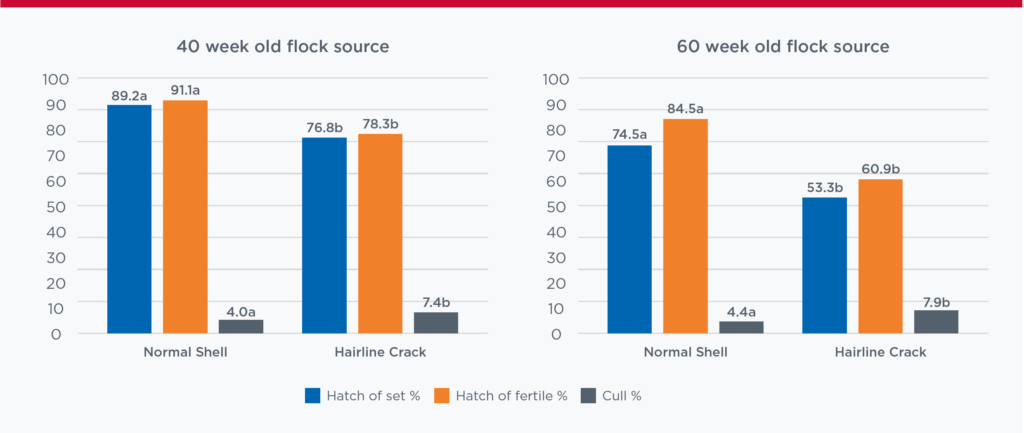
Figure 5: Hatch of set, hatch of fertile, and cull %. Hatch of set and hatch of fertile have culls removed. (Aviagen trials 2025 and 2026). Letters show statistical di erences for weight loss between normal eggshells compared to shells with a hairline crack.
As a commercial example, an average hatchery that sets 1 million eggs per week, with 4% hairline cracks in their egg pack, loses 0.5% hatchability. Assuming that hairline cracked eggs under hatch at a rate of 12.4%, this means 5,000 chicks are lost weekly. On a yearly basis, this translates to a loss of 260,000 chicks.
CONCLUSION
Eggs with hairline cracks are inferior compared to eggs without hairline cracks in terms of hatchability and chick quality, and cause an economic loss. Hairline cracks are detectable and mostly visible after a few days of storage at either the breeder farm or hatchery. There are multiple ways to find the cause, and therefore, eggs with hairline cracks are an unnecessary loss that should be avoided.