Better gut health, better performance
By Dr. Madri Brink, Global Technical Manager – Gut Health and Immunity, Orffa Additives B.V., The Netherlands. Sopaphan Pruekvimolphan, Technical Manager, Orffa (Thailand) Ltd.
Modern poultry production is evolving toward systems that demand both high efficiency and reduced dependence on antibiotic growth promoters. Under these conditions, intestinal health has become the central driver of profitability. Among the available nutritional tools to support gut health, butyric acid and its derivatives have proven highly effective. Butyrate is a key energy source for enterocytes, supporting rapid intestinal renewal. It also improves the villus-to-crypt ratio, enhancing nutrient absorption. Butyrate also plays a role in strengthening tight junction integrity, modulates NF-κB–mediated inflammation (cytokine production), and stimulates antimicrobial peptide production, thereby reinforcing host defense.
Different forms of butyric acid (salts, coated salts, and butyric acid glycerides) are used in poultry nutrition, each differing in efficacy, bioavailability, stability, and release within the gastrointestinal tract.
- Calcium or sodium salts form of butyric acid have free-flowing characteristics, easing their inclusion in compound feed,however, the antimicrobial activity of butyric acid salts is limited to the upper gastrointestinal tract (GIT).
- Encapsulated/coatedform with vegetable fats prevents butyric acid from being prematurely absorbed in the upper digestive tract so it can reach the hindgut and cecum.
- Butyric acid glyceridesform where butyric acid can be combined with glycerol, results in mono-, di-, or triacylglycerol forms. These forms of the acid are released only in the presence of pancreatic lipase in the small intestine, ensuring a more controlled release of butyric acid.
- Among this group, Tributyrin (TB)is generally considered more effective and practical than mono- or di-butyrin in commercial poultry feeds, delivering a much higher concentration of butyric acid per molecule.
Structure of tributyrin and its release kinetics
Tributyrin is the tri-ester of glycerol and butyric acid, meaning that one molecule of glycerol is esterified with three molecules of butyrate (Figure 1). The release kinetics could beestimatedas follows:
- Stomach (crop-proventriculus-gizzard): None, orvery limited: < 5% (because TB requires enzymatic degradation, it can resist gastric degradation).
- Small intestine (proximal & distal): 70-80% (because it requires enzymatic digestion by pancreatic lipase, hydrolysis mainly occurs in small intestine).
- Hindgut (cecum & colon): 20-25% (its gradual lipolysis allows active butyrate to reach the distal gut).
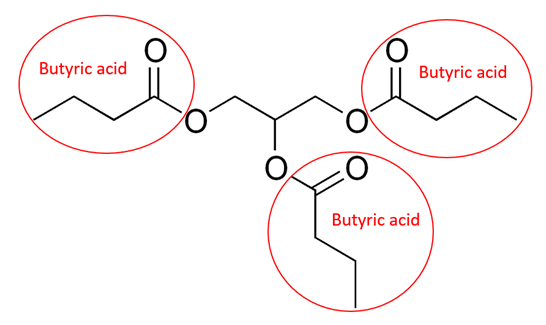
Figure 1. Tributyrin: Three butyrate molecules on a glycerol backbone.
This targeted releasemechanism provides a key advantage over both unprotected and coated butyrate. Free butyrate is absorbed very fast in the upper intestinal tract, limiting its availability in distal intestinalsegments. The release of butyrate from coated sources depends on coating quantity and integrity, which may vary under different feed processing and environmental conditions. In contrast, the release of tributyrin relies on enzymatic digestion by pancreatic lipase, ensuring a more predictable and physiologically controlled release profile. This results in more consistent biological responses, particularly in villidevelopment, epithelial renewal, and intestinal barrier function.
Proven efficacy in broilers, layers, and breeders
In a 42-day broiler study by Hu et al., (2021), 540 Arbor Acres birdswererandomly assigned to five treatments, each with 12 replicates: basal diet (Control) and basaldiet with TB at doses of 0.23, 0.46, 0.92, and 1.84 g/kg in TB1, TB2, TB3, and TB4, respectively.Tributyrin supplementation significantly improved average daily gain (Control vs. TB4:P < 0.05) and feed conversion ratio (Control vs. TB3 and TB4; P < 0.05)(Figure 2). Furthermore, significant improvements in jejunum’s villus height (VH), villus-to-crypt ratio(V/C) and ileum’s V/Cwere observedin all TB groups (P < 0.05), while duodenum’s VH and V/C were numerically higher in all TB groups,compared to Control. Tributyrin supplementation also numerically increased population of Lactobacillus and Bacillusin ileal and cecal digesta in all TB groups, with most of significant differences seen in TB3 and TB4 groups, compared to Control (P < 0.05). Coliforms population in cecal digesta were significantly lower in TB3 and TB4, compared to Control (P < 0.05). Shortchain fatty acid (SCFA) concentrations in the ileal and cecal digesta in all TB groupswere either numerically or significantly(P<0.05) higher than those from Control group (Figure 3).
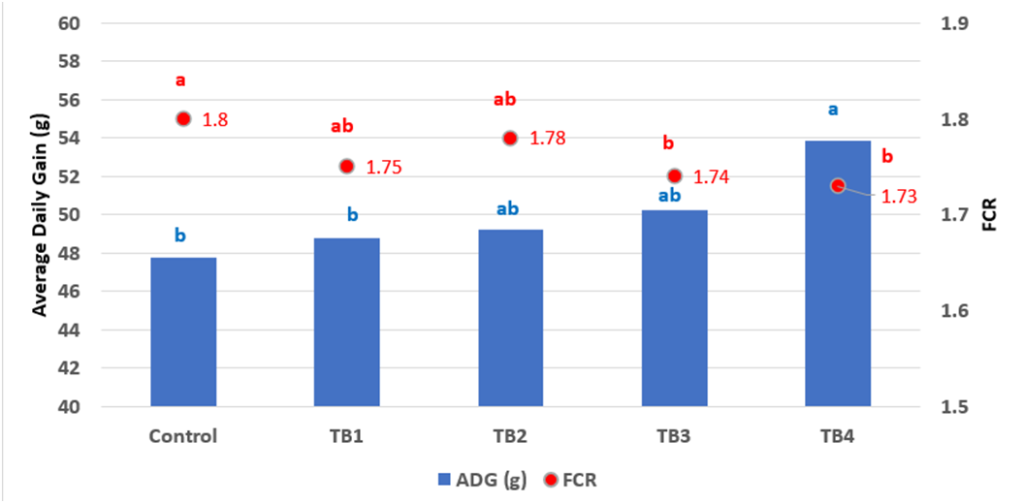
Figure 2. Effect of tributyrin (TB) on growth performance and feed conversion ratio (FCR). Control=basaldiet;TB1=basaldietsupplementedwith0.23g/kgTB;TB2=basaldietsupplementedwith0.46 g/kgTB;TB3=basaldietsupplementedwith0.92g/kgTB;TB4=basaldietsupplementedwith1.84g/kgTB. a,bMeanvalueswithdifferentsuperscript lettersweresignificantlydifferent (P<0.05).
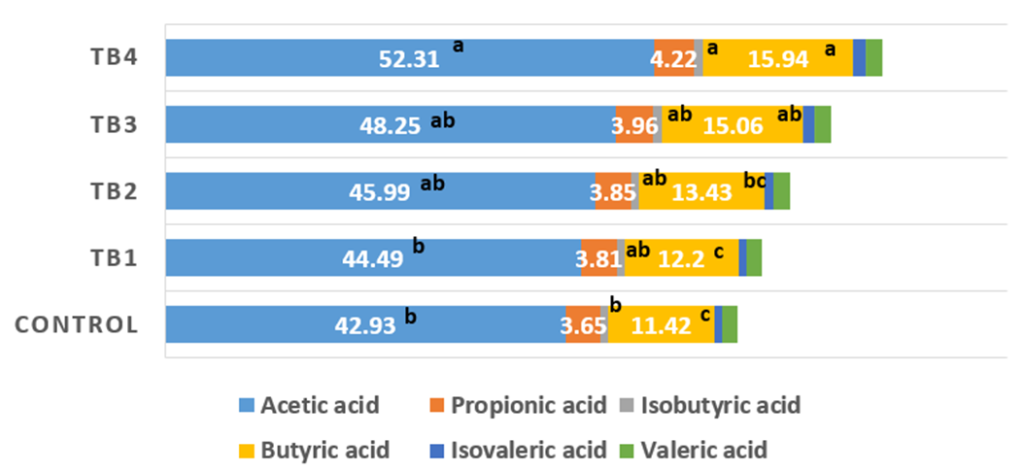
Figure 3. Effect of tributyrin (TB) on shortchain fatty acids concentration (µmol/g fresh digesta) incecaldigestainbroilers at 42 days. a,b Mean values with differentsuperscript letters were significantly different (P<0.05). Numerical data shown in the figure are acetic, propionic, and butyric acid only for legibility.
Another42-day ArborAcresbroiler study by Hu et al., (2022) with 432 birds confirmed the value of tributyrin.Graded supplementation of a tributyrin product at 0.5, 1.0, and 2.0 g/kg improved growth performance (lower FCR in all feeding phases: 0-21, 22-42, and 0-42 days in 1.0 and 2.0 g/kg TB groups; P < 0.05), and better carcass traits (higher eviscerated carcass rate and lowerabdominal fat yield than those in the control group (P <0.05).Dietary TB groups improved the kidney, spleen, thymus, and bursa indices (P < 0.05) compared with those in the Control group. In addition, the white and red blood cell counts, platelet count, hemoglobin and hematocrit at d 21, and platelet count at d 42 were improved (P < 0.05), with those in 2.0 g/kg TB group being most affected.These findings indicate that tributyrin acts beyond the gut, supporting systemic physiology and overall bird robustness.
The benefits of tributyrin also extend to layers and breeders. Better intestinal health supportsmore efficientallocation of absorbed nutrients toward productive functions, not only maintenance, intestinal integrity, immune response, but also reproduction and egg formation. In broiler breeder study by Wang et al., (2021), dietary tributyrin (1g/kg) improved reproductive performance and egg characteristics, increasing egg weight, albumen height, Haugh unit, and ovarian antioxidant capacity (Table 1), while reducing malondialdehyde and ovarian cell apoptosis.
Table 1. Effect of tributyrin on egg production, reproductive performance, and ovary antioxidant capacityofbroilerbreeders.
| Treatment | Laying rate, % | Egg weight, g | FCR | Albumin height, mm | Haugh unit | SOD | T-AOC | MDA |
| Control | 78.58a | 64.10b | 3.12a | 6.12b | 74.60b | 181.41 | 0.60b | 1.65a |
| Tributyrin | 78.67a | 66.99a | 2.92a | 6.61a | 78.51a | 191.03 | 0.78a | 1.23b |
| P-value | <0.01 | <0.01 | 0.05 | 0.02 | 0.05 | 0.55 | 0.01 | 0.05 |
Abbreviations:SOD: Superoxidedismutase; T-AOC: Total antioxidantcapacity; MDA: malondialdehyde.a,bMeanswithdifferentsuperscriptswithinacolumndiffersignificantly (P≤0.05).
Key considerations
A wide range of commercial butyric acid products are available, including butyric acid salts, coated salts, and butyrate glycerides such as tributyrin. While all forms can support gut health, intestinal integrity, and performance, they differ markedly in active butyric acid level, site of release, stability, and handling properties. Key considerations include whether the butyrate reaches the target intestinal segment, the level of butyric acid effectively delivered, and how consistent the product performs after pelleting process. Coating quality, odor, volatility, andthe whole feed processing process can all influence practical value beyond the label claim. Overall, TB and coated BA are generally preferred when targeted delivery, ease of handling, and processing practicality are priorities. The table below summarizes the main advantages and concerns of each product type.
| Category | Tributyrin (TB) | Coated butyric acid salts | Unprotected butyric acid salts |
| Molecule and delivery mechanism | Advantage: Glycerol tri-ester releases butyrate via lipase digestion for controlled intestinal delivery. Consideration:Influenced by lipid digestion. | Advantage: Protected form for gradual gastrointestinal release. Consideration: Release kinetic varies with coating and processing methods. | Advantage: Highest immediate butyric acid level. Consideration: Rapid upper-gut absorption limits distal delivery. |
| Butyric acid equivalence / active content | Advantage: High butyrate equivalence; 60% TB provides about 52.45% butyric acid equivalent. Consideration:Ensure effective dosage is met. | Advantage: HighBA content products can deliver more total butyric acid. Consideration: Lower butyrate equivalence than TB. | Advantage: 100% butyric acid. Consideration: High active BA content does not ensure distal delivery. |
| Gut morphology and microbial effects | Advantage: Studies show higher villus height, villus: crypt ratio, beneficial bacteria, and SCFAs concentration. Consideration:Ensure effective dosage is met. | Advantage: Improves GIT morphology, beneficialbacteria, and SCFAs concentration. Consideration: Response varies with coating technique and release profile. | Advantage: Acidification and antimicrobial effects in the upper gut. Consideration: Less reliable delivery to distal intestinal sites. |
| Handling and processing | Advantage: No coating step, less odor, easier formulation and handling than free BA. Consideration:Choose high purity for the best quality product. | Advantage: Established and widely used technology. Less odor. Consideration: Coating can dilute active content and add complexity. | Advantage: Simple chemistry with no coating cost. Consideration: Strong unpleasant odor, volatility, and handling challenges. |
Conclusion
As poultry production moves toward greater efficiency, resilience, and reduced antibiotic dependence, the value of targeted butyrate delivery becomes increasingly clear. The evidence presented in this article shows that tributyrin provides a controlled and gradual release of butyric acid that supports intestinal integrity, microbial balance, nutrient utilization, and productive performance across broilers, layers, and breeders.Tributyrin combines strong biological efficacy with good handling properties, formulation flexibility, and consistency under modern feed processing conditions.
References available upon request