Dr. Pothanna Technical Manager (Trouw Nutrition)
Introduction
Mash feed continues to be the most widely adopted feeding system in the poultry and livestock industry because of its simplicity, flexibility, cost-effectiveness, and ease of implementation at both feed mill and farm levels. For decades, conventional mash feed manufacturing has played a critical role in supporting animal productivity by enabling nutritionists to formulate precise diets based on species, age and production stages.
Traditionally, micro-ingredients such as vitamins, minerals, amino acids, enzymes, toxin binders, and other functional feed additives are incorporated individually into the mixer. While this approach remains widely practiced, the growing intricacy of modern feed formulations has introduced several operational challenges. Achieving uniform distribution of low-inclusion ingredients, maintaining dosing accuracy, minimizing segregation, and efficiently handling multiple additives during feed processing can become difficult, particularly under large-scale production conditions.
In recent years, feed formulations have expanded beyond conventional raw materials to include a broader range of functional components such as acidifiers, probiotics, antioxidants, and other bioactive compounds. While these additions enhance performance and resilience, they also increase formulation complexity and place greater demands on mixing precision and process control.
To address these challenges, composite premix technology has emerged as an advanced solution within conventional mash feed systems. By combining multiple micro-ingredients into a single, homogeneous blend prior to inclusion, composite premixes help improve mixing efficiency, reduce handling complexity, and enhance nutrient uniformity in the final feed.
However, the use of composite premixes also requires careful consideration. Nutrient stability, ingredient compatibility, and potential interactions among vitamins, minerals, and functional additives during processing and storage can influence overall efficacy if not properly managed through meticulous formulation and quality control practices.The selection of appropriate raw materials, carrier systems, mixing technologies, and storage conditions plays a vital role in preserving nutrient integrity and ensuring optimal bioavailability.
Therefore, both conventional mash feed systems and composite premixes hold significant relevance in modern poultry nutrition. While mash feed remains the foundation of feed manufacturing, composite premixes offer a strategic approach to improving precision, consistency, and functional performance when designed and applied effectively.
Composite Premix
A composite premix is a scientifically formulated blend of multiple micro-ingredients combined into a single homogeneous mixture prior to incorporation into animal feed. These premixes typically include vitamins, minerals, amino acids, enzymes, toxin binders, acidifiers, antioxidants, probiotics, betaine, and other functional additives in well-adjusted proportions.
In modern poultry and livestock nutrition, the inclusion of multiple functional additives at very low inclusion levels has become increasingly common. Under such conditions, achieving uniform distribution of individual ingredients in conventional mash feed systems becomes challenging. Composite premixes address this limitation by improving dispersion and ensuring a more consistent supply of nutrients throughout the feed.
Besides facilitating mixing uniformity, composite premixes contribute to overall feed system efficiency by supporting:
- Precision nutrition through accurate nutrient delivery
- Better feed consistency across batches
- Reduction in weighing and handling errors at the feed mill
- Improved feed mill efficiency
- Simplified inventory management
- Consistency in animal performance
An important advantage of composite premixes lies in their flexibility. They can be customized based on species, production stage, and specific field challenges such as heat stress, gut health management, liver function support, and mycotoxin risk mitigation. This adaptability makes them a valuable tool in addressing region-specific and farm-level nutritional requirements.
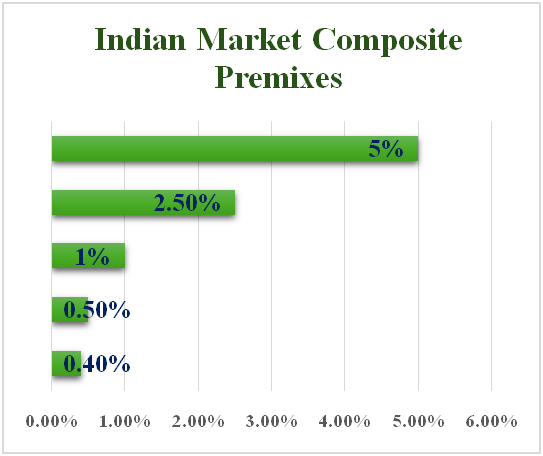
In the Indian poultry industry, 0.4%, 0.5%, 1%, 2.5%, and 5% composite premixes are commonly used, each offering distinct functional and practical advantages. The choice of inclusion level is influenced by feed mill capabilities, formulation strategy, ingredient availability, and the degree of nutritional precision required.
Lower inclusion premixes, particularly 0.4% and 0.5%, are widely adopted in layer feed as flexible, near-universal solutions. These formulations typically exclude fixed amino acid profiles, allowing nutritionists greater freedom to adjust protein sources and incorporate unconventional raw materials based on cost and availability.
In contrast, higher inclusion premixes such as 1%, 2.5%, and 5% often contain defined amino acid specifications along with a broader range of functional additives. While these systems offer improved standardization and ease of formulation, they require careful alignment with bird age, production stage, and performance targets to fully realize their benefits.
Key Practical Considerations
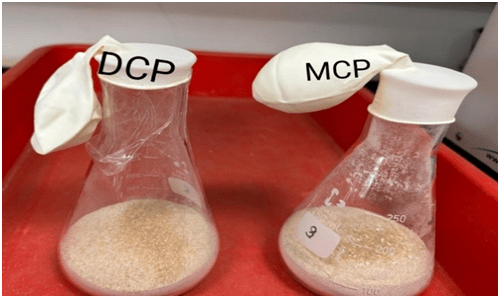
In composite premix formulation, the selection of mineral sources is critical for maintaining nutrient stability, feed quality, and shelf life. Among phosphorus sources, Mono Calcium Phosphate (MCP) and Di Calcium Phosphate (DCP) are commonly used based on formulation and handling requirements.
DCP is generally preferred in commercial premixes due to its better physical stability, lower moisture absorption, ease of handling, and cost-effectiveness under practical storage conditions.
| Source | Advantages | Disadvantages |
| MCP (Mono Calcium Phosphate) | Higher phosphorus availability, better digestibility, improved nutrient utilization, greater formulation flexibility | Hygroscopic in nature, may lead to bag bulging, caking, reduced flowability, and potential vitamin stability issues during storage |
| DCP (Di Calcium Phosphate) | More economical, widely available, better physical stability, lower moisture absorption, easier storage and handling | Lower phosphorus availability and comparatively lower nutrient utilization than MCP |
Ingredient Interactions and Nutrient Stability
One of the key challenges in composite premixes is the interaction between vitamins, minerals, and other functional additives during storage and feed processing. Certain inorganic minerals can accelerate the oxidation of sensitive vitamins, leading to reduced nutrient stability and biological effectiveness before feed consumption.
Additionally, the source and form of minerals significantly influence nutrient utilization. Inorganic minerals generally have lower bioavailability compared to organic or chelated forms. As a result, improper ingredient selection and incompatibility among nutrients can adversely affect nutrient availability, animal performance, and overall feed efficiency.
Importance of Carriers and Density in Composite Premixes
Both organic and inorganic carriers are commonly used in composite premix formulations, with selection depending on formulation objectives, physical properties, and cost considerations. Inorganic carriers such as calcium carbonate, dicalcium phosphate, and silica-based materials are widely used for their consistent particle size, density, and compatibility with various nutrients.
Organic carriers, including rice hulls, wheat bran, rice bran, maize bran, and soybean hulls, are also used based on availability and desired functional properties. These materials can contribute to moisture absorption, improved bulk characteristics, and better handling during processing.
The choice of carrier should be based on factors such as particle size, bulk density, moisture content, interaction with active ingredients, and overall impact on premix stability, rather than preference for any specific material.
Homogeneity and Quality Control
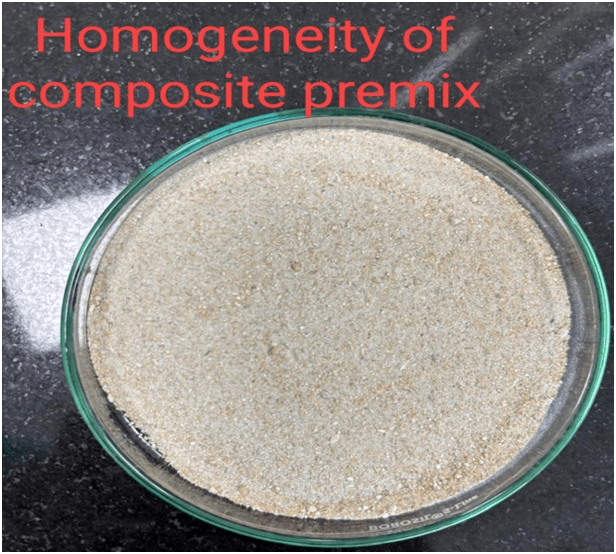
Proper homogeneity is essential in composite premixes to ensure uniform nutrient distribution and consistent animal performance. Good mixing uniformity supports feed quality, nutrient accuracy, and overall product consistency.
Regular quality control is critical to maintain premix stability and effectiveness. Key parameters such as moisture content, physical stability, coefficient of variation (CV), and vitamin recovery should be routinely monitored to ensure nutrient integrity during manufacturing and storage.
In addition, maintaining fresh stock and minimizing storage duration are important for preserving nutrient activity and shelf life. Appropriate storage conditions and efficient inventory management further help in maintaining product quality and achieving consistent field performance.
Conclusion
The success of composite premix systems depends on a well-controlled approach to formulation and manufacturing. Key factors such as ingredient compatibility, nutrient stability, carrier selection, density balance, mixing uniformity, storage conditions, and robust quality control collectively determine the consistency and effectiveness of the final product. Equally important is the role of modern feed mill infrastructure, including advanced mixing technology, accurate dosing systems, and controlled processing conditions.
Trouw Nutrition supports this approach through customized composite premix solutions backed by strong technical expertise, advanced manufacturing capabilities, and comprehensive laboratory support. By integrating scientific formulation with practical field application, composite premixes can significantly enhance feed quality, optimize nutrient utilization, and drive consistent animal performance.
As the industry continues to move toward precision nutrition and performance consistency, composite premix systems will play an increasingly important role in modern poultry feed manufacturing.