By Inge Peeters, Global Solution Manager – Feed Efficiency, Orffa Additives B.V., The Netherlands. Sopaphan Pruekvimolphan, Technical Manager, Orffa (Thailand) Ltd.
Fat digestion remains one of the most persistent challenges in poultry production. Whether in fast-growing broilers or long-cycle layers, birds must emulsify dietary fats efficiently within a digestive system dominated by water. Young birds struggle with limited bile and lipase secretion, while layers face constant metabolic pressure from egg production. Emulsifiers help bridge these physiological gaps—but their chemistry determines how effectively they perform inside the bird.
Among the various emulsifier options available, Glyceryl Polyethylene Glycol Ricinoleate (GPGR) stands out: its physicochemical behavior aligns closely with the actual conditions of the small intestine.
What is GPGR?
GPGR, also known as E484, is a non-ionic emulsifier produced through ethoxylation of castor-oil-derived glycerol esters. Its hydrophilic–lipophilic balance (HLB) is defined by the way the molecule is engineered. High-HLB GPGR typically falls within the 16–18 range, assuring it as a strongly hydrophilic molecule optimized for forming oil-in-water emulsions.
Scientifically, GPGR is defined by three core properties:
- Strong hydrophilicity, enabling dispersion in the intestine’s aqueous environment.
- Non-ionic behavior, meaning its functionality does not depend on bile concentration or conjugation.
- High emulsion stability, allowing consistent smaller droplet formation across a wide range of pH and temperatures.
Why does the Aqueous Gut Favors GPGR?
The small intestine is fundamentally water-rich, regardless of dietary fat levels. Emulsifiers that perform well in this environment must favor oil-in-water systems. Lecithin, with its low HLB, is better suited for feed processing roles than intestinal emulsification. Lysolecithin can perform more effectively inside the gut, however, it still depends heavily on adequate bile salt secretion and quality.
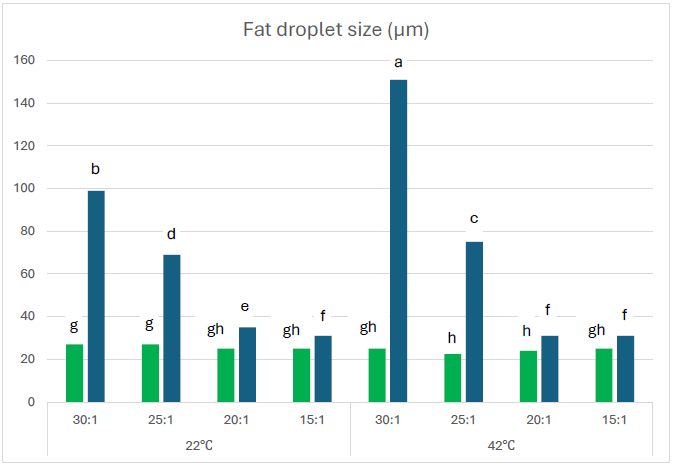
In contrast, GPGR’s high HLB allows it to disperse rapidly in the aqueous lumen and form fine, stable droplets that persist longer as digesta moves along the gut. This stability is critical because it preserves fat surface area for enzymatic attack and improves downstream steps in digestion. An in vitro study (Figure 1) conducted by Northwest A&F University in China showed a significant smaller fat droplet size (P<0.0001) of GPGR-based, compared to Lysolecithin- based emulsifier, over all Water:Oil ratios (30:1 to 15:1) and temperatures (22°C and 42°C, mimicking chicken body temperature).
What GPGR Changes in the Digestive Process
Once GPGR contacts dietary fats, interfacial tension drops sharply, enabling fats to disperse evenly throughout the lumen. This fine droplet structure remains intact despite fluctuations in pH or temperature that naturally occur during digestion.
As lipolysis progresses, GPGR supports the formation of mixed micelles—tiny carriers that transport fatty acids and fat-soluble nutrients across the intestinal wall. This micellar support is essential for efficient absorption and becomes increasingly important in birds with limited endogenous bile or lipase.
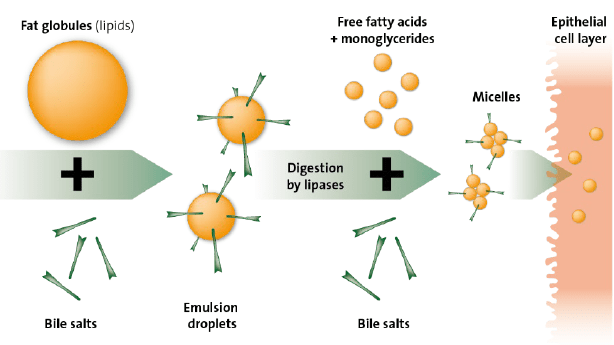
To emphasize this digestibility pathway, GPGR strengthens all three rate-limiting steps:
• Emulsification: Creating small, stable droplets in the aqueous lumen.
• Lipolysis: Prolonging enzyme access to fat surfaces.
• Micelle formation: Stabilizing transport of lipolysis products for efficient absorption.
This coordinated improvement explains why GPGR often outperforms emulsifiers with lower HLB values or bile-dependent mechanisms.
Reliability Under Challenging Conditions
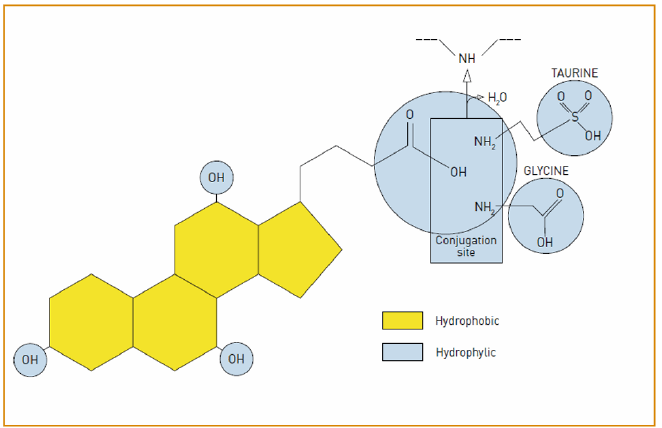
Modern poultry systems face digestive variability, particularly in antibiotic-free (ABF) environments. Microbial populations often produce bile salt hydrolase, which deconjugates bile salts and reduces their emulsifying power (Figure 3). Under such conditions, lecithin- based or lysolecithin-based emulsifiers lose efficiency.
GPGR avoids this weakness because it is non-ionic and bile-independent, it remains functional regardless of bile status. Its performance also remains stable when diets contain higher-saturated fats, when temperatures fluctuate, or when energy density is intentionally reduced. Even pelleting and processing stresses do not significantly impair GPGR’s functionality. This stability is one of the reasons GPGR works predictably and consistently across farms, feed mills, fat sources, and microbial environments.
What Broiler Studies Reveal About GPGR
Across controlled trials, broilers fed GPGR show improvements in body weight gain, feed conversion, and total-tract nutrient retention. These gains appear consistently, not only in high-energy diets but also in formulations where energy has been reduced. Young broilers exhibit the strongest responses due to their natural limitations in bile and enzyme secretion. GPGR supplements this gap by stabilizing emulsification and micellar transport during the developmental stages when birds struggle most with fat digestion.
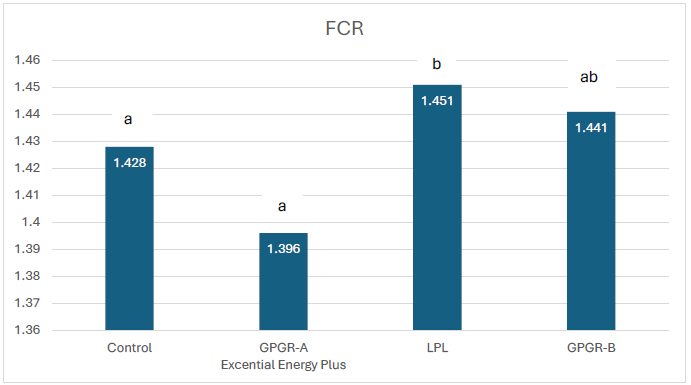
A study was conducted (Belgium, 2021) with 1,080 male Ross 308 broilers fed one of four diets for 35 days: a Control diet, GPGR-A (350 ppm Excential Energy Plus, Orffa Additives BV), a lysophospholipids-based emulsifier (500 ppm), and GPGR-B (500 ppm) (Figure 4). All tested emulsifiers were added on top of nutritionally challenged control diet with added rye and rapeseed meal, an increased crude protein level, without non-starch polysaccharides
(NSP) enzyme. Excential Energy Plus consistently showed a numerically and significantly better final body weight, FCR, and European Production Efficiency Factor (EPEF), as compared to Control and other emulsifier groups. This study also highlighted that not all GPGR-based emulsifiers are the same and have the same benefits on performance. Therefore, it is advisable for nutritionists to make well-informed choices when selecting the most suitable and effective emulsifier.
What Layer Studies Reveal — Different Physiology, Same Advantage
Layers face a completely different physiological challenge, but the advantage remains. Instead of rapid growth, they require steady nutrient delivery to support ongoing egg formation over an extended cycle. Fat digestion influences egg mass, yolk quality, persistency of lay, and metabolic resilience. These effects become especially noticeable when diets contain more saturated fats or when energy density fluctuates. GPGR’s independence from bile allows hens to maintain efficient fat utilization even when their endogenous systems weaken. This results in smoother transitions through peak lay and fewer dips associated with fat quality or digestive stress. In a study (Brazil, 2024) of Bovans White laying hens fed an energy-reduced diet (-70 kcal/kg feed), several emulsifiers with different active ingredients and HLB values were evaluated. Emulsifiers overall helped boost production efficiency and egg quality. Among them, Excential Energy Plus, which contains GPGR, showed superior results in egg production percentage, egg weight, and feed conversion ratio per kilogram of egg (Figure 5) compared to other emulsifiers. Additionally, the yolk color and uniformity of yolk pigmentation improved significantly, compared to other treatments, suggesting increased pigment absorption and better fat emulsification and digestion in layer fed Excential Energy Plus.
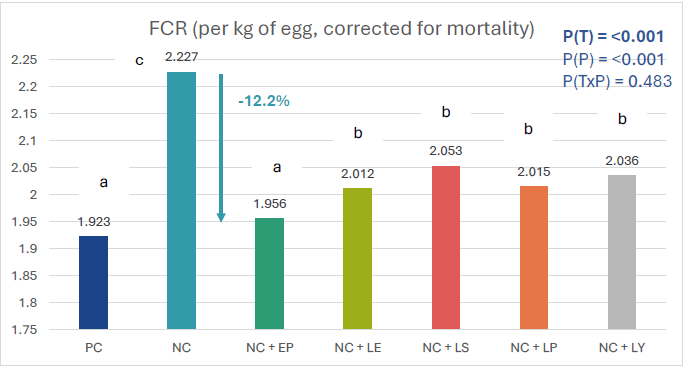
NC: Negative Control
EP: Excential Energy Plus 350 ppm LE: GPGR-based, low HLB, 500 ppm LS: Lecithin + GPGR 250 ppm
LP: Lysolecithins 500 ppm
LY: Lysolecithin + Monoglycerides + GPGR 500 ppm.
How GPGR Differs From Traditional Emulsifiers
- Lecithin remains useful for feed and feed mill processing benefits but performs inconsistently inside the gut due to its low HLB.
- Lysolecithin offers stronger intestinal performance but is more sensitive to bile variability and stress conditions.
- Bile acids can help with saturated fats but are dose-dependent and highly vulnerable to microbial deconjugation.
- GPGR stands out for its stable gut performance, high hydrophilicity, independence from bile, working reliably across different ages, dietary oil/fat source and quality, and production systems.
Right Emulsifier, Right HLB, Right Outcome
It is important to choose an emulsifier that matches the gut’s aqueous environment. GPGR’s high-HLB, non-ionic chemistry is built to create stable oil-in-water emulsions in vivo. Use it according to your objective—reformulate and reduce feed cost or apply on-top to increase performance when savings aren’t the priority. The same mechanism—improved dispersion, lipase access, and micelle transport—underpins consistent results across diets and conditions.
Reference available upon request