


Pelleted feed has become the dominant choice in the poultry industry due to its proven advantages in improving feed efficiency, minimizing feed wastage, and improving bird performance. Compared to mash diets, pelleting reduces ingredient segregation and selective feeding, ensuring birds to consume a consistent and balanced nutrient mix (Cutlip et al., 2008). This uniform nutrient intake leads to improved flock performance and more consistent growth. Additionally, pelleting process enhances nutrient utilization by promoting starch gelatinization, protein denaturation, and overall digestibility (Amerah et al., 2007). Conversely, poor pellet quality can have significant economic and nutritional drawbacks. Excess fines in the feed increases feed wastage, lower feed intake, and cause nutrient imbalance, ultimately impairing growth and feed conversion ratio (FCR). Studies have consistently demonstrated that improved pellet durability is associated with better body weight gain, FCR, and overall flock uniformity (Abadi et al., 2019; Abdollahi et al., 2013).
To address these challenges, feed manufacturers often add pellet binders to their feed formulations. Pellet binders help the feed particles stick together, enhancing inter-particle adhesion, reduce breakage during handling, and minimize fines, leading to improved pellet durability index (PDI) and hardness. Their role is particularly crucial in diets low in natural binders (e.g., corn–soy diets) or high in fat, where pellet integrity is otherwise compromised (Thomas & van der Poel, 1996). Thus, the inclusion of pellet binders has become a valuable technological strategy for sustaining pellet quality and improving poultry production outcomes.
2. Pellet Quality and Its Measurement
Pellet quality is vital in poultry feed production as it affects feed intake, nutrient utilization, and bird performance. High-quality pellets resist breakage, reducing fines and wastage (Thomas et al., 1998), while poor-quality ones cause selective feeding and lower growth efficiency (Abadi et al., 2019).
- Pellet Durability Index (PDI):
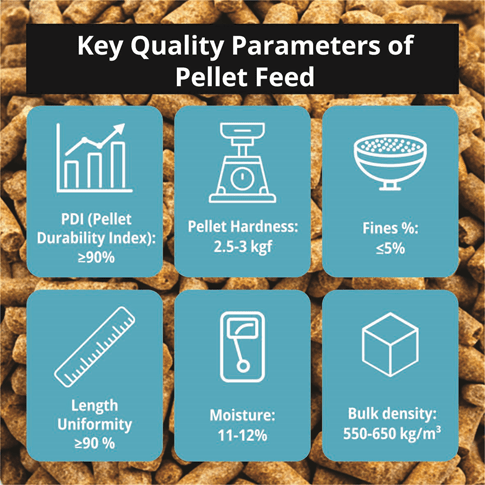
PDI measures a pellet’s resistance to mechanical breakdown during handling. It is expressed as the percentage of intact pellets after tumbling; values above 90% indicate good quality, while below 85% suggest poor durability (Pfost, 1995; Behnke, 1994; Ridla et al., 2024). - Pellet Hardness:
Indicates resistance to crushing and it depends on conditioning temperature, die design, moisture, and binder use (Thomas & van der Poel, 1996; Amerah et al., 2007). - Fines Percentage:
Refers to broken pellet fragments or dust that reduce feed efficiency. Binders like lignosulfonates, clays, and hydrocolloids minimize fines by enhancing particle adhesion (Briggs et al., 1999; Saleh et al., 2020). - Other Parameters:
Uniform pellet length, proper moisture, and bulk density ensure consistent intake and prevent pellet softening or brittleness (Thomas et al., 2001).
3. Factors Affecting Pellet Quality Measurement
- Feed formulation: High fat reduces bonding and weakens pellets, while wheat or gluten enhances durability through starch–protein interactions.
- Particle size: Fine, uniform grind improves PDI by increasing bonding surface, though over-grinding raises energy use and blockage risk.
- Moisture and steam: Adequate moisture and quality steam promote starch gelatinization and protein denaturation, strengthening pellets.
- Conditioning: Optimal temperature (70–80°C) and retention time improve hardness and durability, but heat-sensitive nutrients must be protected.
- Binder use: Additives like lignosulfonates, clays, or hydrocolloids enhance PDI, especially in low-starch or high-fat feeds; dosage should be optimized.
- Die design: Proper die thickness, L:D ratio, and finish improve compression and durability while maintaining throughput.
- Mill setup: Correct roll–die gap and maintenance ensure effective consolidation and fewer fines.
- Cooling and drying: Controlled cooling stabilizes pellet structure; over-cooling or high moisture increases breakage and microbial risk.
- Post-pellet liquids: Applying fats or enzymes after cooling maintains strength; excess coating can cause slippage and fines.
- Raw materials: Starch type and gelatinization properties affect achievable pellet strength.
- Energy and throughput: High throughput shortens compression time, reducing PDI; balance is key for consistent quality.
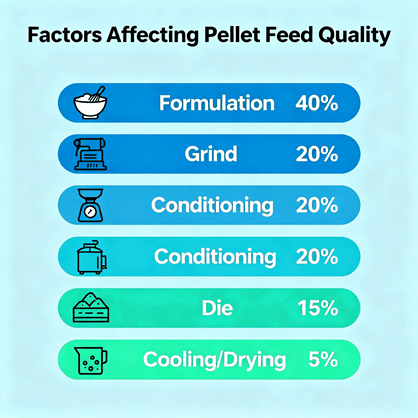
Accurate measurement of these parameters allows feed manufacturers to monitor and optimize the pelleting process, ensuring consistent feed quality and better performance outcomes in poultry production.
4. Types of Pellet Binders and Their Mechanisms
4.1 Cereal-Based Binders
Wheat, wheat middlings, and gluten serve as natural binders through starch gelatinization and protein matrix formation. Wheat gluten provides viscoelastic strength, while corn- or sorghum-based diets often require added binders (Thomas & van der Poel, 1996; Saleh et al., 2020).
4.2 Lignosulfonates
Calcium lignosulfonate (Ca-LS), a byproduct of the pulp industry, forms a sticky matrix that solidifies on drying, reducing fines. Inclusion at 0.5–1.0% enhances PDI and hardness, particularly in high-fat feeds, and is considered safe for all species (Skoch et al., 1981; Abadi et al., 2019; EFSA, 2020).
4.3 Clays and Mineral Binders
Bentonite, zeolite, and sepiolite improve pellet density and hardness while offering toxin-binding benefits. Their main function is physical compaction, though excessive use may dilute nutrients (Yalçin et al., 2017).
4.4 Hydrocolloids and Polymers
Binders like CMC, guar gum, and starch derivatives enhance pellet cohesiveness by forming viscous solutions during conditioning. Even at <0.5%, they improve durability in low-starch feeds (Thomas et al., 2001; Ridla et al., 2024).
4.5 Liquid Binders
Molasses, glycerine, and liquid lignin derivatives increase pellet integrity and reduce dust. Molasses also supplies energy but excessive use may cause microbial growth and handling issues (Almeida & Pfost, 1989).
5. Benefits of Pellet Binders in Poultry Feed
- Feed Quality and Handling:
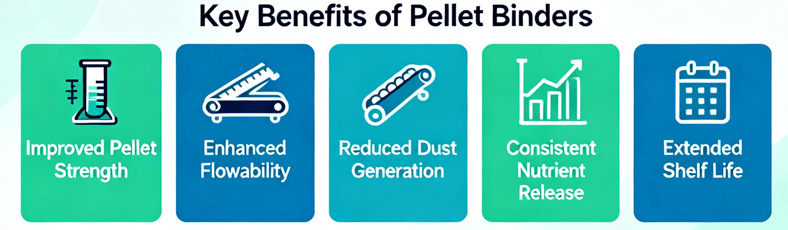
Pellet binders improve pellet durability, reduce fines and dust, and minimize wastage, ensuring birds consume a uniform, balanced ration (Thomas & van der Poel, 1996; Serrano, 2013). - Nutritional and Health Advantages:
Stable pellets enhance palatability, ensure consistent nutrient intake, and support better digestive health and flock uniformity (Abdollahi et al., 2013; Choct, 2009). - Processing Efficiency:
Binders aid compaction and starch gelatinization, lowering energy use and equipment wear while improving throughput and pellet consistency (Briggs et al., 1999; Abdollahi et al., 2011). - Farm Performance:
These benefits result in better FCR, uniform growth, and cleaner environments, reinforcing the role of pellet binders in both feed quality and economic efficiency (Amerah et al., 2007; Svihus, 2011).
6. Advances and Future Perspectives
Recent advances in pellet binder technology focus on multifunctional additives that go beyond improving pellet durability. Modern binders are designed to enhance mycotoxin adsorption, gut health, and nutrient release (Choct, 2009; Abdollahi et al., 2013). Clay- and yeast-based binders improve pellet quality while binding mycotoxins (Jouany, 2007). Natural polymers like gums, starch derivatives, and cellulose are valued for their biodegradability and safety (Thomas & van der Poel, 1996). Plant extracts and phytogenic additives add antimicrobial and antioxidant benefits, supporting gut health and feed preservation (Windisch et al., 2008).
Enzymatic approaches further improve pellet quality and nutrient digestibility by enhancing starch and protein interactions during pelleting (Svihus, 2011). The industry is increasingly adopting residue-free, eco-friendly binders that align with sustainability goals. Future developments may integrate precision nutrition, where binders also serve as carriers for bioactives, probiotics, or heat-sensitive nutrients (Amerah et al., 2007).
Overall, pellet binders are evolving from simple mechanical agents into multifunctional feed additives that enhance poultry health, performance, and feed sustainability.
7. Practical Considerations
Pellet binders play a key role in improving poultry feed quality, but their use depends on type, diet, and processing conditions. Typical inclusion rates are: wheat gluten ≥10%, Ca-LS 0.25–1%, CMC <0.5%, clays 1–3%, and molasses 2–4%, with overuse potentially reducing nutrient density (Abadi et al., 2019). Corn–soy diets often need binders, while wheat-based feeds usually do not (Feed Strategy, 2019). Higher conditioning temperatures (70–80°C) and steam
8. Conclusion
Pellet binders play a vital role in modern poultry nutrition by significantly improving the physical quality of feed, including pellet durability, hardness, and reduction of fines. These improvements not only facilitate easier handling, storage, and transportation of feed but also enhance feed intake consistency, reduce wastage, and promote uniform nutrient consumption among birds. While pellet binders do not contribute directly to the nutritional content of the diet, their indirect effects can positively influence growth performance, feed conversion efficiency, and carcass yield. The selection and inclusion of appropriate binders should be carefully based on diet composition, feed processing conditions, compatibility with medicated feeds, cost-effectiveness, and regulatory compliance. Properly applied, pellet binders support sustainable poultry production by optimizing feed utilization, improving flock uniformity, and contributing to the economic efficiency of poultry operations, thereby making them an indispensable component of contemporary feed manufacturing strategies.
References:
Will be provided on request