Pauline Rovers-Paap
Principal Relations Manager, Orffa Additives B.V., The Netherlands
Large volumes of saleable eggs at the highest quality are key for egg producers. Intestinal health and optimal nutrient and mineral absorption in the digestive tract are essential for egg production, shell quality and food safety of eggs. Probiotics are known to have a beneficial effect on the intestinal microbial composition, as probiotics support the persistence of beneficial commensal microbes which assist in the digestion of feed and help to protect the host from pathogenic colonization.
In 2016, the probiotic with the commercial name Calsporin® received a new European feed additive registration for the application in laying hens. Since then, numerous new studies have been carried out that further demonstrate the beneficial effect of the dietary probiotic in layers and breeders. Calsporin® contains viable spores of Bacillus subtilis C-3102 at 1.0 x 10¹⁰ CFU/g product. This article provides an update of scientific research available on the effect of probiotic Bacillus subtilis C-3102 in laying hens.
Support performance of hens, young and old
Optimal feeding supports young hens in early peak production and will enable egg producers to better maintain production performance in the final stage of laying. In young hens, between 19 to 42 weeks of age, the addition of 3 x 10⁸ CFU B. subtilis C-3102 per kg feed (30 g Calsporin® per MT feed), resulted in a faster increase of egg weight, higher egg mass and better utilization of the feed (figure 1). Even with hens during peak performance, similar feed intake and higher performance did not negatively influence live hen weight in the probiotic group. Reflecting an improved feed efficiency, instead of mobilization of body reserves for the egg production. In another study, following hens for a period of one year (from 19 to 70 weeks of age), the inclusion of 3 x 10⁸ CFU B. subtilis C-3102 per kg feed improved laying rate, egg weight, egg mass, and feed conversion over the whole period. The beneficial support of laying performance by the addition of Calsporin® proven in the registration and practical field trials, is also reaffirmed in recent published scientific articles. In various studies, the addition of B. subtilis C-3102 improved egg production, egg weight, egg mass and feed conversion ratio. In a study with increasing amounts of the probiotic per treatment, addition of B. subtilis in the diet linearly increased egg weight. Even though the fact that the probiotic is already effective at a low dosage of 30 ppm (3 x 10⁸ CFU/ kg feed), higher concentrations can improve animal performance even more.
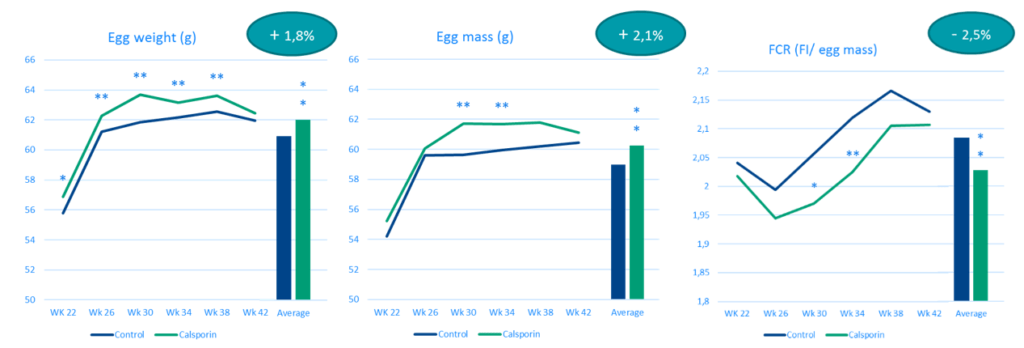
Figure 1 a-c: Bacillus subtilis C-3102 positively influenced laying hen performance in early stages of the production period (1). * Trend for significant difference (P < 0.10), ** Significant difference (P < 0.05).
Freshness and colour of the egg
Haugh unit and yolk index are important indicators to evaluate the freshness of eggs. Although a trend for a higher Haugh unit was found in one trial, this could not be confirmed by another study, in which a significant positive effect on yolk index (calculated by dividing yolk height by yolk width) was found by the addition of B. subtilis C-3102. Interestingly, yolk colour was linearly and quadratically increased with increasing levels of the B. subtilis strain (figure 2). Enriched yolk colour might be related to a better absorption of carotenoids, primarily xanthophylls, and deposition into the developing ova by the laying hen. Changes in colour were seen before in a practical field trial with brown laying hens, where the addition of the probiotic resulted in a higher percentage of more dark coloured eggshells.
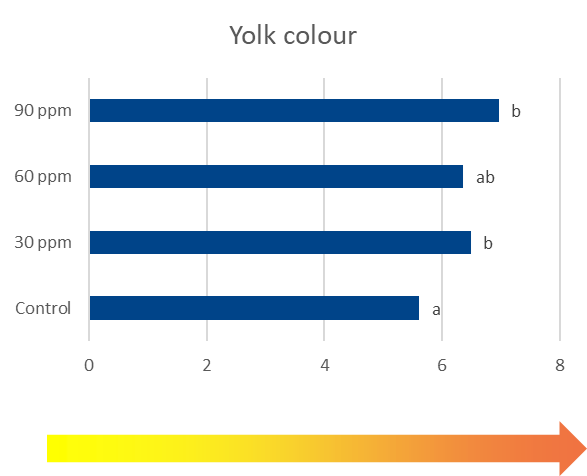
Figure 2: Bacillus subtilis C-3102 linearly and quadratically increased yolk colour. a, b: Bars with different superscript are significant different between treatments (P < 0.05).
Robust eggshells
Eggshell formation is a classical and rapid biomineralization process. In a span of less than 20 hours, about 2 grams of calcium deposits as calcium carbonate in the eggshell gland. As already mentioned, hens receiving B. subtilis C-3102 in their diet have a higher egg weight compared to hens receiving the same diet without the probiotic. In practice, an increase in egg size is often negatively correlated with shell quality. With probiotic, however, in all cases larger eggs did not result in thinner eggshells or compromise the eggshell strength. In contrast, even thicker eggshells and less cracked eggs were noticed when egg size was increased.
Calcium absorption declines in older laying hens and can partly explain the reduced eggshell quality during the late production phase. Dietary probiotics can help to maintain eggshell quality and supplementation enables the egg producers to prolong the laying period. In aged laying hens, the addition of B. subtilis C-3102 resulted in higher shell weight, increase of the eggshell thickness and as a result improved eggshell strength. The eggshell breaking potential reduced from 3-4% in the control group to less than 1% in the Calsporin® treated group.
Support nutrient and calcium absorption
Improved performance and eggshell quality can be explained by better feed utilization by the hens, as it was shown that the apparent digestibility of protein, fiber and ash was significantly higher in 70-weeks old birds receiving B. subtilis C-3102. Recently, a new trial confirmed the improved apparent digestibility of calcium in 79-weeks old laying hens. Increased absorptive area (higher villi and villi-crypt ratio) and transcellular transport by CALB1 (major component of transcellular Ca transport in duodenum and upper jejunum) could explain the higher calcium absorption by the use of Calsporin®. Composition of the microbiota could also have an influence on the solubility and absorption of calcium. By the stimulation of the lactic acid production of commensal lactobacilli, probiotics can decrease the luminal pH, beneficial for the dissolution and uptake of calcium. Higher calcium absorption in laying hens was also confirmed by higher calcium levels in the serum and increased calcium in the eggshell content, without affecting calcium levels stored in the tibia (figure 3).
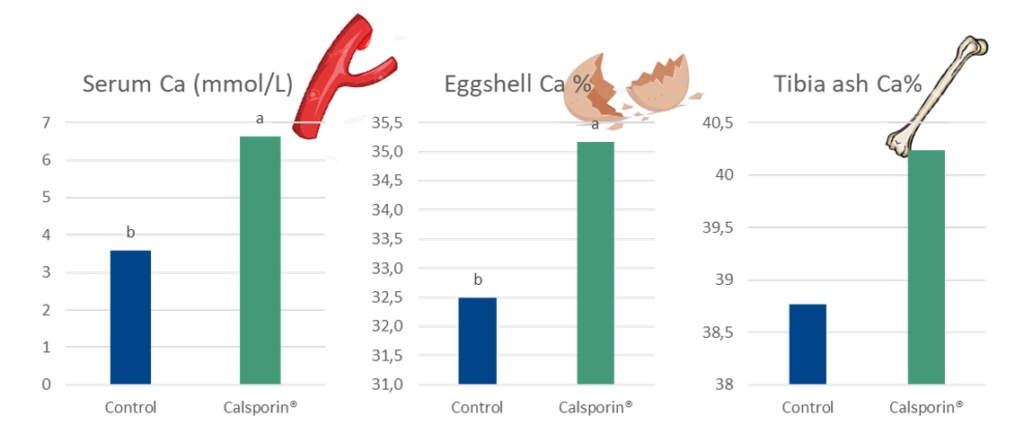
Figure 3: Addition of B. subtilis C-3102 increased the calcium in serum, eggshell, and tibia of aged laying hens (week 79). a, b: Bars with different superscript are significant different between treatments (P < 0.05).
Bacillus subtilis to fight pathogens
Layer health and the food safety of eggs are related to intestinal health and the composition of the microbiota. Probiotics support the presence of beneficial gut bacteria and can suppress the development of opportunistic pathogens. Local bacteria in the digestive tract compete with pathogenic species for epithelial binding sites and nutrients, positively support the host intestinal immune response and are able to produce metabolites to control the growth of opportunistic pathogens. In young pullets, a combination of Calsporin® and yeast cell walls increased the microbial diversity of the immature microbiota and simultaneously reduced the Salmonella Enteritidis infection. Salmonella Enteritidis (SE) is one of the most reported serotypes causing foodborne illness in humans, where laying hens can serve as a SE reservoir and eggs are at a high risk of contamination. In aged laying hens after molting, Bacillus subtilis C-3102 elevated the amount of beneficial microbes (e.g. Lactobacillus) and decreased Clostridium perfringens, another opportunistic pathogen. Supporting the immune status of the laying hens is another strategy to fight against various infections. In laying breeders, both serum IgM and serum antibody levels against avian influenza after vaccination linearly increased by increasing levels of B. subtilis in the diet.
Microbiota and inflammatory responses
Opportunistic pathogens can also trigger energy demanding immunological pathways in the gut. Harmful microbes are recognized by receptors on immune cells and can trigger pro-inflammatory responses. Addition of B. subtilis C-3102 to the diet of laying hens modulated the TLR4/MyD88/NF-kB signaling pathway, resulting in a reduced release of the pro-inflammatory cytokines IL-1β and TNF-α. Especially Escherichia coli and Salmonella exhibit structural characteristics that can be recognized by toll-like receptors (TLRs), particularly TLR4, and activate a cascade of inflammatory signals. Lower numbers of E.coli, Salmonella and Clostridium were confirmed in the small intestine and can explain that the suppression of pro-inflammatory cytokines might be attributed to an improved microbiota. Antioxidant status of the hens was evaluated by total antioxidant capacity, catalase, total superoxide dismutase, glutathione peroxidase malondialdehyde in the intestinal mucosa, plasma, spleen and liver. Both the intestinal and overall antioxidant status of the laying hens improved by the supplementation of Calsporin®. Energy savings related to an improved anti-inflammatory and antioxidant status can also contribute to the ameliorated egg production and feed efficiency in laying hens.
Probiotic as a nutritional solution
Bacillus subtilis C-3102 has proven to be an effective feed solution to support laying hen performance, egg quality and food safety of the eggs. The low inclusion level makes the probiotic cost attractive, and the heat-resistance of the probiotic spores enables survival of the probiotic also in pelleted layer feed.
References available upon request