Evaluating the Efficacy of Natural Vitamin C-Based Phytogenic Supplementation (VAM-C)
Abstract: India’s poultry industry operates under persistent environmental, physiological, and pathogenic stress. Oxidative stress leads to impaired immunity and reduced production performance. This paper evaluates VAM-C, a natural Vitamin C derived from Phyllanthus emblica (Amla), combined with Ashwagandha, Selenium, and Garlic, as a superior alternative to synthetic Vitamin C.
Introduction
The Indian poultry sector is among the largest globally, contributing significantly to protein supply through egg and meat production. However, intensive production systems expose birds to continuous stressors such as high ambient temperatures, vaccination schedules, transportation, and disease challenges. These stressors disrupt physiological homeostasis and increase oxidative stress levels.
Oxidative stress results from an imbalance between reactive oxygen species (ROS) generation and antioxidant defense mechanisms. In poultry, endogenous synthesis of Vitamin C becomes insufficient during stress, necessitating external supplementation. While synthetic ascorbic acid has been widely used, its limitations necessitate exploration of more effective alternatives.
Oxidative Stress in Poultry: Mechanisms and Impact
Physiological Basis: Reactive oxygen species, including superoxide radicals, hydrogen peroxide, and hydroxyl radicals, are natural by-products of metabolism. Under stress conditions, excessive ROS production overwhelms antioxidant systems such as superoxide dismutase, catalase, and glutathione peroxidase.
This leads to:
- Lipid peroxidation
- Protein denaturation
- DNA damage
Production Implications
The biological consequences of oxidative stress in poultry include:
- Reduced growth rate and feed efficiency
- Impaired immune response
- Decline in egg production and shell quality
- Increased mortality rates
Indian Production Scenario
India’s climatic diversity intensifies oxidative stress:
- High temperatures and humidity in southern and western regions
- Seasonal fluctuations in northern regions
- Mycotoxin challenges in eastern regions
These factors collectively contribute to suboptimal productivity compared to global benchmarks.
Limitations of Synthetic Vitamin C Supplementation
Synthetic ascorbic acid supplementation presents several constraints:
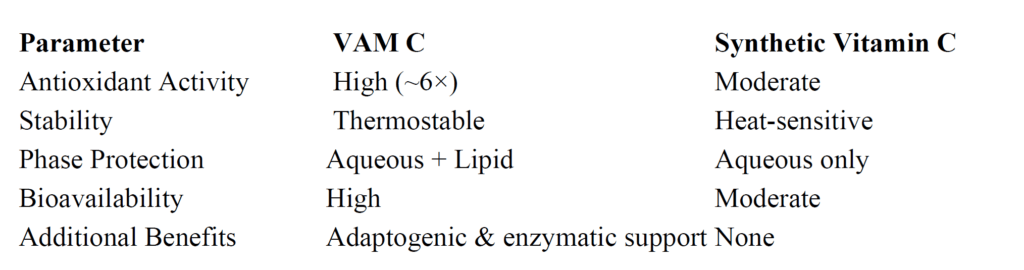
• Thermal degradation during feed pelleting (up to 50% loss)
• Limited activity in aqueous environments only
• Rapid metabolism and excretion
• Absence of synergistic compounds
These limitations reduce its effectiveness under commercial farming conditions.
VAM-C as a Phytogenic Alternative Source and Composition
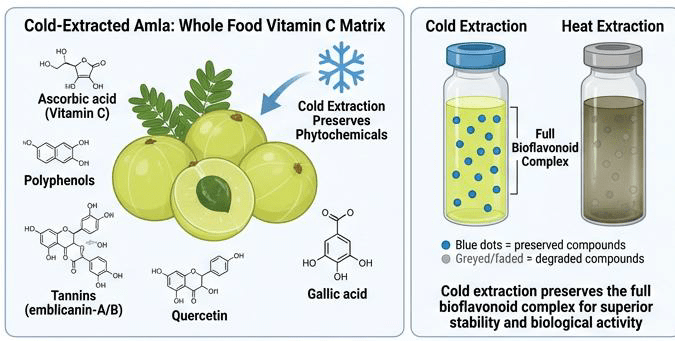
VAM-C is derived from Phyllanthus emblica (Amla) contains:
• Ascorbic acid
• Bioflavonoids
• Polyphenols
• Tannins (emblicanin A & B)
This complex matrix enhances antioxidant stability and activity.
Mechanism of Action
VAM-C provides:
• Dual-phase antioxidant protection (aqueous and lipid phases)
• Cell membrane stabilization
• Enhanced collagen synthesis
• Immune system support
Thermostability and Bioavailability
Cold-extracted natural Vitamin C retains activity during feed processing and storage,ensuring effective delivery to the bird.
Ashwagandha (Withania somnifera)
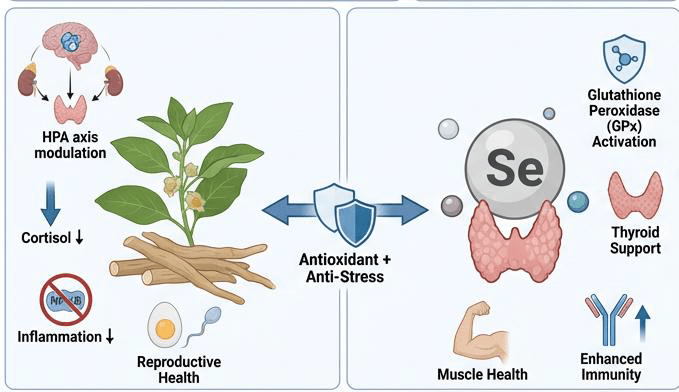
Ashwagandha functions as an adaptogen, regulating stress responses through the
hypothalamic-pituitary-adrenal axis.
Key benefits:
- Reduction in cortisol levels
- Anti-inflammatory effects
- Improved reproductive performance
Selenium is a critical component of antioxidant enzymes.
Functions include:
- Activation of glutathione peroxidase
- Enhancement of immune response
- Support of thyroid metabolism
Garlic (Allium sativum)
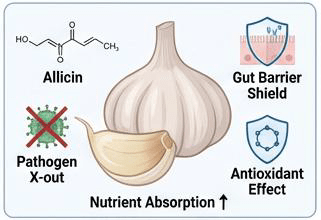
Garlic contributes to:
- Antimicrobial activity
- Gut microbiota modulation
- Improved nutrient absorption
Comparative Evaluation: VAM-C vs Synthetic Vitamin C
Economic and Production Benefits
Feed Conversion Efficiency
VAM- C supplementation improves feed conversion ratio (FCR) by approximately 0.05–0.10 points under stress conditions, resulting in significant feed cost savings.
Egg Production
In layers, supplementation mitigates heat stress effects and can recover 3–5% egg production losses.
Mortality and Health Costs
Improved antioxidant and immune status reduces:
- Disease incidence
- Mortality rates
- Veterinary intervention costs
Return on Investment
Considering improved productivity and reduced losses, natural Vitamin C supplementation delivers an estimated ROI of 5:1 to 10:1.
Practical Applications
VAM-C is recommended in:
• Heat stress conditions
• Vaccination programs
• Transportation and handling stress
• High stocking density environments
• Disease recovery phases
• Mycotoxin exposure scenarios
Conclusion
Oxidative stress remains a major limiting factor in poultry productivity under Indian conditions. Synthetic Vitamin C supplementation, while widely used, is constrained by instability and limited biological activity.
VAM- C derived from Amla, combined with adaptogenic and antioxidant co-factors such as Ashwagandha, Selenium, and Garlic, offers a comprehensive and effective solution. Its superior stability, bioavailability, and multi-functional benefits translate into improved performance, enhanced immunity, and better economic returns.
Adopting phytogenic antioxidant strategies represents a scientifically sound and commercially viable approach for sustainable poultry production.