By: Dr Vishal, Dr Manjeet Singh and Dr V.K. Aggarwal
ZIVOTA Private Limited, Panchkula
Coccidiosis is one of the most economically devastating parasitic diseases in the global broiler industry,caused by Eimeria spp, this intestinal disease severely compromises the health and productivity of broiler flocks. The parasites multiply within the intestinal epithelium, causing severe tissue damage, malabsorption of nutrients, diarrhea, reduced weight gain, poor feed conversion, and in severe cases high mortality.
Coccidiosis is estimated to cost the global chicken industry about £10.4 billion (range £7.7–13.0 billion) annually, or roughly £0.16 per chicken produced. In India coccidiosis remains one of the biggest causes of economic loss, with heavy mortality in broilers raised on deep litter.Damaged intestines also open the door to secondary problems such as necrotic enteritis, dysbacteriosis and Salmonella.
Life Cycle of Eimeria
Eimeria has a rapid and direct life cycle that is typically completed within 4–7 days, depending on the species, enabling rapid environmental contamination and transmission within poultry houses. Following ingestion of infective oocysts, the parasite undergoes successive asexual (merogony) and sexual (gametogony) developmental stages in the intestinal epithelium, resulting in epithelial damage and the production of new oocysts. These oocysts are shed in the feces and after sporulation under favourable environmental conditions, become infective, thereby perpetuating the cycle.
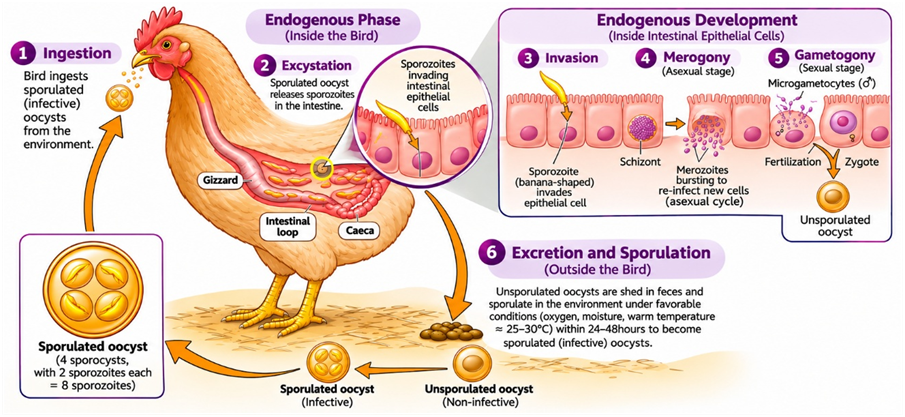
Figure: Life Cycle of Eimeria in Poultry
Transmission
Transmission of coccidiosis occurs strictly through the fecal-oral route. Birds ingest sporulated oocysts from contaminated litter, feed or drinking water. Oocysts are incredibly resilient to environmental stress and standard disinfectants, allowing them to persist in broiler houses for months, and even years. Only temperatures above 56 °C and drying (desiccation) destroy them, while gases such as ammonia and methyl bromide that can kill them are too hazardous for practical use.
Mechanical vectors, such as the boots of farm workers, feed trucks, crates, equipment, pets, wild birds, rodents and insects, easily spread oocysts between houses and farms. Disease pressure is lower in hot, dry weather and higher in the cooler, wetter rainy and winter seasons.
Symptoms
The signs of coccidiosis vary with the species involved and the number of oocysts ingested. Mild infections may go unnoticed, showing only as poor growth and feed conversion, whereas severe infections with the most harmful species may begin as a sudden jump in daily mortality.Eimeria spp are highly host-specific. Seven species of Eimeria are recognized in chickens (Gallus gallus), but only three of them are of economic importance in broilers. Mixed infection with two or more of the main species is common in the field. E. necatrix mainly affects breeders and layers.
| Species | Site affected | Clinical signs | Post-mortem lesions |
| E. tenella | Caeca | Blood in droppings, high mortality, reduced weight gain, emaciation | Caeca enlarged and distended with clotted blood |
| E. maxima | Middle small intestine (jejuno-ileum) | Poor weight gain, diarrhea, extreme emaciation, roughened feathers, loss of appetite; sometimes mortality | Loose, fluid-filled intestine with mucus and blood; ballooning; orange mucus |
| E. acervulina | Duodenum and upper small intestine | Reduced weight gain, watery diarrhea; occasional mortality in heavy infections | White plaques arranged transversely, giving a ladder-like look |
Diagnosis
A confident diagnosis rests on putting several findings together rather than on any single test:
- Clinical signs and history: Bloody droppings, diarrhea, a sudden rise in mortality or an unexplained fall in growth in a flock of 3–6 weeks of age should raise suspicion.Sick birds fail to reach feeders and drinkers, remaining in corners.
- Post-mortem examination:Examine dead, diseased, and live birds to confirm the diagnosis, looking at both the outer surface and the inner (mucosal) surface along the entire intestinal tract. The site and appearance of the lesions point to the species involved.
- Microscopic examination: A small amount of mucosal scraping mixed with saline on a slide, covered with a coverslip, shows oocysts, schizonts and other stages. Deep scrapings from the jejunum are especially useful for confirming E. maxima, whose mild lesions are easily overlooked on gross examination.
- Interpreting the result: Coccidia are present in the intestines of most 3–6 week-old flocks, so finding a few oocysts only proves infection, not disease. Coccidiosis should be diagnosed only when gross lesions are serious and associated with mortality.
Treatment
Coccidiosis is far easier to prevent than to treat, and most of the damage is already done by the time signs appear. Treatment should be administered only to birds within the affected shed after a confirmed diagnosis.Water-soluble anticoccidial medicines such as sulphonamides, amprolium and toltrazuril can be used for this purpose. The choice of product, dose and duration should be under the guidance of a veterinarian, following the manufacturer’s label and the stated withdrawal period before slaughter.
Anticoccidial drugs used in poultry are broadly classified into ionophores and chemical (synthetic) anticoccidials. Ionophores primarily disrupt ion transport across the parasite’s cell membrane, whereas chemical anticoccidials act through diverse mechanisms targeting different stages of the Eimeria life cycle. Ionophores are further divided into monovalent, divalent, and monovalent glycoside compounds. The monovalent ionophores include monensin, salinomycin, and narasin, while lasalocid is the only commonly used divalent ionophore. The monovalent glycosides comprise maduramicin and semduramicin. In contrast, chemical or synthetic anticoccidials include robenidine, diclazuril, clopidol, decoquinate, and nicarbazin.
To minimize the development of anticoccidial resistance, no single anticoccidial should be used continuously for prolonged periods. Instead, drugs should be rotated between different classes (e.g., ionophores and chemical anticoccidials), allowing an adequate resting period before reintroducing the same molecule. During this interval, other compounds belonging to the same class should also be avoided to reduce cross-resistance. Additionally, two ionophores should not be used sequentially, as they share similar modes of action. Implementing well-planned rotation or shuttle programs is essential for maintaining drug efficacy and delaying the emergence of resistant Eimeriaspp strains.
Vaccination
In some countries, phytogenic compounds and vaccination are used as prophylactic strategies for the prevention of coccidiosis.Coccidiosis vaccines give a controlled, small dose of the parasite so that birds build immunity before heavy field challenge. As immunity is species specific, a vaccine must include all the important species. Good litter management afterwards helps the vaccine strains cycle and build uniform immunity.
Control and Prevention
Under commercial conditions it is impossible to prevent infection altogether, because the main source is the oocysts left behind in the house by earlier flocks and these cannot be eliminated by medicines or standard disinfection. Good management, however, can greatly reduce the number of oocysts in the environment and stop them from reaching the numbers that cause disease.
- Maintain dry, friable litter by promptly removing wet or caked patches, repairing leaking drinkers, and preventing water spillage to inhibit Eimeria sporulation.
- Provide continuous access to clean, fresh drinking water through an adequate number of clean drinkers, and maintain proper feeder hygiene.
- Ensure optimal shed conditions with adequate ventilation, appropriate stocking density, and proper feeder and drinker space to minimize litter moisture and bird stress.
- Reduce stress by avoiding overcrowding and sudden changes in feed or management practices, while providing a balanced, high-quality diet.
- Implement strict biosecurity by restricting visitor access, disinfecting equipment and footwear, following an all-in, all-out system, and preventing cross-contamination during bird placement.
- Clean and disinfect poultry houses, equipment, and water systems thoroughly between flocks to reduce environmental contamination.
- Remove and safely dispose of dead birds immediately to limit disease transmission and reduce the risk of secondary infections such as necrotic enteritis.
- Use strategic anticoccidial programs like rotation or shuttle programs, where appropriate to reduce disease incidence and delay drug resistance.